This review first appeared in the CHRISTIAN RESEARCH JOURNAL, volume 35, number 06 (2012). The full text of this article in PDF format can be obtained by clicking here. For further information or to subscribe to the CHRISTIAN RESEARCH JOURNAL go to: https://www.equip.org/christian-research-journal/
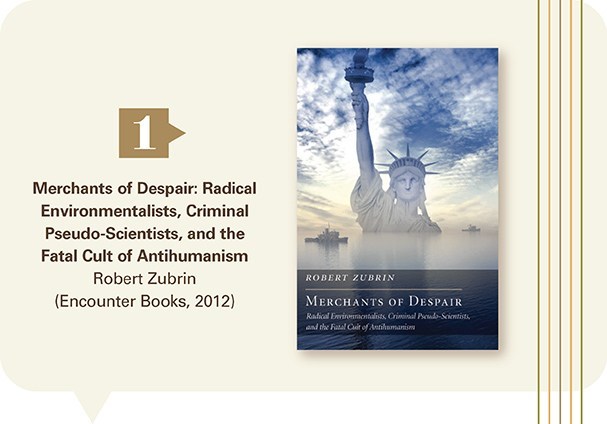
Robert Zubrin has written an important account of the racist roots of modern movements from Social Darwinism and eugenics, to Nazi environmentalism and modern world population reduction programs, to extremist green movements, which, in his view, leave the poor of the world impoverished and hungry by condemning the use of technological developments such as nuclear energy and biotechnology. While a few of his historical citations are incomplete or misleading, and some of his attempts to link later scientific and political movements with past “antihumanism”1 are unconvincing, his historical survey and scientific insights make this book a worthwhile and fascinating read.
A prolific author and inventor, Zubrin has a Ph.D. in nuclear physics and ten U.S. patents granted or pending. He dedicates his book “to the inventors and discoverers, be they famous or nameless; that company of heroes whose noble work must ever confound the antihumanists.” Passionate about nuclear energy as well as space exploration and colonization, Zubrin is the author of Energy Victory and The Case for Mars, and a contributing editor to The New Atlantis.
Zubrin’s basic thesis, reflected in his book’s dedication, is that human freedom and ingenuity must and will always make it possible to raise the global standard of living, no matter how much the Earth’s population grows. His historical survey begins with Thomas Malthus (1766–1834), an economist who studied the relationship between population and welfare, and who taught for three decades at the East India Company College in Hertfordshire, England. Zubrin states that Malthus “famously argued that human reproduction always outruns available resources,” a doctrine that “served to rationalize the starvation of millions caused by his employer’s policy of brutal oppression of the peasants of the Indian Subcontinent” (p. 5).2
Malthus did argue against Enlightenment thinkers who believed that “human liberty, expanding knowledge, and technological progress could ultimately make possible a decent life for all mankind” because he believed that food supplies could not keep up with exponential population growth (6). However, Zubrin’s combination of two unrelated quotations by Malthus, as well as his failure to give the context of these quotes, unfairly make Malthus out to be guilty of arguing that the poor should be paid little to nothing, discouraged from living clean and healthy lives (e.g., be kept in crowded tenements and other disease-carrying environments), and be left alone to die from plagues and famines—while those “mistaken men” who wish to provide relief, medicine, and food should be derided! 3 (6)
Malthus, who was a mathematician, economist (cited by scholars as one of the most important economists of the past three centuries), and an Anglican priest, was a controversial figure in his own time. He was excoriated by some of his contemporaries as being demeaning and harsh toward the poor, but he was defended by others as propounding policies intended to address (if controversially) the poverty, hunger, and misery of the poor and help them lead better lives.4 Still, Malthus’s views on overpopulation and limited food sources, which became known as the Malthusian theory or doctrine, did reflect the philosophy of white supremacy that dominated his time and culture.
During Malthus’s lifetime, his theory was used to justify repressive measures against the poor, especially the Poor Act of 1934 (9). Further, the nineteenth and early twentieth centuries saw insane, racist applications of Malthusian theory, especially in the British government’s refusal to provide relief to the Irish people (whom the British had forced into abject poverty) during the great potato famine, as well as their refusal to assist peasants in India (whom they had also forced into tyrannical poverty and slavery) through terrible droughts that killed nearly thirty million (15).
Zubrin regards Darwin as a “superb naturalist [whose] theory of natural selection represents a significant contribution to biology” (27). He views evolution in the natural world (which Darwin did not discover) as fact. However, Darwin made a critical scientific error in applying processes inherent in the natural world to issues as complex as human social history; Darwin’s specious conclusions, as Zubrin documents in more than two hundred pages, have resulted in disaster after disaster in the modern world.5 (Here, regardless of what a person may think of biological evolution—and devout Christians differ on this subject—we would do well to heed Zubrin’s insistence that one of the most devastating critiques of Darwin comes from the historical applications of his social theory, which helped provide a “scientific” rationale for, among other atrocities, the Nazi Holocaust.)
Zubrin is correct in citing Malthusian theory combined with Darwin’s social theory (based on natural selection) as providing the fundamental philosophical and “scientific” rationale for the greatest atrocities perpetuated by the western world. His following quote of Darwin is typical: “At some future period, not very distant as measured by centuries, the civilized races of man will almost certainly exterminate, and replace, the savage races throughout the world. At the same time the anthropomorphous apes…will no doubt be exterminated. The break between man and his nearest allies will then be wider, for it will intervene between man in a more civilized state, as we may hope, even than the Caucasian, and some ape as low as a baboon, instead of as now between the negro or Australian and the gorilla” (26).
Darwin believed that natural selection would eventually eliminate weaker elements of human society, but he also believed that to deny aid to the weakest and most helpless is evil (cf. 11n, 259). While Darwin was a mild-mannered man who hated slavery, his cousin Sir Francis Galton developed the pseudoscience he named “eugenics,” his “new religion,” which assumed the superiority of certain races and sought to show “scientifically” that all human success and failure is due to inherited traits; thus only those with the most successful children (gauged by their positions in society) should be encouraged to have more (36).6 Galton disdained American ideals, stating, “It is in the most unqualified manner that I object to pretensions of natural equality” (38).
Wedding his ideas to Malthusian/Darwinian social theory of natural selection, Galton eventually won wealthy adherents in England, Germany, and the United States (40). (Interestingly, in a personal letter, Darwin notes, “The support which I receive from Germany is my chief ground for hoping our views will ultimately prevail” [41].) Adherents included the famous German atheist biologist and virulent racist, Ernst Haeckel, who coined the word “ecology” and popularized theories that led to Nazi extermination camps (41–50). Zubrin links his study of the confluence of German “back to nature” movements (early environmentalism), nationalism, and Nazi racism with the more recent rise of population control movements by connecting them both to the rise of Malthusian theory and eugenics movements in America after the war.7
Zubrin demonstrates that human living standards have risen as quickly as human population, and that “the key metric of average human well-being, GDP per capita, has gone up as population has increased, rather than down as Malthusian theory would predict” (16). He attributes this to various factors, including the advancement of technology and the ability of larger communities of human beings to harness their own creativity to work for the common good (e.g., in the rise of sanitation, trade, and medical advances).
The bulk of Zubrin’s book deals with movements he sees as combining Malthusian thought with a radical environmentalism that postulates that, at best, human beings are part of nature with no inherent value above the value of other animals (or, in some cases, plants); and, at worst, humans are a scourge or cancer on the earth and should be severely curtailed or eradicated (93ff.). His most caustic words are reserved for Paul Ehrlich, author of the 1968 bestseller, The Population Bomb, a work Zubrin describes as “a new Malthusian bible for modern times” and “a bestseller, unmatched by any other piece of antihuman literature since Adolf Hitler’s Mein Kampf” (109). (Ehrlich’s younger associate, John Holdren, is current director of the White House Office of Science and Technology Policy.)
Zubrin’s chapter on “The Betrayal of the Left” is a fascinating account of what was, in his view, the co-opting of the civil rights movement and Vietnam protests by radical environmental interests that denigrated the welfare of people. The last half of his book includes extensive chapters on what he regards as an unscrupulous and pseudoscientific rejection of such vital advances as nuclear energy (the best source of clean energy) and genetically modified crops (which have massively helped to nourish developing nations and which, he believes, are banned by Europe largely because of the power and policies of the German Green Party, which was first headed up by a former Nazi). He ends with a long chapter on global warming (which, as a scientist, he believes is real and is partially human-caused—though he disputes that global warming is necessarily a harmful phenomenon) and a short hopeful chapter on human potential.
In Zubrin’s zeal to link such a broad spectrum of issues all to antihumanism, sometimes even those who may have valid historical and/or scientific disagreements with him are painted with the same “antihumanist” brush. Additionally, he is poisoning the well when he implies, for example, that all Green Party platforms are suspect because a Nazi was involved in the leadership of the first Green Party.
Nevertheless, I believe Zubrin’s work merits a careful reading. His book, which also includes well-documented examples of violence against women and girls, such as the Chinese one-child policy and similar practices in other parts of the developing world (at least partially philosophically founded and funded by western interests8), is a sobering reminder of what the forces of evil have perpetrated on the world’s poorest people.
Having also reviewed The New Hate: A History of Fear and Loathing on the Populist Right, by Arthur Goldwag,9 I am struck by the fact that evil at its worst (whether from extreme rightwing, left-wing, or any-wing ideology) often assumes the faces of racism, classism, and sexism—a trinity of evil that is completely rejected by Christians who believe that Jesus has once and for all abolished all human barriers and hostility (cf. Eph. 2; Gal. 3:26–29) and who has, in a massive divine self-disclosure, identified Himself forever with society’s most wretched and marginalized when He insists, “Whatever you did for one of the least of these brothers and sisters of mine, you did for me” (Matt. 25:31–46 NIV) —Carole Ryan
Carole Ryan, M.Div., is a freelance writer, editor, and tutor who lives in Montana with her husband, Mark, and their two children, Timothy and Petrea.
NOTES
- Zubrin defines antihumanism as the idea that “humans are a cancer upon the earth, a horde of vermin whose unconstrained aspirations and appetites are endangering the natural order” (p. 1). Antihumanism is the opposite of both the biblical and Enlightenment understandings of the value, worth, and dignity of human beings, which inform our nation’s history, government, and ideals (ibid.).
- Here Zubrin is not careful to distinguish Malthus’s economic theory (that population growth, which is exponential [1, 2, 4, 8, 16…], will outstrip agricultural growth, which is arithmetical [1, 2, 3, 4, 5…], leading to starvation and misery among the poor) from his theory’s use by unscrupulous people and institutions to justify allowing mass starvation in exploited nations.
- In Zubrin’s extensive quote from Malthus’s most famous work, An Essay on the Principle of Population, 6th ed., his sole attribution is to Book IV, chap. 5, 300–301 (chap.1 in the online version; cf. econlib.org/library/Malthus/malPlong30.html#IV.) However the first sentence Zubrin quotes (which is separated from the second part of Zubrin’s quote only by an ellipsis) is actually from chap. 8.4, and is neither quoted in its entirety nor quoted in its context, which is very different from the context of chap. 5. Additionally, contrary to Zubrin’s usage, Malthus’s chap. 5 comments are regarded by many to be an ironic exposition of possible heinous alternatives to Malthus’s own proposals (which include self control and moral choices such as marrying later and having only as many children as one can support) for dealing with overpopulation and resulting poverty. (Here I am indebted to Elliot Temple, who covers other misquotations by Zubrin as well. Cf. curi.us/1561-badscholarship-merchants-of-despair-by-robert-zubrin.)
- For other viewpoints on Malthus, see “The Secret History of the ‘Dismal Science’ Parts 1–3” by David Levy and Sandra J. Peart at econlib.org/library/Columns/LevyPeartdismal.html#affiliation; see also economistsview.typepad.com/economistsview/2006/10/blaming_the_poo.html; https://www.econlib.org/library/Enc/bios/Malthus.html.
- He succinctly states Darwin’s scientific error in footnote 5, p. 258.
- In Galton’s view, inferior races included Australian aborigines, “Orientals,” Jews, Africans, and the Irish.
- For example, he cites the racist and eugenic writings and practices of Margaret Sanger, the founder of International Planned Parenthood (87–88). On this see Bob Perry, “Margaret Sanger: ‘No Gods, No Masters,’” Christian Research Journal 33, 4 (2010): https://www.equip.org/articles/margaret-sanger-no-gods-nomasters/.
- See 168–95.
- See Carole Hausmann Ryan, “Hate in America,” Christian Research Journal 35:5 (2012): 58–59.