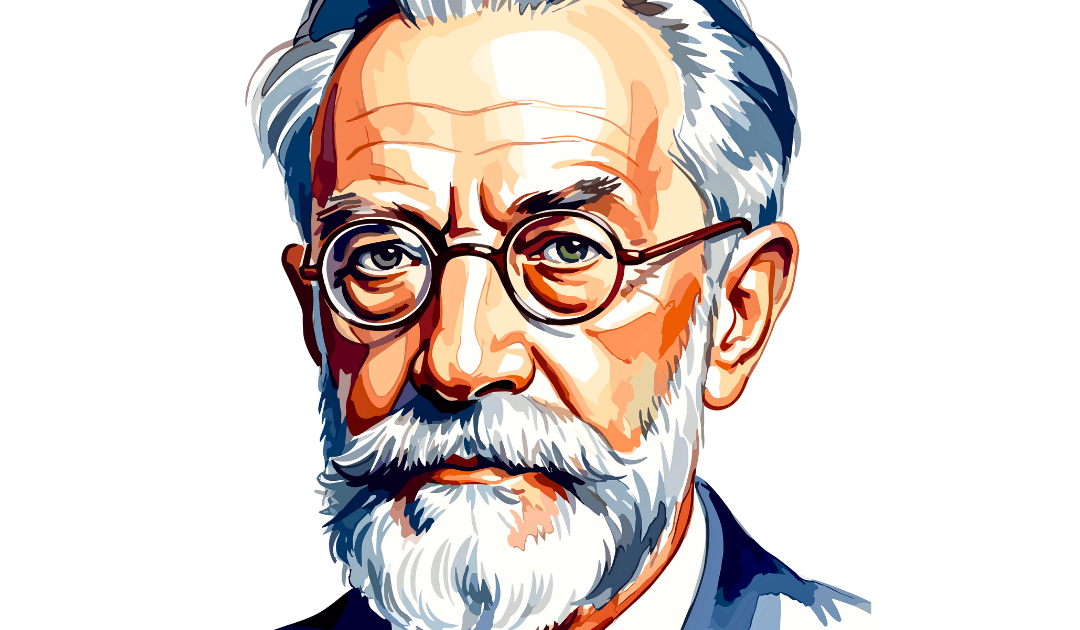
This article was published exclusively online in the Christian Research Journal, Volume 49, number 01 (2026).
Note: This is also part of our ongoing Philosophers Series.
When you support the Journal, you join the team and help provide the resources at equip.org that minister to people worldwide. These resources include our ever-growing database of more than 2,500 articles and Bible Answers, as well as our free Postmodern Realities podcast.
Another way you can support our online articles is by leaving us a tip. A tip is just a small amount, like $3, $5, or $10, which is the cost of a latte, lunch out, or coffee drink. To leave a tip, click here.
Editors’ Note: This essay engages Sigmund Freud’s thought and legacy with candor and historical precision. An accurate analysis necessarily involves frank discussion of sexual behavior, impulses, and theories advanced by Freud and his intellectual successors. Author Alisa Ruddell examines this material critically from a Christian moral perspective. Discretion is advised for readers who may find such material unexpected or unsettling.
SYNOPSIS
Sigmund Freud (1856–1939), the founding father of psychoanalysis, stood at the threshold of a dying Christian moral order of sin and redemption as it gave way to a scientific order of diagnosis and health. Freud’s theories and their modification by Marxist successors show how sexuality shifted from being our responsibility to being our identity. Freud favored theory over facts, creating an impression of psychoanalytic cure that did not exist. Some ideas rang true — the unconscious, the inner self divided, and the “talking cure” — yet none are unique to him, having roots in the ancient world and Christianity. Psychoanalytic technique democratizes inner desires, treating drives as morally neutral, flattening inner hierarchy and making us shallow. It medicalizes moral life: we diagnose our sins instead of repenting.
Freud portrays the ego as negotiating between instinct, social judgment, and reality’s limits, often resulting in misery. He viewed moral aspiration with suspicion and doubted happiness in this life, since civilization demands repression of libido. Freud first attributed neurotic misery to childhood sexual abuse, but then replaced that theory with the universal Oedipus Complex, in which repressed incestuous childhood fantasies leak out as symptoms. He did not ask why some become sexually deviant, but rather how anyone navigates childhood to become sexually “normal.” “Polymorphous perversity” replaces childhood innocence, spreading sex over all of life.
Freud’s Marxist counterculture successors turned repression on its head: rather than seeing it as necessary for order, they sought its abolition and sexual liberation, making the id a god and cultural superego a tyrant to be overthrown. The popularization of Freud’s ideas led to a permission for license, as if fulfilling all desire yields mental health. But Christian testimony holds that we are more than material beings: by grace we become masters of ourselves and experience freedom from slavery to desire.
“A WHOLE CLIMATE OF OPINION”
For decades, Sigmund Freud was revered as a scientific genius, a fearless pioneer, and an indomitable sage. Then, for the following several decades, he was debunked as a pseudo-scientific fraud, a plagiarist, and a liar who spun theories like yarns while facts slipped through his fingers unnoticed, a cranky old man as neurotic as his patients — and a cad to boot. Today, he is, as the poet W. H. Auden put it, “a whole climate of opinion,” forgotten for all but his most shocking and preposterous theories, his few lasting insights so absorbed by the cultural imaginary that we no longer trace them back to his lyrical detective stories of the seedy unconscious — that part of the mind not directly accessible to conscious awareness. We take his (slim) best utterly for granted, and roll our eyes over everything else.
But Sigmund Freud the man — and psychoanalysis as his theory of interpreting the human person — must be reckoned with, not because he is trustworthy and his theories all true, but because they molded the way we live now, for better and for worse. Mostly for worse. Freud is a liminal figure who stood at the threshold between a dying Christian order where the old categories of sin and redemption sounded increasingly obsolete, and our own age in which science provides us with categories of diagnosis and health. The way we collectively framed the problem of the human condition and its purported solution were undergoing a radical change in Freud’s day. He did not create the vacuum at the heart of the West: he articulated, popularized, and commercialized the replacement of a religious paradigm with a scientific one, applied specifically to the realm we used to think of as “moral” — the realm of human discontent and desire, especially sexual desire. If you want to understand how sexual desire went from being our responsibility to being our identity, you need to trace the way Freud reframed it, and the way his successors took that theory and ran with it — straight off a cliff.
Today’s therapeutic landscape is dominated by psychopharmacology, cognitive-behavioral therapy, cafeteria-style eclecticism by therapists selecting from a myriad of modern modalities, and an explosion of online and AI substitutes for personal and in-person counseling. There are few people practicing distinctively Freudian psychoanalysis today.1 And yet the fact remains that Freud’s cultural influence is enormous and undeniable. He is “destined to remain among us as the most influential of twentieth-century sages,”2 writes his fiercest critic (and former acolyte), Frederick Crews.
The fact is, Freud lives in my head, and in yours — an unwelcome squatter who can’t be evicted. As Philip Rieff notes in The Triumph of the Therapeutic: Uses of Faith After Freud, each one of us is “Psychological Man,” whether we like it or not.3 We moderns are constituted by that psychological perspective which Freud inaugurated and which made him more famous than the putative “scientific” quality of his work gives him any right to be. The view which asserts that we are not the masters in our own house, that childhood contains the seeds of adult dysfunction, that our “inner critic” is as cruel a tyrant as our lower passions, that the truest things about us are not our choices but our desires, and that everything in life comes down to sex — that set of assumptions is as all-encompassing as our mother tongue. We can’t escape it, but can only make good (or poor) use of it.
Auden, in his obituary poem “In Memory of Sigmund Freud,” wrote,
if often he was wrong and, at times, absurd,
to us he is no more a person
now but a whole climate of opinion
under whom we conduct our different lives:
Like weather he can only hinder or help.4
As temporarily cathartic as it may be to rage about the weather, it’s more practical to make sure you’ve got rainboots, a raincoat, and a working umbrella (there is no bad weather, only bad clothes). Since we are living in a world that’s “raining Freud,” it behooves us to be prepared. By tracing the lines of Freud’s climatic influence on us, particularly in the realm of sex, we can reduce the degree to which his false ideas hinder us, and increase the likelihood we’ll find a sliver of something helpful amidst his deeply flawed legacy.
A SAVVY, SELF-STYLED SHERLOCK HOLMES
Sigmund Freud (1856–1939) was an Austrian university-trained neurologist and psychoanalyst of Ashkenazi Jewish descent. He lived through the Victorian Era and World War I, and fled Vienna for London to escape the Nazis (who were burning his books) in 1938, only to die of cancer the following year. He never believed in or practiced the Jewish faith, and referred to himself as both an atheist and a “Godless Jew.” Throughout his life, Freud insisted publicly that the field which history gives him credit for — psychoanalysis — was indeed a science. He claimed that psychoanalysis and its exploration of the unconscious grew through critical observation and experiment, that it was based on testable hypotheses rather than revealed and settled doctrines. He claimed it proceeded on the basis of objectivity, seeking only to correspond with reality. Unfortunately, none of that was true.
Freud’s range of techniques for relieving patients of neurotic or “hysterical” symptoms changed over time, but the goal was to make the unconscious conscious in a curative catharsis. From hypnosis and applying bodily pressure (to conjure repressed memories), to dream interpretation, free association, and “transference” (the emotional attachment between patient and analyst), Freud sought to cure patients of their distress. None of it worked. “There is now practically unanimous agreement among experts that psychoanalysis does not in fact produce…cures,” writes psychologist Hans J. Eysenck.5 As much as Freud swore that his clinical practice was rooted in science and effective, he failed that standard by every measure. The crazy theories and harmful practices he perpetrated against his “guinea pig” patients were obscured under the banner of “science,” making him the grandfather of today’s latest medical abuse scandal in psychology: the mutilation/sterilization of adults and children in the name of science and mental health (a.k.a. “gender-affirming care”).6 Publicly claiming your patients have good outcomes after treatment when there is no evidence to support it is a Freudian modus operandi that gender-affirming therapists perpetuate today.
In practice, Freud’s theories preceded and even dictated the evidence he published.7 His friend Wilhelm Fliess wrote that the famed “reader of thoughts merely reads his own thoughts into other people.”8 Freud always found what he was looking for, and never let himself be troubled by patients who disagreed with his diagnosis of the source of their neurotic symptoms. He portrayed himself in print as a real-life Sherlock Holmes, a scientific detective of the mind who leaps off the page of his case studies, a savvy protagonist outwitting each patient’s equally cunning unconscious. He channeled Holmes while inviting readers to join him in prurient adventures into the inner sexual fantasies of teenage patients’ minds.9 Perhaps we can credit Freud with being the forerunner of the true crime podcast and the forensic psychology TV show.
“That is where his ‘genius’ will be found,” writes Frederick Crews, “not in having understood anyone’s mind but in having created an impression of success from stories that, regarded objectively, constitute evidence of his own obsession, coercion, and want of empathy.”10 Reading Freud is challenging (and risky apart from the help of historical-critical scholars). It’s difficult to know when he’s telling observable truths, when he’s theorizing, and when he’s fudging the facts to fit his fancy. His unreliable work, which was driven more by personal ambition than respect for truth, is mirrored in the “reproducibility crisis” within psychology today.11 Like Freud, current psychologists follow the incentives, and if what’s good for science isn’t also good for the scientist (in terms of funding and reputation), we know who usually wins out.
Freud’s Concession: He Never Cured Anyone
Freud admitted in “Analysis Terminable and Interminable” (1937) that the patients who needed the most help — the individual in an acute crisis, or the psychotic — were the least likely to benefit from analysis, no matter how long it dragged on. Freud wrote that for a crisis patient subsumed in a painful reality, “analysis is to all intents and purposes unusable” because their current suffering prevents them from entering into reflection on their past.12 He likewise admitted that an analyst’s attempts to ally himself with the patient “habitually fails” in the case of psychotics, because cooperation between an analyst and a patient presumes a certain level of normalcy which affords a personal connection.13 Psychotics and those in acute crisis were not “curable” because the kind of treatment analysis offered would not work on those lacking the prerequisites for participation in the process. On the other hand, patients whose difficulties were rooted in a painful past (not a present crisis) and who were relatively “normal” made the most responsive patients.14 Those who needed the least help responded best to what analysis could provide: a listening ear and a wise guide in personal reflection, someone to strengthen patients against their own destructive impulses. But using the language of “cure” for such people is hardly appropriate, not because the treatment fails (they can experience greater depths of personal insight and self-governance) but because it is questionable to call such people “sick” in the first place. What such patients achieved with an analyst’s help could probably have been achieved without it.
Patients occupying a middle-ground, those with obvious problems yet still capable of connecting with the analyst, tended to put up enormous resistance to the analyst’s insights, using an array of defense mechanisms to thwart recovery. They exhibited what Freud called “psychical inertia” that was “fixed and rigid,” lacking receptivity and plasticity. The failure of analysis in these cases couldn’t be pinned on the analyst, Freud implied, but was the patient’s own fault for resisting, for failing to demonstrate “unshakable loyalty to the work of analysis” and instead marshaling their own “hostile forces” against the analyst’s efforts because they were “absolutely resolved to hold on to illness and suffering.”15 Freud conceded defeat in the face of those patients he viewed as stubborn masochists.
There is a marked difference in the tone of Freud’s earlier published case histories, which are optimistic and confident that his patients (even serious cases) are showing genuine improvement, and the tone of his private correspondence,16 as well as later writings (like “Analysis Terminable and Interminable” in 1937) that betray doubts, questions, and so many caveats that it becomes hard to tell whether or not he still believed in psychoanalysis as a treatment (not just as a field of study or a theory). The older Freud conceded how little durable change occurred (especially in patients whose issues were ones of “constitution” or personality rather a traumatic event), how common it was for patients to relapse, and how the apparent cure of one problem was not generally prophylactic, since resolution of one issue was frequently followed by the emergence of a new one.17 Thus the whole medicalized framework of diagnosable illness, time-bound psychoanalytic treatment, and durable cure for psychological problems is called into question by the mature (and pessimistic) Freud’s reflections. The truly sick are incurable, the somewhat sick offer too strong a resistance to change, and those with troubles responsive to analysis are not actually sick but simply suffering humans in need of personal insight and moral support.
Thus, Freud’s work was theoretical, not therapeutic; his skills rhetorical, not relational or empirical. “I am actually not at all a man of science,” Freud wrote to a friend, “not an observer, not an experimenter, not a thinker. I am by temperament nothing but a conquistador — an adventurer, if you want it translated — with all the curiosity, daring, and tenacity characteristic of a man of this sort.”18 Creating grand ideas and generating an aura of authority was what fueled Freud’s ambitions. He admitted in 1932 (long after securing his reputation) that he had “never been a therapeutic enthusiast.”19 Freud told other analysts there are only two reasons for doing analysis: to understand the unconscious and to make a living. The patients themselves he considered largely beyond help20 and extremely irritating, confessing to a colleague: “I could throttle every one of them.”21
A NEW IDIOM FOR OLD PROBLEMS
Freud is not remembered for therapeutic skill or scientific genius; he endures because a small number of his theories, once systematized and enacted, aligned with people’s emotional experience — particularly their sense of helplessness. Even so, the ideas that resonated (the power of the unconscious, the divided psyche, and the “talking cure”) can’t rightly be called his own, for he neither discovered nor created them. But as the first one to attempt to operationalize these ideas in the service of clinical psychology as “treatments,” he started a trend that proved enormously popular and remains a booming industry today: plying therapeutic techniques baptized in a scientific idiom to cope with the age-old human condition.22
Foremost among Freud’s greatest hits was the unconscious, our nonrational inner depth (rife with biological drives) which influences our actions and emotions, but remains hidden to us, outside of our conscious control. The theory of the unconscious was anticipated by Janet and Nietzsche, along with German romantic philosophers like Schelling, Schopenhauer, and Goethe, long before Freud began exploring it.23 “The ego is not master in its own house,”24 was Freud’s famous dictum. The unconscious drive-laden component of man really runs the show rather than reason, he maintained. Your unconscious will lead you by the nose, and probably in self-sabotaging ways, unless you make the unconscious conscious, which is the goal of psychoanalysis. Unlike the Christian tradition and certain other psychoanalysts (like Carl Jung) who perceived the unconscious as a fruitful source of creativity and wisdom along with being the source of unruly desires,25 Freud saw the unconscious as entirely negative — a garbage dump of repressed memories and shameful fantasies, a hotbed of lust and rage, and the home of the sadistic self-punisher who sees all your inner trash and hates you for it. The unconscious thus exhibits both uncontrollable desire and uncontrollable castigation of desire.26
Then there is the tripartite division of man which Freud labeled the id (the non-moral biological drives for sex and aggression), the ego (the aspirationally moral decision-maker which aims at control), and the superego (the hyper-moral voice of parents and society which is often cruel).27 In Freud’s vision, the somewhat pitiful ego tries to mediate between the equally noisy demands of embodied desire and internalized social opprobrium, within the hard limits reality imposes. This psychological triptych existed by other names prior to Freud’s time. A conflicted vision of man is present in Plato’s metaphor of the pliable white horse, the lusty black horse, and the charioteer (the voice of reason) who attempts to steer them both.28 Rooted in the Apostle Paul’s language about “the flesh” (the sinful nature, the passions) and “the spirit” (the conscience, the imago dei), Christianity developed ways of talking about the war within man. From Paul’s agony in Romans chapter 7 (“For I do not do the good I want, but the evil I do not want is what I keep on doing”)29 to Augustine’s Confessions (“It was foul, and I loved it….I loved my error — not that for which I erred but the error itself”)30 to Luther’s battle between his besetting sins and his hyper-scrupulosity — Christians have lived honestly in the trenches of this self-contradiction. But they lived in that embattled state with the promise of forgiveness and redemption, the hope of divine intervention — a hope Freud saw as childish.31
Even the supposed innovation of Freud’s cathartic “talking cure,” which elicited “repressed” secrets and discussed dream symbolism, is neither distinctive nor remarkable. The ancient Greeks and Egyptians practiced dream interpretation within their temple complexes to soothe sufferers. Ancient Greek drama provided emotional catharsis by bonding with others through the spoken word.32 Aristotle wrote about the value of friendship and the way dialogue between kindred spirits generates self-knowledge and virtue.33 And for a thousand years, the church practiced private, one-on-one confession of sins and secrets to a priest offering pastoral counsel. The transformative power of dialogue, drama, and dreams has been in humanity’s collective back pocket for ages.
Freud took common knowledge and systematized it within a scientific idiom, claiming cures for clinical practice in the paid realm of white collar expertise, catering to the particular hysterias and neuroses of upper class Viennese Victorians (especially delicate wealthy women). He made a career out of what had long been the purview of religious and social life, coining new terms and categories for old realities, and doing so with rhetorical flourish. Freud was among the first to medicalize, professionalize, and monetize “the science” of soul care, which arose at exactly the time we needed it — after Nietzsche observed that God was dead, and we had killed Him. Being beyond redemption, beyond good and evil, we reached for the next best thing that seemed to hold some promise, and it did so by lowering the bar.
HOW DEPTH PSYCHOLOGY MAKES US MORALLY SHALLOW
Philip Rieff said Freud maintained “a sober vision of man in the middle, a go-between, aware of the fact that he had little strength of his own, forever mediating between culture and instinct in an effort to gain some room for maneuver between these hostile powers.”34 Freud was pessimistic about the possibility of man’s happiness in such a conflicted, ambivalent state. He was suspicious of moral aspirations for personal transformation, of people who tried to be good. In the past, such aspirations were integrated with religious beliefs and church communities, which had their own traditions of “soul care” through radical commitment to the transcendent — making use of sacraments, confession, spiritual direction, Bible reading, liturgy, music, asceticism, mysticism, and other spiritual practices to combat sin and grow in holiness. These commitments cultivated communion, drove the individual out of himself, and made the inner life serviceable to the outer.35 Within Christian tradition, soul healing could only come about through some kind of relationship with a moral exemplar — the mentor, the saint, the spiritual director, the priest, the pastor — and most importantly Christ Himself. Virtue embodied in a holy person could become, through dialogue and example, a channel of transformative grace. Virtue and happiness were two sides of the same coin: feeling emotionally better without becoming morally better would have been seen as nonsensical (or a sign of a seared conscience).
But what Christians employed as “therapies of commitment”36 and means of grace for healing, Freud deemed evidence of mental pathology. In his mind, religion could be explained away by science as a universal neurosis of mankind — a weak-minded, childish “wish impulse” that seeks protection and happiness in the fantasy of a father-god modelled after one’s real-life father. To Freud, religious belief in an adult represented a failure to mature. “A personal God is, psychologically, nothing other than an exalted father,” he wrote. “The roots of the need for religion are in the parental complex.”37 Those made of sterner stuff are willing to face the inherent meaninglessness and existential loneliness of the universe without the religious “security blanket” that belongs to life in the nursery. In other words, religion is for babies.38 It embodies in a communal group the neurotic symptoms and obsessions Freud saw in his patients.
Because he observed compulsive rituals aimed at controlling the uncontrollable in the private lives of neurotics, he cast religious rituals as private obsessions writ large, suffused with guilt and anxiety, undertaken to quell temptation and prevent punishment. Sacraments were reinterpreted as symptoms, evidence of repression rather than repentance and a means of social communion. To the degree that true faith was fading in the West (even as communal rituals were retained), Freud’s perspective on the pathological fruitlessness of repeated activities devoid of meaning may in fact be accurate. Religion as neurosis is an apt description for liturgy after the sacredness has leaked out. It’s a zombie version of the faith — movement without inner life.
With religion understood as a way folks express their sickness rather than the way they get better, the fragile ego becomes more lonely than ever in the cold, hard world. Freud embraced that bleakness, bolstered perhaps by his awareness of how many of his patients remained just as stuck after treatment as before, or who relapsed and worsened after a brief burst of improvement. Freud believed the best one could hope for in this life would be to reach a “shrewd compromise with the human condition”39 that reduced neurotic symptoms and mildly boosted a sense of wellbeing. This compromise wasn’t salvific or morally transformative — it was barely even therapeutic. Analysis was simply informative, providing patients with a larger range of choices in life without dictating what the content of those choices should be, increasing personal power while staying morally neutral about ends. The analyst is under no pressure to be morally superior to the patient (as in the older order); intelligent detachment is the key to proper technique, not virtue. The point of analysis isn’t to make you a better person, merely a “more aware” person. In other words, you’re still neurotic, but at least you know why.
The Stoic analytic approach tries to help the patient become a better negotiator with the id and the superego, culminating in resignation to the unchangeable and disagreeable facts of life. “The business of the analysis,” Freud wrote near the end of his life, “is to secure the best possible psychological conditions for the functions of the ego; with that it has discharged its task.”40 Freud offers no higher purpose than a durable sense of wellbeing: the feeling of mental health that comes with knowing your ambivalent situation more clearly (and even that he couldn’t deliver on).41 Freud thus robs us — or, depending on your perspective, relieves us — of the responsibility of magnanimity, of moral greatness, of an all-consuming sacrifice or a deeper meaning in our suffering.
Freud said he plumbed the depths of the human psyche, but the effect of his analytic technique is to make us shallow. Our inner world is democratized and leveled: the older moral pedagogies kept the inner hierarchy, the distinction between good and evil — between superior and inferior — capacities. But the modern analytic pedagogy teaches us (in an egalitarian spirit) to tolerate our unresolvable contradictions, to live within the tension of morally equivalent and opposing desires jostling for ascendency. Not only must we avoid discriminating against others in the outside world: we must no longer discriminate against any desire within ourselves. All drives should be treated with forbearance, if not outright acceptance. But because society will not (and cannot) tolerate all our disordered desires even if we secretly do, we will be miserable.42 To reduce the amount of harm people caused was the limit of Freud’s ambition, Rieff says. For all of his theorizing, Freud didn’t create a doctrine of the good life, or of the good society.43 He wasn’t interested in goodness: he made the categories of both saint and sinner culturally obsolete.44 Rieff writes, “Religious man was born to be saved; psychological man is born to be pleased. The difference was established long ago, when ‘I believe,’ the cry of the ascetic, lost precedence to ‘one feels,’ the caveat of the therapeutic. And if the therapeutic is to win out, then surely the psychotherapist will be his secular spiritual guide.”45
I’m tempted to say one feels that Freud’s therapeutic endeavor may have been successful after all, even if his patients seldom got better. To the degree that we all tentatively feel more than we firmly believe; that we embrace the medicalization of our moral lives and diagnose our sins rather than repent of them; that we turn soul care into scientific “solutioning” — as if people were machines to be tweaked and oiled into a smoothly humming modicum of happiness (for a fee, of course) — then we pay our respects to the founding father of psychoanalysis. We tip our hat to Freud when we blush to call something “bad,” as if the act of making moral judgments was the thing to be ashamed of, rather than the sins themselves.
THE TURN FROM ABUSE TO OEDIPAL FANTASY
Speaking of blushing, Freud’s controversial approach to human sexuality is what he is most known for. Early in his years of psychoanalytic practice, Freud formulated “the seduction theory” (what we today call childhood sexual abuse or molestation) to explain hysteria46 in women, only to change his mind later on. Freud said so many of his female patients remembered sexual assault by fathers and brothers that he came to believe these testimonies were not in fact real, but rather psychological fantasies: “I was at last obliged to recognize that these scenes of seduction had never taken place, and that they were only phantasies which my patients had made up.”47 Modern feminists have accused Freud of reframing actual rape and incest into wishful thinking (i.e., victim blaming) for the sake of not rocking the boat. (How could he stand by his apparent findings that so many men of upper class Jewish Viennese society were incestuous abusers and still expect to acquire new patients and earn a living?)
It’s hard to say whether Freud truly believed his patients were abused or not (it may have been a mix). But what is certain is that the abandonment of the “seduction theory” led to its direct replacement with “the Oedipus complex” involving infantile sexuality, incestuous fantasy, and repression.48 To Freud, the distinction between real incest and fantasized incest was minimal: since both are shameful enough to trigger repression, his theory treats them as functionally equivalent.49 Not trauma itself, but the mechanism of repression (whether of events or fantasies) is what makes people neurotic.50
Freud came to care more about the internal psyches of those “hysterical” women than about what really happened to them. If even some of those women were indeed sexual abuse survivors, then they were sacrificed on the altar of Freud’s ambitions for psychoanalysis (as always, theories before facts). If they were not, then one wonders how many “repressed memories” were not discovered by Freud but rather implanted by him, a possibility he entertained in his Autobiographical Study in 1925.51 The modern “recovered memory movement” and “memory wars” of the 1980s and ’90s, which destroyed the lives of countless people through false accusations of childhood sex abuse (“recovered” under hypnosis or by therapist suggestion), are direct descendants of Freudian psychoanalysis.52 Freud’s old failures have a way of popping up in new times and places.
Such confusions and tragedies are bound to happen when people believe (along with Freud) that the distinction between thought and deed, between fantasy and history, is not essential. The idea that neurosis and hysteria arise from the repression of infantile Oedipal fantasies shaken from slumber by a recent (unwanted) sexual event took shape in Freud’s mind as a universal principle. “A single idea of general value dawned on me,” Freud wrote to Fliess in 1897. “I have found, in my own case too, [the phenomenon of] being in love with my mother and jealous of my father, and I now consider it a universal event in early childhood.”53 Eight years later in Three Essays on the Theory of Sexuality (1905), Freud explained more fully his ideas on childhood sexuality, perversions, and psychosexual development.
EXPANDING THE SURFACE AREA OF SEX
A traditional pre-Freudian understanding of the words “sex” and “sexuality” conjures three components — 1) adults, 2) that are male and female, 3) engaging in genital sexual intercourse that is at least potentially procreative. Freud broadened the definition of sex in a way that let him break it down into constituent parts, extending its presence prior to puberty. These sexual components involve a successive focus on “erogenous zones” corresponding to age — oral (birth to one), anal (one to three), phallic (three to six), latent (six to puberty), and genital (puberty to death). These pleasure zones of the body are present in infancy, and experiences with them are built up developmentally over time. Children begin with breastfeeding, then potty training, then playing with their genitals, then experiencing rivalry, desire, and identification with their parents, and then eventually their sexual development is consolidated towards a singular “object” of the opposite sex during puberty. These preliminary experiences should, in Freud’s view, build towards that normative picture of sex most of us start out with.
Freud framed heterosexual, marital, procreative sex as a final developmental achievement at the end of a long road involving crises that must be mastered successfully. He believed all of us have endured infantile trauma and shame through our encounter with the universal “Oedipus complex” — a libidinal, emotional attachment to our opposite-sex parent alongside a murderous rivalry with the same-sex parent. This is resolved only when the little boy gives up his incestuous dreams of mother out of fear his father will castrate him, or when the little girl gives up her desire for a penis and settles for the hope of having a baby instead (like her mother). If all goes well, these violent incest fantasies are replaced by proper identification of the boy with his father and of the girl with her mother. Few of us make it down the road to sexual maturity unscathed, however. There are countless cul-de-sacs, pitfalls, and wrong turns which could waylay a child (the Oedipal drama being the most treacherous).
But I never had thoughts or experiences like that as a child, you might be thinking. Freud had a ready answer: you’ve repressed them. Repression serves as a guardian or censor standing at the door of consciousness, forbidding entry to shameful fantasies and painful experiences we’d rather forget.54 Despite this repression, the unconscious persists in issuing powerful impulses that threaten our composure and happy childhood stories. In Freud’s metaphorically hydraulic system of sexual energy which pulses through us, the thwarted unconscious must find a way to discharge its infantile sexual libido which has been tamped down for years. Barred from the main entrance, the unconscious slips in the back door, producing neurotic symptoms like phobias, anxieties, and obsessions, or through physical symptoms like nosebleeds, unaccountable pain, and fainting spells, or by signaling to us in dreams and slips of the tongue.55 Unconscious symptoms erupting into daily life represent incomplete repression of our shameful infantile sexuality. This explains why Freud was quick to tell his patients that the root of their problems was sex, and why he persisted in forcing this interpretation on them despite their protests.
By adopting a complex developmental framework, Freud could explain sexual deviations from the norm as something other than straight-up, consciously chosen sins. Everything from masturbation, homosexuality, and fetishes to voyeurism, sadomasochism, and incest could be understood as a psychological failure of development — a “perversion” resulting from being stuck at an earlier phase of maturation due to abuse, shame, or (more commonly) a personal failure to overcome the challenges of growing up that we all face. Freud demolishes childhood innocence, replacing it with juvenile rivalrous rage and infantile “polymorphous perversity”56 (just think of how babies stick absolutely everything inside their mouths!).
Freud didn’t see sexuality as something that begins at puberty and straightforwardly becomes “successful” marital sex. For him, the question wasn’t why do some people become sexually deviant? but rather how does anyone safely traverse the treacherous emotional minefield of childhood and adolescence to become sexually “normal”?57 The effect of this paradigm is twofold: 1) sexual deviance gets a medical, non-moral genesis story that increases sympathy, since children at the mercy of caregivers bear no culpability for what happens to them, and 2) every single individual is placed on a spectrum of deviance, because even the best of us is tainted with repressed remnants of our passage through that “polymorphous perversity.”
Freud’s emphasis on sexual arousal as an appetite oriented towards certain body parts which can be satisfied by any number of different people or things, beginning in infancy, shifts the focal point of sex away from nuptiality to the self, making sexuality a fundamentally masturbatory experience. Only under the right pressures and opportunities will sexual desire be molded into something serviceable for society (procreative marital fidelity). Since life is filled with intense sexual ambivalence and conflict between the id and the superego, folks can hardly be faulted for sexual immaturity, deviance, and perversion. Aren’t these just as natural as nuptial sexuality’s family-building? Failure to mature isn’t the same as “being bad.” Philosopher Roger Scruton describes the effect of Freud’s deconstruction of sex: “Instead of reading childish sexuality forward into its mature realisation in adult desire, he reads adult desire backwards, into the naive titillations of the child. By thus polluting the image of childhood he casts a spell over his readers. This is how it must be, he implies; and as with the theory of incest, we acquiesce in fascination as our last picture of innocence is destroyed.”58
The hard lines between normal and abnormal, between personal responsibility and biological determinism, between natural and unnatural, between right and wrong actions, become blurred. Ambiguity and ambivalence replace clarity regarding sex (a precursor to today’s queer theory). This is how Freud’s vision of sexual libido — with its constant impersonal search for a pleasurable outlet — becomes an all-encompassing fact of life, an ever-present, undeniable force shaping our personalities and relationships beginning at birth. Freud spreads the surface area of sex over every single second of our lives, imbuing sexuality with an almost numinous significance. The centrality of sexual desire to the individual personality, and from there to our culture’s arguments about the “rights” of “sexual minorities” to public approval, is a Freudian inheritance. The Oedipus complex, penis envy, the anal stage, and homosexuality as a developmental failure have long been dropped (in anger or scorn) by our culture at large, but the sexualization of everything — especially of our “true self” and certainly of children — has only increased.
AN “INFINITELY FREER” SEXUAL LIFE?
The closest to “saintly” one can come in a classic Freudian worldview is the partial fulfillment of heterosexual desire in a procreative marriage, and the “sublimation” (mastery and redirection) of excess libido into non-sexual work that benefits others. Since in Freud’s hydraulic view, libido can’t be eliminated but only redirected (like the conservation of energy in physics), the only options for a person with “non-normative” sexual desires are to 1) fulfill them and risk condemnation as criminally perverse by a judgmental society, 2) unconsciously repress them and develop neuroses, which are the pathological “leakage” of unconscious libido seeking an outlet, or 3) sublimate them through an incredible effort and use that drive to serve society through creative achievements like art, scientific investigation, and invention. Only a rare few succeed in sublimating their drives toward socially creative ends. Such is the power of libido (and the weakness of man) that society creates many more neurotics and criminals than artistic geniuses.59 Freud thought option number three was the foundation of civilization, but it was probably out of reach for the average Joe. Freud made creative self-control elitist. “The price we pay for our advance in civilization is a loss of happiness through the heightening of the sense of guilt,” Freud wrote in his classic Civilization and Its Discontents.60
Freud believed that civilization ran on the energy of displaced libido: both total repression of all sexual desire and total freedom of expression for sexual desire would be socially disastrous. Without the tension of drives denied, we’d still be living in huts — or we’d descend into total social chaos. For civilization to exist (with all its benefits of safety and artistic beauty and technological progress), we must frustrate our desires. We need society, but it imposes terrible burdens on us. The sexual repression/sublimation of “the closet” (where all sexual deviations were hidden from view) was simply the inner wall of that outward-facing, public, creative ingenuity we call “civilization.” They are intimately connected, in Freud’s mind: to abolish all sexual limits would be to abolish society itself. Therefore, we will suffer as we deny sexual pleasures that aren’t oriented towards sustaining the future (i.e., marriage and family) but rather exhaust themselves in the present and in the individual. Hence Freud’s pessimism, and the oddity of using his ideas as a justification for total sexual liberation (which many have done, and which I’ll describe below). Freud placed virtue and happiness — which both the ancients and Christians perceived as two sides of the same coin — firmly out of reach. Misery, conflict, and vice reframed as neutral drives or neurotic symptoms — that’s what Freud sees for our future. The human condition is one of unsatisfied longing without change or redemption.
Some of Freud’s followers (Wilhelm Reich, Herbert Marcuse, Norman Mailer, and Norman O. Brown) took aspects of his work — “polymorphous perversity,” complaints over society’s harsh moral codes on sex, sexual repression causing neuroticism, and Freud’s autobiographical kvetching over dissatisfying marital sex — and developed them into a grand scheme of “sexual liberation.” But Freud never championed widescale moral rebellion against society’s mores; he encouraged something much smaller in scale that left civilization intact and functioning (which of necessity means keeping traditional families intact and functioning). He advocated private negotiation with your unruly drives. “The cure for nervous illness arising from marriage would be marital unfaithfulness,”61 he writes. Throw the id a bone sometimes, just don’t let things get out of hand, he seems to say. Visiting a prostitute, or discreetly taking a mistress? Sure. But pride parades, drag queen story hour, gay marriage, hook-up culture, Tindr/Grindr, internet porn, and fan clubs for furries and BDSM? I’m confident that’s not what Freud had in mind.
If Freud could have foreseen these culturally destructive forces, he might have modified the adverb infinitely in his declaration, “I stand for an infinitely freer sexual life,”62 to something a little less exuberant. He was still a buttoned-up Victorian at the end of the day, and did his best to keep his (alleged) affair with his live-in sister-in-law a carefully guarded secret.63 Freud expected people (himself included) to suffer for their sexual desires that were irreconcilable with social stability. Freud hoped to make “the closet” a little less torturous and isolating for gays and lesbians, but he never expected our culture to abolish the closet. Neither did he expect society to hallow sexual desires and kinks of all kinds as identities worthy of affirmation and public acceptance. He knew that would be civilizationally disastrous, and remained “reluctant to tamper radically with the cultural super-ego.”64
In Freud’s framing, society demonizes certain forms of sexual expression for the sake of public order, but those whose drives are labelled unacceptable will be shunted into one of two miserable futures: if they act on their desires, they will be stigmatized as “perverts” or even put in jail (as pedophiles, voyeurs, exhibitionists, and rapists are today, and as male homosexuals used to be in the past). Or, if such people succeed in repressing and renouncing their desires, they will inevitably become neurotic and suffer psychologically as victims of society’s harsh demands. Thus, neurosis is understood as the inverse counterpart of perversion. Freud believes the pervert and the neurotic have the same appetites: the only difference is in whether the appetite is fulfilled or repressed.65
One can anticipate the LGBTQ movement’s simultaneous rejection and adoption of Freud’s perspective. They eschew his “heteronormative” assumptions that procreative married sex is the mature pinnacle of development (making homosexuality either a “perversion” or a mark of immaturity or stuckness), but they amplify his assumption that social stigma and private shame over “inappropriate” sex is a crushing force that harms people: the destigmatizing of newly-minted “sexual minorities” is now the only moral path forward.
“ORGASM IS HIS THERAPY”
Freud’s followers were less circumspect, less pessimistic, and much more ambitious in imagining a sexual utopia of free love (or at least, free orgasms). Psychoanalyst Wilhelm Reich, writing in the 1920s through the 1950s, took Freudian ideas on sexual instincts and melded them with Marxist ideas on revolutionary politics. By metaphorically linking libido with the proletariat underclass, and the superego’s demands with the ruling bourgeoisie, Reich imagined humanity could abolish their repressions while simultaneously revolting against the tyrannical state.66
Freud expected people to shed light on their repressed fantasies and manage their instincts, not liberate them and set them at large. But Reich thought the best in man was his erotic impulse; the original sin was fear of desire, not disobedience to God; and the traditional family was the chief instrument of all repressive authority, both inwardly in the individual and outwardly in the state. Liberation could be achieved only by overthrowing the family (especially the father). Reich viewed “character” as a symptom of disease and the satisfaction of libido as a sign of health and freedom. “The act of liberation was to be the orgasm.”67
Reich claimed that the morality “which we reject (abstinence for children and adolescents, absolute and eternal marital fidelity, compulsory marriage, etc.) is itself pathological.”68 As America’s first sexual evangelist, he held that satisfactory orgasms “made the difference between sickness and health. It was the panacea for all ills”69 — both neurotic and fascist. The good life and the good world are made by “good” sex. Postwar Reichian radicals saw promiscuity as political activism, becoming a smug “sexual elite” combating the “toxic dangers of conformity” by sleeping around.70
Herbert Marcuse of the Frankfurt School modified and developed Reich’s and Freud’s ideas in his classic Eros and Civilization: A Philosophical Inquiry into Freud (1955). Marcuse agreed with Freud that society requires some measure of sexual repression, but he believed (in line with his Marxism) that technologically advanced capitalist societies required “surplus repression,” forcing workers to exhaust themselves for corporate America’s bottom line.71 Marcuse believed we shouldn’t suffer through the pain of sexual self-restraint beyond the bare minimum. In a revolutionized post-capitalist world, we could indeed have it all, and technology would deliver.72 If we’re powerful enough to lock up our sexual drives in repression, Marcuse thought, aren’t we powerful enough to let them loose?73
The American novelist Norman Mailer, writing in the 1940s to the ’60s, also picked up on Reich’s Freudian revisionism and the centrality of the instinctual life, and idealized the psychopath. Mailer elevated the person who embraced the id in all its spontaneous, selfish, sexual pleasure-seeking as the new form of purity — a kind of natural, Rousseauian innocence that flew in the face of society’s repressive, tyrannical superego. The healthy person was no longer the one who could master, deny, or direct his impulses, but the one who could fully and freely express them.
“The psychopath knows instinctively that to express a forbidden impulse actively is far more beneficial to him than merely to confess the desire in the safety of a doctor’s room,” Mailer wrote.74 Why trade your “possible victories in life for the grim if peaceful attrition of the analyst’s couch”? For the beat generation and the hippies, being a neurotic in analysis was as awful as being a straight-up conformist “square.” Mailer said the psychopath seeks love as “an orgasm more apocalyptic than the one which preceded it. Orgasm is his therapy.”75
This new vision of “love” was born along with a new hero myth, a new ideal. What could be more American, freedom-loving, and revolutionary than the unfettered orgasm? In the height of the counterculture’s “Dionysian faith,”76 the orgasm became both sacrament and therapy, both holy and healthy — a simultaneous culmination, caricature, and inversion of Freud’s thought. This couldn’t have happened without Freud, but he must be rolling in his grave over the fetid fruit his theories grew.77 In Time magazine, Ervin Drake described the way popularized Freudian psychology eroded the residue of American Puritanism. “Gradually, the belief spread that repression, not license, was the great evil, and that sexual matters belonged in the realm of science, not morals.”78
What began as “the flesh” and the Spirit-baptized “conscience,” Freud recast as a morally ambivalent warring pair — the id and the superego. This duality took on a life of its own in the works of Freud’s successors, losing that ambivalent tension, and leading to an inversion of Christianity’s sexual ethic. The id became a god, the superego the devil. Conscience was no longer a divine gift cultivated by personal practice and communally shaped (the Christian view), nor was it even the guilt-tripping voice of parents and culture (the Freudian view). The superego was now the voice of your sadistic oppressor squelching your freedom and flourishing (the Reichian view). Mailer described it best, praising the “megalomaniacal God who is It, who is energy, life, sex, force…not the God of the churches but the unachievable whisper of mystery within the sex…just beyond the next wave of the next orgasm.”79 Freud’s id with its limitless libido and infantile impulsivity had officially ascended to the throne.
In Life Against Death: The Psychoanalytic Meaning of History (1959), scholar and social philosopher Norman O. Brown argued that rather than repressing or changing our sexual desires, we should change reality to align with desire, as the only rational response to the “immortal strength” of libido.80 From Freud’s Stoic acceptance of an ineradicable misery built into the riddle of human existence (the “reality principle”), we arrived at a particularly American-tinged revolt against reality: the abolition of societal repression in service of self-centered pleasure. This is Freud’s “pleasure principle” bullying the “reality principle” into submission through technology (as Marcuse anticipated). Our medical-therapeutic industrial complex has gone into high gear creating what the counterculture called for: a reality suited to individual desire. Casual sex without pregnancy? The Pill and the IUD. Promiscuous gay sex without disease? The condom, antiretroviral therapy, and pre-exposure prophylaxis (PreP). Parenthood without fertile heterosexual sex? IVF. Genetic parenthood minus the mother? Rent-a-womb surrogacy. Babies without disease? Genetic testing and abortion. Born in the “wrong” body? “Gender affirming care” with hormones and surgeries. This is the replacement of virtue with medical technique in service of the sexualized self.
Whatever your desire is, the medical market will help you out. Now mere “lack of access” to the above forms of “healthcare” has been dubbed an “injustice.” Wherever someone isn’t having their desires met, you can be sure they’re being oppressed — not by some inescapable reality (like biology), but by “systems of oppression” implicating anyone more fortunate than you are. If sin once meant seeking pleasure at others’ expense (my personal id overriding the cultural superego), sin now means obstructing someone else’s pleasure-seeking (my personal superego overriding your id). This is how popular mental health websites like verywellmind.com can proclaim in the authoritative voice of doctors and psychologists that kink isn’t the problem: kink-shaming is.81
LOVE IN THE TRUTH OF THE BODY
Most Americans have shed Freud’s pessimism about human nature and the inevitability of misery, keeping only the tasty bits about society’s supposed sexual repressiveness, the toxicity of shame, and the need for the individual id to have a bit of wiggle room. Philip Rieff notes that Americans use Freudian doctrine in much more permissive ways than Freud intended, as an intellectual authority to safeguard them against fresh calls by Christians and conservatives towards communal purposes that might require sexual self-discipline.82 Sexual perversion is no longer private and repressed: it’s not even “perversion” anymore, it’s an identity that gets an entire month of celebration. It’s the superego of Christian sexual morality that is now inappropriate, too shameful to display or discuss in public (at least in liberal enclaves). A man in a dress entering women’s bathrooms and forcing them to participate in his autogynephilic fetish? Perfectly acceptable. But saying aloud that sex is for marriage, or that men and women are biologically different and non-interchangeable? Disgusting! Get a room. Shame and stigma are as active as ever. We just flipped who’s on the giving and receiving end.
If Freud is remembered positively within our liberal culture, it is for this: his ability to reframe the fulfillment of sexual desire as crucial for mental health and wellbeing, at the same time that mental health is elevated to the status once afforded to faith in God. “A man can be made healthier without being made better — rather, morally worse,” writes Rieff. “Not the good life but better living is the therapeutic standard. It is a popular standard, not difficult to swallow.”83
Plenty of people presume the truth of Freud’s scientific-sounding permission for sexual license: do it for your mental health. It’s better to be a fulfilled libertine than a virtuous neurotic. But this either/or Freudian framing makes three false assumptions: 1) that sexual desire is unchangeable, 2) that humans are no match for it, and 3) that by simply removing the category of “sin” and the practice of stigma, we will cease to incur moral injury (as if a sin by any other name wouldn’t do just as much damage). Pope John Paul II begged to differ. He said Freud was wrong to think of man as being entirely at the mercy of his sexual instincts, as if they enslaved him. Such a view assumes humanity as merely material, without a spirit and without innate moral instincts:
Certainly mankind is marked by concupiscence (lust), and if one was guided solely by the forces of nature one could not avoid its influence. But the main difference between the vision of Freud (and that of the church) is that Christ did not leave us entrapped by this influence. Man is not a being continually at the mercy of concupiscence as the Freudian “libido” would have it. He is called to the supreme value of love in the truth of his body.84
For all of Freud’s theorizing over instincts and desires, fantasies and fears, neuroses and compulsions, his writings lack an understanding of genuine embodied love. Even when he speaks of superego-approved “mature” marital sexuality, it comes across coldly — mere “copulation,” centered on body parts as if they were instruments for pleasure, rather than seeing the body as the incarnation of a beloved person. Freud’s descriptions of sex are never personal: sex is hydraulic, tool-like, phallic-centered, disenchanted, lonely, shameful, and contaminated with infantile fantasies. Freudian sex always sounds masturbatory and pornographic, even if there are two people present and no video cameras. Many people in our culture today are stuck in the instrumentalized, disenchanted, objectifying sexual climate Freud gave us.
The lie we swallowed wholesale — if my desires are destigmatized and technologically fulfilled, then I’ll be happy — is finally beginning to sicken enough stomachs to reveal its rottenness. The ranks of those suffering moral injury as a result of promiscuity and perversion grows daily, as people begin to realize that living without limits and standards isn’t as fun as it looks.85 The willingness of young secular men to admit to their pornography and masturbation addictions and to seek help from support groups (like NoFap) is growing.86 And the greatest heresy possible (to liberal minds) — that sexual orientation is fluid, that sexual desire is both malleable enough to be changed and durable enough to hold a new shape — is being openly discussed. In a recent First Things article entitled “My Gay Tragedy,” Karl Johann Petersen describes his escape from “the benevolent condemnation to fixed inclinations” which straight liberals foist upon him, insisting he follow his same-sex desires at every opportunity and be happy about it. “When I finally understood that I was master in my own house,” he writes, in a clear rebuttal of Freud, “the possibility of sexual conversion opened up….It’s amazing how today’s public reacts to a change like mine: with a mixture of disbelief, disappointment, and anger”87 (emphasis added).
Once our culture decided that repression is bad and license is good, a self-described “renegade homosexual” like Petersen who is seeking heterosexual desire, marriage, and family-making is the worst of apostates, turning his back on the Great God Id in search of a sexuality that is oriented not around the self but around a fruitful, faithful future. He was weary of the “diabolical monotony” of “narcissistic sexuality, a sexuality without love or encounter, a sexuality of pure arousal.”88 He was tired of being a rainbow-clad foot soldier sent to the front lines of the culture war, his promiscuous identity providing cover for straight people’s sexual sins. He wanted to become a husband and a father, to enact love in the truth of his body.
Freud’s theory that sexual repression makes people neurotic, that socially imposed sexual constraint is psychologically damaging for individuals, is one of those “zombie ideas” that “keep being killed by evidence, but nonetheless shamble relentlessly forward.”89 It’s regularly given a boost by “sexy studies” that reduce people to orgasm machines: more input equals “better mental health” outcomes. “Resisting the urge to chase the big O turns out to be a big N-O for body and mind,” sings the New York Post with obvious glee,90 referring to a study undertaken by a company that sells vibrators.91
But studies which aren’t financially motivated paint a different picture: a lack of close and supportive relationships (or marriages that have fallen into sexlessness92) do indeed lead to psychological distress.93 But simply the lack of sex in a person’s life, the absence of orgasm through one’s “preferred means,” isn’t a harbinger of neurosis. Self-chosen abstinence and celibacy pose no mental health risks to individuals, though loneliness and a lack of affectionate touch and emotional connection are a risk.94 It’s common knowledge that marital lovemaking is therapeutic for the couple’s bond,95 but orgasm by itself, as a contextless physical event or revolutionary self-expression, is not “therapy.” We can experience wellbeing without sex — just not without love and friendship.96
Freud simply had no category for a regular person who could renounce certain forms of sexual expression and yet be psychologically healthy, self-composed, and even fulfilled (much less did he have a category for people like Petersen who could alter or mitigate “undesirable desires” rather than merely repress them).97 His hopeless moral pessimism prompted claims like this: “All who wish to be more noble-minded than their constitution allows, fall victim to neurosis. They would have been more healthy if it could have been possible for them to be less good.”98 Attempts at metanoia (repentance) and growth in virtue looked to Freud like a pathological obsession; such people were not admirable, but pitiable.
I disagree. Those who still remember how to hierarchically order their desires — who have enough inner depth to elevate certain instincts and deny others in the service of an outward-facing love and an upward-facing worship — are the truly wise and healthy among us.99 They remember what our ancestors knew: My desire isn’t me. My desire may in fact be unworthy of me. I am responsible for “desiring better desires.” Such moral transformation is possible and I am willing to work at it in cooperation with grace. God grants me the agency to become the master in my own house: I am no longer a slave to desire.
If the goal of the post-Freudian counterculture and the Sexual Revolution was to make reality compatible with desire, to remove human discontent by removing the paradigm of sin and redemption and replacing it with diagnosis and health, such a goal makes clear by contrast the truths that have always been at the heart of the Christian confession: that instinctual pleasure is not synonymous with true happiness; that true happiness is actually synonymous with virtue and divine communion; that freedom isn’t the ability to “do whatever you want” but the ability to say “no” to an unworthy desire; that even though we are dust, we are loved by God, and this love is morally transformative; and, finally, that when reality objects to our desires, God provides grace to transform our desires into something better, as well as grace to help us suffer bravely in communion with Christ when desire remains unchanged and unfulfilled.
Both Freud’s moral helplessness and pessimism, and our desire-enslaved and technology-dependent culture, are put to shame by the depth, courage, freedom, magnanimity, and hope of the Christian moral vision in which we are not only saved, but “with unveiled face, beholding the glory of the Lord, are being transformed into the same image from one degree of glory to another” (2 Corinthians 3:18 ESV).
Alisa Ruddell is a staff writer and associate editor for the online magazine Christ and Pop Culture and has previously published at Front Porch Republic, Salt and Iron, and Christian Research Journal.
NOTES
- “Media Kit — American Psychoanalytic Association,” American Psychoanalytic Association (APSA), accessed January 26, 2026, https://apsa.org/apsanews/media-kit/; “About — Division 39 Membership Services,” Society for Psychoanalysis and Psychoanalytic Psychology (Div. 39), WildApricot, accessed January 26, 2026, https://div39members.wildapricot.org/About; “US Mental Health Workforce Stats — Integrative Psychology Institute,” Integrative Psychology, October 30, 2025, accessed January 26, 2026, https://www.integrativepsychology.org/us-mental-health-workforce-stats. The American Psychoanalytic Association has about 3,000 members, and the Society for Psychoanalysis and Psychoanalytic Psychology also has about 3,000 members. This is in contrast to the 198,811 therapists and approximately 81,000 psychologists practicing in America today who are not explicitly identified with psychoanalysis. There are, however, many mental health clinicians who make use of “psychodynamic” techniques rooted in ideas about unconscious processes, even if such practitioners haven’t received strictly “Freudian” training.
- Frederick C. Crews, Freud: The Making of an Illusion (Metropolitan Books, 2017), 2.
- Philip Rieff, The Triumph of the Therapeutic: Uses of Faith After Freud (University of Chicago Press, 1987), 200.
- W. H. Auden, “In Memory of Sigmund Freud” (1940), Academy of American Poets, accessed December 18, 2025, https://poets.org/poem/memory‑sigmund‑freud.
- Hans J. Eysenck, Decline and Fall of the Freudian Empire (Viking, 1985), 18.
- Alisa Ruddell, “Gendered Worlds: Our Need for Belonging and Usefulness,” Front Porch Republic, October 11, 2024, accessed December 19, 2025, https://www.frontporchrepublic.com/2024/10/gendered-worlds-our-need-for-belonging-and-usefulness/.
- Crews, Freud, 639.
- Sigmund Freud to Wilhelm Fliess, March 25, 1903, in The Complete Letters of Sigmund Freud to Wilhelm Fliess, 1887–1904, trans. and ed. Jeffrey Moussaieff Masson (Belknap of Harvard University, 1985), 447.
- Sigmund Freud, “Three Essays on the Theory of Sexuality” (1905), in The Standard Edition of the Complete Psychological Works of Sigmund Freud, 24 vols., trans. James Strachey, with Anna Freud, Alix Strachey, and Alan Tyson (Hogarth, 1953–1974), vol. 7, 77–78.
- Crews, Freud, 638.
- Shannon Palus, “Science Under Scrutiny: The Problem of Reproducibility,” Scientific American, October 1, 2018, accessed December 19, 2025, https://www.scientificamerican.com/article/science-under-scrutiny-the-problem-of-reproducibility/.
- Freud, “Analysis Terminable and Interminable” (1937), The Standard Edition, vol. 23, 231.
- Freud, “Analysis Terminable and Interminable,” 234.
- Freud, “Analysis Terminable and Interminable,” 234.
- Freud, “Analysis Terminable and Interminable,” 238–39.
- Sigmund Freud to Wilhelm Fliess, September 21, 1897, The Complete Letters of Sigmund Freud to Wilhelm Fliess, 1887–1904, 264–67.
- Freud, “Analysis Terminable and Interminable,” 229.
- Sigmund Freud to Wilhelm Fliess, February 1, 1900, The Complete Letters of Sigmund Freud to Wilhelm Fliess, 398.
- Freud, “The Question of a Weltanschauung” (1933), The Standard Edition, vol. 22, 151.
- Crews, Freud, 646.
- Crews, Freud, 648.
- Hans J. Eysenck, Sense and Nonsense in Psychology (Penguin Books Ltd., 1957), 153–54.
- For antecedents to Freud’s concept of the unconscious in nineteenth-century psychology and philosophy, see Henri F. Ellenberger, The Discovery of the Unconscious: The History and Evolution of Dynamic Psychiatry (Basic Books, 1970); Frank J. Sulloway, Freud, Biologist of the Mind: Beyond the Psychoanalytic Legend (Basic Books, 1979).
- Freud, “A Difficulty in the Path of Psycho-Analysis,” The Standard Edition, vol. 17, 135–144.
- Alisa Ruddell, “Carl Jung and the Modern World’s Wound,” Christian Research Journal, January 4, 2023, updated August 6, 2025, Christian Research Institute, accessed December 18, 2025, https://www.equip.org/articles/carl-jung-and-the-modern-worlds-wound/.
- Freud, New Introductory Lectures on Psycho-Analysis (1933), The Standard Edition, vol. 22. Freud referred to the unconscious id as “a chaos, a cauldron full of seething excitations,” compulsively pleasure-seeking, inherently contradictory, primitive and irrational,” knowing “no judgements of value: no good and evil, no morality.” The unconscious superego he deemed “over-severe,” noting how it “abuses the poor ego, humiliates it and ill-treats it, threatens it with the direst punishments” while applying “the strictest moral standard to the helpless ego which is at its mercy” (Lecture XXXI, “The Dissection of the Psychical Personality”).
- Freud, The Ego and the Id (1923), The Standard Edition, vol. 19.
- Plato, Phaedrus.
- Romans 7:19 ESV; see vv. 15–23.
- St. Augustine, Confessions, bk. 2, chap. 4, trans. and ed. Albert C. Outler, accessed December 18, 2025, https://faculty.georgetown.edu/jod/augustine/conf.pdf.
- See, e.g., Sigmund Freud, The Future of an Illusion (1927).
- Kay Redfield Jamison, “The Ancient Roots of Psychotherapy,” Time, May 25, 2023, accessed December 18, 2025, https://www.time.com/6282500/ancient-roots-of-psychotherapy/.
- Aristotle, Nicomachean Ethics, bk. 9.
- Rieff, The Triumph of the Therapeutic, 31.
- Rieff, The Triumph of the Therapeutic, 32.
- Rieff, The Triumph of the Therapeutic, 73–76.
- Sigmund Freud, “Leonardo da Vinci and a Memory of His Childhood,” in Art and Literature, ed. Albert Dickson, The Penguin Freud Library, vol. 14 (Penguin Books, 1990), 216.
- Michael Palmer, Freud and Jung on Religion (Routledge, 2022), 8.
- Richard Peters, review of Freud, The Mind of the Moralist, by Philip Rieff, Commentary (November 1959), accessed January 27, 2026, https://www.commentary.org/articles/richard-peters/freud-the-mind-of-the-moralist-by-philip-rieff/.
- Freud, “Analysis Terminable and Interminable,” The Standard Edition, vol. 23, 249.
- Rieff, The Triumph of the Therapeutic, 40.
- Rieff, The Triumph of the Therapeutic, 55.
- Rieff, The Triumph of the Therapeutic, 87.
- Rieff, The Triumph of the Therapeutic, 137.
- Rieff, The Triumph of the Therapeutic, 24–25.
- “Hysteria” was a Victorian umbrella term for a wide variety of problems that today we diagnose separately, including neurological and dissociative disorders, histrionic personality disorder, and anxiety/panic disorders.
- Freud, An Autobiographical Study, The Standard Edition, vol. 20, 36–37.
- Karin Ahbel‑Rappe, “‘I No Longer Believe’: Did Freud Abandon the Seduction Theory?,” Journal of the American Psychoanalytic Association 54, no. 1 (2006): 171–99, accessed January 27, 2026, https://pubmed.ncbi.nlm.nih.gov/16602351/.
- Jeffrey Moussaieff Masson, The Assault on Truth: Freud’s Suppression of the Seduction Theory (Farrar, Straus and Giroux, 1984).
- Freud, Inhibitions, Symptoms and Anxiety (1926), The Standard Edition, vol. 20, 94. Freud writes, “A symptom arises from an instinctual impulse which has been detrimentally affected by repression.”
- Freud, An Autobiographical Study, The Standard Edition, vol. 20, 33–34.
- Richard Beck, We Believe the Children: A Moral Panic in the 1980s (Public Affairs, 2015).
- Freud, “Extracts from the Fliess Papers,” The Standard Edition, vol. 1, 272–73.
- Palmer, Freud and Jung on Religion, 15–17.
- Palmer, Freud and Jung on Religion, 14–15.
- Freud, “Three Essays on the Theory of Sexuality,” The Standard Edition, vol. 7, 123–124.
- Freud Museum London, “What Is Psychoanalysis? Part 2: Sexuality,” November 2, 2015, YouTube video, 10:14, accessed December 18, 2025, https://www.youtube.com/watch?v=fRlwDJusJ78.
- Roger Scruton, “An Unhappy Birthday to Sigmund the Fraud,” The Spectator, May 18, 2006, accessed December 18, 2025, https://www.spectator.co.uk/article/an-unhappy-birthday-to-sigmund-the-fraud/.
- Sigmund Freud, Civilization and Its Discontents (1930), trans. David McClintock (Penguin, 2002).
- Freud, Civilization and Its Discontents (1930), The Standard Edition, vol. 21, 131–132.
- Freud, “‘Civilized’ Sexual Morality and Modern Nervous Illness” (1908), The Standard Edition, vol. 9, 191.
- Sigmund Freud, Letters of Sigmund Freud, ed. Ernst L. Freud (Basic Books, 1960), 308.
- Crews, Freud: The Making of an Illusion, chap. 23, “The Secret Sharer,” on Freud’s relationship with Minna Bernays. See also Ralph Blumenthal, “New Evidence for That Rumor on Freud and Wife’s Sister,” SFGate, December 25, 2006, accessed January 27, 2026, https://www.sfgate.com/news/article/New-evidence-for-that-rumor-on-Freud-and-wife-s-2464935.php. Blumenthal reports Jung’s account from the 1957 Billinsky interview that Minna Bernays “was very good looking” (in contrast to Freud’s description of Martha as his “elderly wife”) and “in private…[Minna] confessed that she was very much bothered by her relationship with Freud and felt guilty about it.” Jung said, “from her I learned that Freud was in love with her and that their relationship was indeed very intimate” (John M. Billinsky, “Jung and Freud [The End of a Romance],” Andover Newton Quarterly 10, no. 2 [1969]: 39–43). While there is no “smoking gun” proving Freud’s affair with Minna, there is enough evidence to consider it plausible. Few Freudians today attempt to clear Freud’s name of the charge of infidelity; they are more likely to say that it is irrelevant to his psychoanalytic theories and practice. But considering how central sexual desire and transgression (including incest) is to his theories, it seems highly relevant that he and his wife Martha stopped having sex after the birth of their sixth child (Hannah Cleaver, “Martha, the Woman Who Loved Freud but Hated His ‘Porn,’” The Guardian, February 16, 2003, accessed January 27, 2026, https://www.theguardian.com/world/2003/feb/16/highereducation.books), and that he possibly carried on an affair with his wife’s sister, even paying for her to get an abortion (Janet Malcolm, “Trouble in the Archives‑II: Inside the Bitter Feud Between Jeffrey Moussaieff Masson, Peter Swales, and Kurt Eissler — And the Secrets of the Freud Archives,” The New Yorker, December 12, 1983, accessed January 27, 2026, https://www.newyorker.com/magazine/1983/12/12/trouble‑in‑the‑archives‑ii). What can’t be disputed is that his theories provide a therapeutic rationale for why adultery is, if not moral, at least understandable, and perhaps even “necessary” for one’s mental health.
- Rieff, The Triumph of the Therapeutic, 249.
- Freud, “‘Civilized’ Sexual Morality and Modern Nervous Illness” (1908), The Standard Edition, vol. 9, 177–204.
- Rieff, The Triumph of the Therapeutic, 148.
- Rieff, The Triumph of the Therapeutic, 167–71. This is Rieff’s description of Reich’s words, not a direct quote of Reich.
- Wilhelm Reich, The Sexual Revolution: Toward a Self‑Governing Character Structure (Farrar, Straus and Giroux, 1974), 28.
- Christopher Turner, “Wilhelm Reich: The Man Who Invented Free Love,” The Guardian, July 8, 2011, accessed December 15, 2025, https://www.theguardian.com/books/2011/jul/08/wilhelm-reich-free-love-orgasmatron.
- Turner, “Wilhelm Reich.”
- Peter Drucker, “LGBT Movements over the Past 40 Years and the Conceptions of Sexual Freedom in Marcuse, Foucault and Rubin,” Europe Solidaire Sans Frontières, April 15, 2014, accessed December 16, 2025, https://www.europe-solidaire.org/spip.php?article35687.
- Herbert Marcuse, Eros and Civilization: A Philosophical Inquiry into Freud (Beacon Press, 1955).
- Arnold Farr, “Herbert Marcuse,” Stanford Encyclopedia of Philosophy (Fall 2022 Edition), ed. Edward N. Zalta and Uri Nodelman, accessed December 17, 2025, https://plato.stanford.edu/archives/fall2022/entries/marcuse/.
- Norman Mailer, “The White Negro (Fall 1957),” Dissent Magazine, June 20, 2007, accessed December 16, 2025, https://www.dissentmagazine.org/online_articles/the-white-negro-fall-1957/.
- Mailer, “The White Negro.”
- Norman O. Brown, Life Against Death: The Psychoanalytical Meaning of History (Wesleyan University Press, 1959).
- Richard A. Koenigsberg, “Freud and Little Richard: Psychoanalysis, Rock ‘n’ Roll, and the Liberation of the American Body,” Library of Social Science, accessed December 16, 2025, https://www.libraryofsocialscience.com/essays/koenigsberg-freud-little-richard/.
- Ervin Drake, “Morals: The Second Sexual Revolution,” Time, January 24, 1964, accessed December 19, 2025, https://www.time.com/archive/6813417/morals-the-second-sexual-revolution/.
- Mailer, “The White Negro.”
- Brown, Life Against Death, 154.
- Sian Ferguson, “10 Things You Shouldn’t Be Ashamed of in the Bedroom,” Verywell Mind, March 11, 2025, accessed December 7, 2025, https://www.verywellmind.com/kinks-you-shouldnt-be-ashamed-of-11693981.
- Rieff, The Triumph of the Therapeutic, 238.
- Rieff, The Triumph of the Therapeutic, 58.
- Pope John Paul II, quoted in Jack R. Payton, “Pope Says Freud Wrong to Consider Humans Slaves to Their Sexual Desire,” UPI Archives, October 29, 1980, accessed December 17, 2025, https://www.upi.com/Archives/1980/10/29/Pope-says-Freud-wrong-to-consider-humans-slaves-to-their-sexual-desire/2636341643600/.
- Louise Perry, The Case Against the Sexual Revolution: A New Guide to Sex in the 21st Century (Polity Press, 2022).
- “What Is NoFap?,” NoFap, accessed December 18, 2025, https://www.nofap.com/about/.
- Karl Johann Petersen, “My Gay Tragedy,” First Things, December 12, 2024, accessed December 18, 2025, https://firstthings.com/my-gay-tragedy/.
- Petersen, “My Gay Tragedy.”
- Susan A. Nolan and Michael Kimball, “The Challenge of Zombie Facts,” Psychology Today (Misinformation Desk blog), April 10, 2025, accessed December 10, 2025, https://www.psychologytoday.com/us/blog/misinformation‑desk/202504/the‑challenge‑of‑zombie‑facts.
- Adriana Diaz, “Don’t Stop Masturbating, It’ll Make You Depressed — and Stressed Out, Too: New Study,” New York Post, July 8, 2025, accessed December 12, 2025, https://nypost.com/2025/07/08/lifestyle/a-week-of-no-masturbation-leads-to-depression-and-stress-study/.
- “Study — Magic Wand Wellness Study,” Magic Wand Original, accessed December 19, 2025, https://magicwandoriginal.com/study/.
- Yan Zhang and Hui Liu, “A National Longitudinal Study of Partnered Sex, Relationship Quality, and Mental Health Among Older Adults,” The Journals of Gerontology: Series B 75, no. 8 (2019): 1772–1782, https://doi.org/10.1093/geronb/gbz074. “Empirical studies have shown that higher frequency of sexual interaction with a partner was linked to better marital quality (Galinsky and Waite, 2014), improved relationship closeness (Basson, 2001) and reduced relationship strain within couples (Orr, Layte, and O’Leary, 2019); and sexual satisfaction was strongly associated with perceived relationship quality for both men and women (van den Brink et al., 2018).”
- Julianne Holt‑Lunstad, “Social Connection as a Critical Factor for Mental and Physical Health: Evidence, Trends, Challenges, and Future Implications,” World Psychiatry 23, no. 3 (2024): 312–32, accessed December 19, 2025, https://pmc.ncbi.nlm.nih.gov/articles/PMC11403199/.
- Katherine V. Bruss, Puja Seth, and Guixiang Zhao, “Loneliness, Lack of Social and Emotional Support, and Mental Health Issues — United States, 2022,” Morbidity and Mortality Weekly Report 73, no. 24 (2024): 539–45, accessed December 19, 2025, https://www.cdc.gov/mmwr/volumes/73/wr/mm7324a1.htm.
- Zhang and Liu, “A National Longitudinal Study of Partnered Sex, Relationship Quality, and Mental Health Among Older Adults.” “Overall, our findings support the hypothesis that relationship quality is a mechanism linking sex and mental health. Older adults who have frequent sex and good quality of sex are more likely to gain support from partners and less likely to have relationship strain, which all benefit their mental health” (1780).
- Arash Emamzadeh, “For Singles, Happiness May Depend on This,” Psychology Today, November 1, 2025, accessed December 19, 2025, https://www.psychologytoday.com/us/blog/finding-a-new-home/202507/singles-happiness-may-depend-on-this-particular-bond? “Your ability to cultivate strong friendships may be your most powerful tool for happiness, health, and emotional resilience.”
- “The Science,” Reintegrative Therapy Association, accessed December 19, 2025, https://www.reintegrativetherapy.com/the-science/. Reintegrative therapy claims evidence that sexuality change can sometimes be “the spontaneous byproduct of trauma treatment.”
- Freud, “‘Civilized’ Sexual Morality and Modern Nervous Illness” (1908), The Standard Edition, vol. 9, 191.
- Charles Taylor, “Responsibility for Self,” in The Identities of Persons, ed. Amélie Oksenberg Rorty (University of California Press, 1976), 281–99.