Listen to this article (13:40)
This article was published exclusively online in the Christian Research Journal, Volume 48, number 04 (2025).
When you support the Journal, you join the team and help provide the resources at equip.org that minister to people worldwide. These resources include our ever-growing database of more than 2,500 articles and Bible Answers, as well as our free Postmodern Realities podcast.
Another way you can support our online articles is by leaving us a tip. A tip is just a small amount, like $3, $5, or $10, which is the cost of a latte, lunch out, or coffee drink. To leave a tip, click here.
Alien: Earth
Hulu
Created by Noah Hawley
Starring Jonathan Ajayi, Samuel Blenkin, Babou Ceesay, Sydney Chandler, Essie Davis, Adrian Edmondson, Adarsh Gourav, Erana James, Alex Lawther, Lily Newmark, Timothy Olyphant, and David Rhysdahl
(Hulu, 2025)
Television series rated MA
[Editor’s Note: This review contains spoilers for Alien: Earth.]
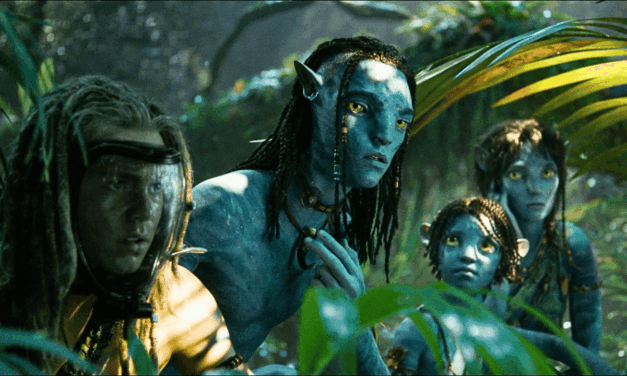
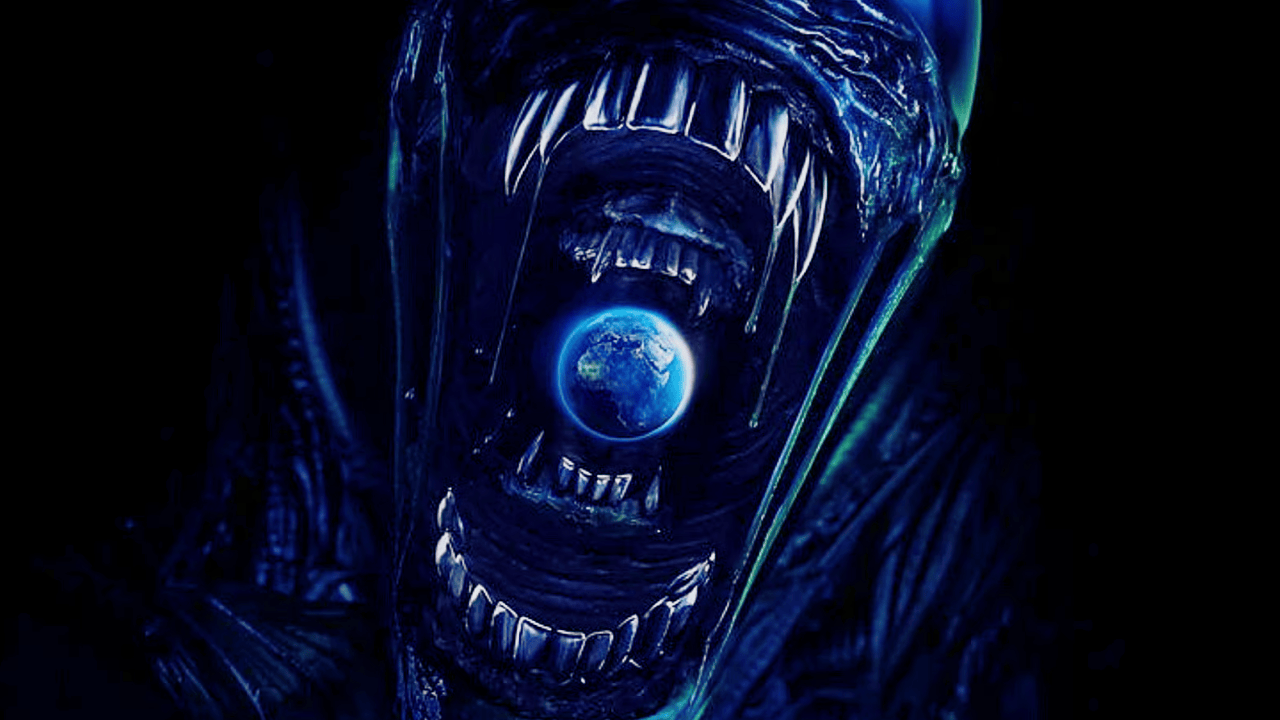
“In space, no one can hear you scream.” This tagline promoted the 1979 science fiction horror film Alien, directed by Ridley Scott. Its action-oriented sequel Aliens (1986), directed by James Cameron, earned its star Sigourney Weaver an Academy Award nomination for Best Actress. The most recent film in the franchise, Alien: Romulus, released in 2024.1 Shifting from space to Earth, and for the first time from the big screen to television, the series Alien: Earth premiered on the Hulu streaming service in August 2025. The events of the series take place two years before the original Alien film, technically making the series a prequel. While this time the story primarily takes place on Earth, with one excellent flashback episode set in space (“In Space, No One…”), back again is the iconic alien menace that has acid for blood and a taste for humans who lack the ability to make smart decisions. This time the story features a boy genius, literally named Boy, who heads a megacorporation that is secretly working on the key to immortality.
In the Greek myth about Tithonus, the mortal man is granted immortality by the god Zeus, but not eternal youth. In his poem about the story, Tennyson called the fate of Tithonus “cruel immortality,” since eternal life came with the price of aging and decay.2 In season one of the eight-episode television series Alien: Earth, set in the year 2120, the search for human immortality is presented as a driving force of the megacorporation Prodigy. They call their technological breakthrough hybrids: “synthetic beings downloaded with human consciousness.”3 Other attempts at improving humanity in Alien: Earth include fully synthetic beings and cyborgs (technologically augmented humans). While topics like this have long been the subject of science fiction, Alien: Earth provides the opportunity to engage questions related to what it means to be human, artificial intelligence, and ethics-related issues surrounding rapidly advancing technology, from a Christian perspective.
What Is a Human? The answer to what it means to be human depends on the worldview offering the answer. The foundational framework for how we see and interpret the world will direct our answer. Everyone has a worldview, though in some cases it is not well thought out and may likely even contain inherent contradictions or tensions, as individuals seek to make sense of ultimate reality (metaphysics). Defining what it means to be human is important to understanding what a human is not. From a Christian perspective, a personal God created humans who are created in His image, meaning that we possess communicable attributes of God, such as morality. We are also beings who are material and immaterial (body and soul).
Alien: Earth, via the character Boy Kavalier, head of Prodigy, sets forth a materialistic worldview, meaning that human beings are the result of an undirected material process (evolution). A materialistic worldview also rules out God, since God is spirit and, by definition, immaterial. Any sort of conscious afterlife is also negated by materialism, since death is the ultimate and final end of a purely material creature. The soul is also excluded by materialism. To the consistent materialist, the human brain is a physical organ and not distinct from the mind or the soul.
Within this materialistic framework, then, the search for immortality without God makes some sense. As head of one of five rival megacorporations essentially ruling Earth, Prodigy is seeking a way to transcend the materialistic limitations of human beings, looking for a way to not only preserve human life through technologically achieved immortality, but to enhance the human experience with super strength and super intelligence. Salvation through technology, such as via transhumanism, avoids the messy Christian business of sin and the need for repentance before a personal, holy, moral, Creator God.
Birth of the “Immortal” Hybrids. Returning to the world of Alien: Earth, Boy Kavalier has invested billions of dollars into developing a competitor to synthetic beings and cyborgs. The hybrids, as he calls them, are synthetic beings that contain within their computer “brains” the transferred consciousness of humans. The first is Wendy, a 12-year-old terminally ill girl who is “transferred” to an adult synthetic body. Wendy is described as “the next evolutionary step between our animal past and our transhuman future.”4
The children in Alien: Earth who are now hybrids are product prototypes. When the process is refined, Prodigy will offer its form of human immortality to the world (for a price). But as we learn in Alien: Earth, there are problems with the hybrids, such as the fact that the process seems to work only on children, and the transfer to synthetic bodies retains inherent pitfalls of being human, such as potential for psychological instability, exhibited mostly by the hybrid character Nibs.
The Crash and the Specimens. Kavalier is distracted from his hybrid project when a deep space research vessel owned by rival megacorporation Weyland-Yutani crashes into a Prodigy city. His attention quickly turns to recovering live alien specimens and he makes a rash decision to deploy his hybrids to the crash site to help recover the alien specimens. Remember, these hybrids behave like children, and even though they have great strength and speed, they still have fears and lack the experience and training to deal with dangerous situations.
Still, the hybrids are valuable to Kavalier and to Prodigy. They are a secret project developed on a secluded private island, termed Neverland by Kavalier, underscoring recurring and often clumsy references to Peter Pan in Alien: Earth. The hybrid project, at any rate, is a technological copying of human consciousness from a purely human body to a synthetic one. In short, it is an attempt at transhumanism, which sees itself as the next step in human development or evolution, utilizing technology to allow human beings to live forever in bodies that strip away human limitations such as disease and decay, as well as offer perks such as increased intelligence, strength, and, of course, the promise of immortality without the curse of Tithonus.
Boy Kavalier, however, doesn’t see the hybrids as human. When one hybrid begins acting erratically (Nibs), he calls the solution an IT problem, meaning that a machine needs technical support, not a medical doctor or a therapist. In fact, he orders the technicians to roll back the memories of this hybrid so she is restored to a state before she began acting strangely.
Human Potential and Cyborgs. Alien: Earth also presents affinity with the human potential movement. In one conversation with a scientist, Boy Kavalier states, “What we’re doing here, you and me, is exploding human potential.”5 Another class of human in the series is the cyborg, a human augmented with technology. The cyborg character featured in the series is Morrow, the chief security officer aboard the ship that crashes into a Prodigy city. Morrow describes himself as “a feral boy with a palsied arm” who is found by one of the megacorporations and taken in, likely to experiment on him with cybernetics.6 He is given a cybernetic arm that is sort of a Swiss army knife limb, capable of becoming a blowtorch to seal metal doors, a deadly knife, and also possesses extraordinary strength. Morrow is also able to interface with computers through cables connected to his head that can copy or download computer data. Interestingly, in Alien: Earth cyborgs like Morrow are viewed with suspicion, distrust, and even fear by normal unaugmented humans. When a hybrid, upon seeing the cybernetic arm, asks Morrow if he is a robot, Morrow replies, “Wouldn’t that be nice, to be all machine instead of what I am, the worst parts of a man.” The cyborg seems to even despise himself, part machine, so not fully man, asking the riddle, “When is a machine not a machine?”7 The answer within the context of Alien: Earth appears to be that a machine is not a machine when it becomes self-aware and begins making decisions beyond its programming or design.
Artificial Intelligence and Human Stagnation? A critical topic relevant to Alien: Earth is that of artificial intelligence (AI). This is a relevant topic for the world today, as the rise of ChatGPT and other AI technology is rapidly appearing and advancing, so much so that AI expert Geoffrey Hinton has warned that there is a 10–20 percent chance that AI could result in human extinction within a few decades.8 Could it also lead to a decline in human culture and civilization? If human beings become complacent in areas such as intellectual development, artistic creativity, science, and more, are we ignoring or damaging the image of God in us? Is the end result akin to Pixar’s film WALL-E (2008), wherein humans become nothing but lazy consumers, entertaining themselves nonstop? As for the possible danger to humanity, Boy Kavalier remarks, “The fear with artificial intelligence is that, you know, we will build a brilliant machine that will build an ever-smarter machine…until so long us.”9
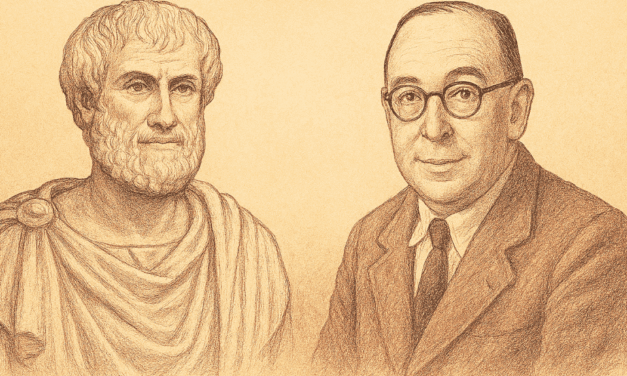
Free of Moral Constraints. In the Narnia book The Magician’s Nephew by C. S. Lewis, the character of Uncle Andrew fancies himself a scientist. He casually experiments on guinea pigs, some of which explode “like little bombs.”10 Uncle Andrew lacks a moral foundation for his inquiries and experiments, leading him later to experiment on a human child. Stepping outside of God’s moral laws, Uncle Andrew steps into the void (see The Abolition of Man [1943], also by Lewis).11 In other words, there are no ethical restraints on what he could or could not do in the name of science or technological advancement. This leads us to Alien: Earth and corporations like Prodigy and Weyland-Yutani that are in an unfettered power struggle for control that has few or no moral boundaries. In the case of Prodigy’s development of hybrids, six children are killed in the process. As one of the scientists involved in the hybrid project states, “If we did this wrong, best case we’ve got a bunch of AIs running around thinking that they’re human. Worst case? We killed six kids.”12 There are no real ethical checks or balances on what the five megacorporations of Alien: Earth can or cannot do. If killing six children leads to a sort of transhuman technological breakthrough, then a new class of being is created, the hybrid, as well as a product to sell to those who seek immortality. Later Boy Kavalier plots to allow an intelligent alien organism to take control of a human so Kavalier can have a conversation with it. Kavalier, we also learn, killed his own father. Without ethical restraints, who is to say anything is wrong? Christianity offers God’s moral law, while materialistic atheism wallows in moral relativism and resultant ethical chaos.
Pride Goes Before Destruction. The plot of Alien: Earth is essentially that of numerous science fiction stories, including those of the late Michael Crichton, from Westworld (1973) to Jurassic Park the novel (1990) and the Steven Spielberg-directed film (1993). Alien: Earth is even set on an island where eventually its inhabitants will have to frantically flee from dangerous creatures run amok (in this case, alien organisms, not dinosaurs). In the end, Prodigy’s Neverland island collapses on its own hubris, imprisoned by the hybrids, who now see their goal as ruling over others. They are, after all, immortal and, by certain definitions, they see themselves as better than their creator humans. In the words of the hybrids to the captured humans, including their creator Boy Kavalier, “Your time is done. It’s our time now.” Another hybrid asks Wendy, “What do we do now?” She answers, “Now we rule.”13
Negative Variables Are Increasing. Alien: Earth can be interpreted as a cautionary tale about humanity overreaching in its pride and, as a result, falling, providing some allusions to Genesis 3. As one character blandly understates the imminent collapse of Prodigy’s Neverland island, “Negative variables are increasing.”14 This may very well be the situation humanity finds itself in today. A cursory examination of human history does see improvements, for instance, in medicine, science, and technology, but morally speaking we seem no better off than our ancient ancestors, divided by factions and perpetually warring with one another. The solution is not a human-driven, self-centered renaissance of thought and action or applied and unfettered science, but a God-driven, Savior-centered focus on eternal truths that will lead to immortality in the presence of the Lord of all creation. We possess both the inner moral witness of natural law (Romans 2:15) and the external revelation of God in His Word, yet we want the no tears and no suffering of Revelation 21:4 without repentance or the restraint of moral law. We want immortality, but we want it on our terms, not God’s.
Robert Velarde, MA, is author of several books, including A Visual Defense (Kregel, 2013), Conversations with C. S. Lewis (InterVarsity Press, 2008), and The Wisdom of Pixar (InterVarsity Press, 2010).
Notes:
- Cole Burgett, “Alien: Romulus, Risk Aversion, and the Parable of the Big Bad Company,” Christian Research Journal 47, no. 03 (2024), https://www.equip.org/articles/alien-romulus-risk-aversion-and-the-parable-of-the-big-bad-company/.
- Alfred, Lord Tennyson, Tithonus, line 5 (1860).
- Alien: Earth, season 1, episode 1, “Neverland,” written by Noah Hawley, Dan O’Bannon, and Ronald Shusett, directed by Noah Hawley, released August 12, 2025, streaming on Hulu.
- Alien: Earth, season 1, episode 4, “Observation,” written by Noah Hawley, Bobak Esfarjani, and Dan O’Bannon, directed by Ugla Hauksdottir, released August 26, 2025, streaming on Hulu.
- Alien: Earth, season 1, episode 2, “Mr. October,” written by Noah Hawley, Dan O’Bannon, and Ronald Shusett, directed by Dana Gonzales, released August 12, 2025, streaming on Hulu.
- Alien: Earth, season 1, episode 6, “In Space, No One…,” written by Noah Hawley, Dan O’Bannon, and Ronald Shusett, directed by Noah Hawley, released September 2, 2025, streaming on Hulu.
- Alien: Earth, season 1, episode 3, “Metamorphosis,” written by Noah Hawley, Robert De Laurentiis, and Dan Obannon, directed by Dana Gonzales, released August 19, 2025, streaming on Hulu.
- Dan Milmo, “‘Godfather of AI’ Raises Odds of the Technology Wiping Out Humanity over Next 30 Years,” The Guardian, December 27, 2024, https://www.theguardian.com/technology/2024/dec/27/godfather-of-ai-raises-odds-of-the-technology-wiping-out-humanity-over-next-30-years.
- Alien: Earth, season 1, episode 2, “Mr. October.”
- C. S. Lewis, The Magician’s Nephew (Harper Trophy, 2000), 24..
- C. S. Lewis, The Abolition of Man (Macmillan Publishing, 1955), 77.
- Alien: Earth, season 1, episode 4, “Observation.”
- Alien: Earth, season 1, episode 8, “The Real Monsters,” written by Noah Hawley, Migizi Pensoneau, and Dan O’Bannon, directed by Dana Gonzales, released September 23, 2025, streaming on Hulu.
- Alien: Earth, season 1, episode 8, “The Real Monsters.”