Listen to this article (17:38 min)
Cultural Apologetics Column
Feature Cultural Analysis and Commentary
This article was published exclusively online in the Christian Research Journal, Volume 49, number 02 (2026).
When you support the Journal, you join the team and help provide the resources at equip.org that minister to people worldwide. These resources include our ever-growing database of more than 2,500 articles and Bible Answers, as well as our free Postmodern Realities podcast.
Another way you can support our online articles is by leaving us a tip. A tip is just a small amount, like $3, $5, or $10, which is the cost of a latte, lunch out, or coffee drink. To leave a tip, click here.
Masters of the Universe
Directed by Travis Knight
Screenplay by Chris Butler, Aaron Nee, Adam Nee, and David Callaham
Story by Aaron Nee, Adam Nee, Alex Litvak, and Michael Finch
Based on Masters of the Universe by Mattel
Produced by Todd Black, Jason Blumenthal, Robbie Brenner, DeVon Franklin
Starring Nicholas Galitzine, Camila Mendes, Alison Brie, James Purefoy, Morena Baccarin, Jóhannes Haukur Jóhannesson, Kristen Wiig, Jared Leto, and Idris Elba
Feature Film (PG–13)
(Amazon MGM Studios, 2026)
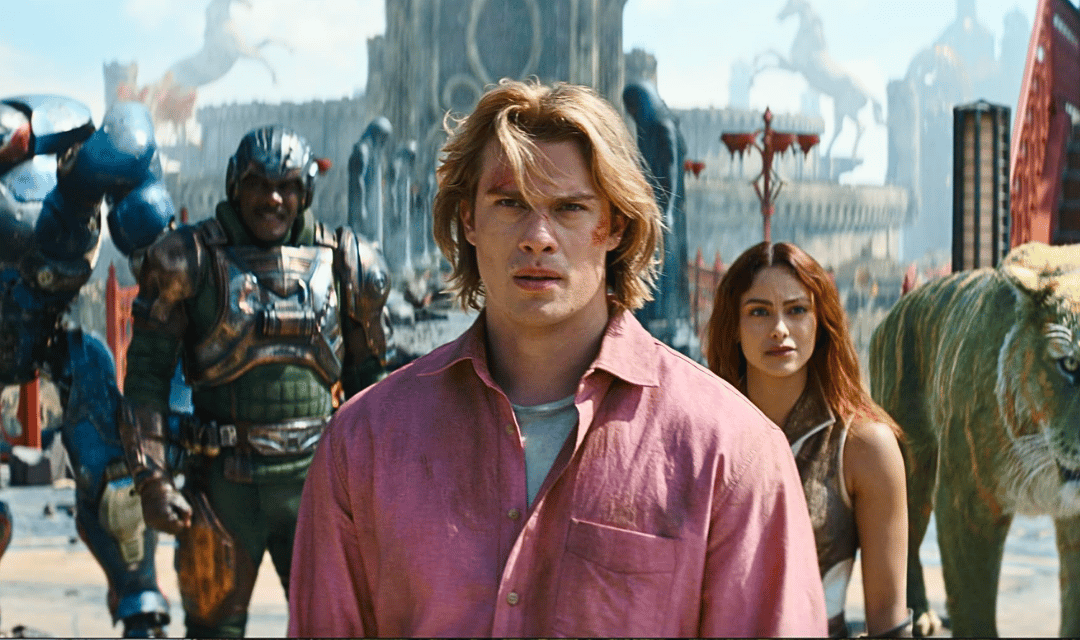
The release of Masters of the Universe (2026) represents the latest development in a broader cultural phenomenon that has come to dominate contemporary popular culture, and that is the revival of certain intellectual properties through the machinery of nostalgia. Like Star Wars, Ghostbusters, Transformers, Jurassic Park, and countless other so-called “legacy” franchises, Masters of the Universe arrives burned with the weight of cultural memory. It attempts to reactivate an existing symbolic world for an audience that already knows something about Eternia, Castle Grayskull, Skeletor, and the Sword of Power.1
Yet Masters of the Universe occupies a somewhat unusual place within modern franchise culture because its origins were never primarily literary or cinematic. Unlike Middle-earth, Narnia, or even the galaxy far, far away, Masters of the Universe began as a toy line, predating Transformers by about two years. Introduced by Mattel in 1982, the franchise emerged from the convergence of several late twentieth-century influences, including the muscular heroics of sword-and-sorcery fantasy, heightened interest in science fiction as a genre, growing interest in action figures, and the increasingly sophisticated relationship between toys and media. The original figures were accompanied by minicomics and later supported by the enormously successful Filmation animated series beginning in 1983, but the toys came first. The narrative universe was therefore built around the products rather than the products emerging from a preexisting narrative universe.2
Thus, Masters of the Universe was never designed around strict continuity or carefully managed “canon” in the style of much modern franchise storytelling. It was designed around visual recognizability and the potential for expansion. Every character possessed a distinctive silhouette. Every vehicle, creature, weapon, or playset implied further possibilities for ownership. The world of Eternia therefore functioned less as a coherent fictional setting than a highly flexible imaginative framework capable of accommodating almost anything, from loincloth-laden barbarians to killer robots, sorcerers, cyborgs, spaceships, and prehistoric beasts. All of these things could coexist because the underlying logic was fundamentally toyetic rather than literary or cinematic.
This helps explain both the continuing appeal, as well as the difficulties involved in adapting it for contemporary audiences. The franchise’s central images remain extraordinarily powerful. Castle Grayskull, Battle Cat, Skeletor’s visage, and He-Man raising the Sword of Power continue to occupy a recognizable place within the iconography of popular culture — specifically American popular culture. Yet iconography alone, as the box office for the new film suggests, cannot sustain narrative meaning.3
The challenge facing every revival property is determining whether these symbols still possess interpretive depth or whether they survive purely as objects of recognition. That question extends far beyond Masters of the Universe, as contemporary culture appears to be trapped in a cycle of revisiting, rebooting, and reimagining its own past. Rather than generating new mythologies, it continually returns to existing ones, so that much of the landscape of popular culture is now saturated with familiarity and repetition. The success or failure of a film such as Masters of the Universe therefore depends on more than its fidelity to a well-known toy line; rather, it depends on whether nostalgia functions as genuine interpretation.
Hauntology
At this point, it’s worthwhile to introduce the concept of hauntology. The term was originally coined by the French philosopher Jacques Derrida in Specters of Marx (1993), where he used it to describe the persistence of ideas, possibilities, and historical conditions that continue to exert influence even after their apparent disappearance.4 In its original context, hauntology referred less to ghosts in the literal sense than to the lingering presence of things that are no longer fully present but have never entirely gone away.
In the decades since, however, the concept has been adapted by cultural critics — most notably Mark Fisher — to describe a broader condition within contemporary culture. For Fisher, hauntology was about time, not political theory. More specifically, it was about a growing sense that popular culture itself had become haunted by its own past.5
The basic observation is relatively straightforward. Earlier generations often imagined radically different futures. Mid-century science fiction envisioned technological utopias, interplanetary exploration, flying cars, orbital cities, and entirely new social arrangements — think The Jetsons (1962–1963) and Gene Roddenberry’s original Star Trek (1966–1969). The late twentieth century generated its own visions of tomorrow through cyberpunk, electronic music, digital aesthetic, and speculative futurism — think Blade Runner (1982) and The Matrix (1999). Whether these futures were optimistic or pessimistic is ultimately beside the point. What matters is that they felt new. They suggested the possibility that tomorrow might look fundamentally different from today.
But contemporary culture appears less interested in imagining new futures than in endlessly revisiting old ones. Rather than producing the next Star Wars, Hollywood continually returns to Star Wars. Rather than developing new icons, studios reproduce existing icons. The result is a culture that often feels suspended, caught between cultural memory and repetition.
This is not just an industrial phenomenon, though economic incentives certainly play a role here. Intellectual property is valuable to studios because it reduces risk. Existing brands come with established audiences, recognizable imagery, and, in some cases, decades of accumulated goodwill. Yet the prevalence of revival culture suggests that audiences often appear drawn toward familiar symbolic worlds.6 The appeal of nostalgia cannot therefore be explained solely through marketing since it reflects a broader desire to reconnect with cultural artifacts that possess stable meaning within a fragmented social landscape.
And this is where hauntology becomes particularly useful as a tool of cultural analysis. It allows us to move beyond the simplistic claim that people just enjoy revisiting childhood favorites. Instead, it encourages us to ask why certain cultural objects continue to exert such gravitational force. Why do properties like Masters of the Universe remain culturally legible decades after their initial appearance?
Part of the answer lies somewhat obviously in the realization that these franchises tend to function as repositories of collective memory. They provide shared symbolic languages capable of connecting generations. A parent who played with He-Man figures in 1983 can recognize the same symbols presented to a child in 2026. The icons wield power even when the surrounding cultural climate changes temperatures.
Symbol, Memory, and Meaning
But this creates a significant artistic problem — the survival of a symbol does not automatically guarantee the continued survival of its meaning. Indeed, one of the most-discussed weaknesses of contemporary franchise storytelling is the tendency to confuse recognition with interpretation. A familiar image produces an emotional response because audiences recognize it, but recognition and meaning are not the same thing. Recognition is immediate — meaning requires development. Recognition depends upon memory, while meaning depends upon context.
Nostalgia. This distinction is useful for explaining why legacy sequels come across as strangely hollow despite their obvious commercial appeal. The audience remembers the symbol, but the narrative often struggles to justify its return. The image itself remains powerful, while the dramatic function becomes increasingly uncertain. In this sense, nostalgia can operate in at least two very different ways. The first is interpretive nostalgia. Here, creators revisit an older property in order to ask what has changed, what has endured, and how the passage of time alters the significance of familiar symbols. Such an approach treats the past as material for reflection, assuming that both characters and audiences have histories that matter.
The second approach is replicative nostalgia. Here, the primary goal is not interpretation, but reproduction. Familiar costumes, vehicles, catchphrases, musical cues, and visual motifs are reintroduced largely because they are familiar. The past becomes something to be displayed rather than examined. Instead of exploring the meaning behind the symbol, the work simply points toward the symbol itself and relies upon audience recognition to generate emotional engagement.
Successful revivals generally depend upon interpretation rather than replication. They understand that symbols remain meaningful only insofar as they continue to participate in ongoing narratives. Once symbols become detached from narrative development, they risk becoming little more than cultural relics. This tension makes Masters of the Universe such a useful case study, as few franchises are more connected to nostalgia and cultural memory.7 Yet few franchises also illustrate so clearly the challenge facing contemporary popular culture, as the question is less whether audiences remember Eternia than it is what Eternia means now, and whether the franchise possesses sufficient interpretive depth to justify another return.
Christ-Hauntedness
Theological reflection reveals something even more interesting about this phenomenon, as Christians should be uniquely equipped to recognize the difference between memory and meaning because Christianity itself is fundamentally concerned with the relationship between the past, the present, and the future. Indeed, the Christian faith is rooted in remembrance. Israel is frequently commanded to remember God’s acts in history. The Lord’s Supper is instituted with the well-known imperative, “Do this in remembrance of me” (Luke 22:19). Yet biblical remembrance is never framed in either the Old Testament or the New as nostalgia for its own sake; rather, the purpose is transformation.
When Israel remembers the Exodus, it is not simply recalling a beloved national story, though that certainly is a part of it. But more importantly, Israel is being reminded of the God who delivered slaves and therefore demands covenant faithfulness in the present. When Christians remember the death and resurrection of Christ, we are not engaging in sentimental reflection upon the past; rather, we are participating in a real and spiritual aspect of reality that continues to shape our identity and the mission of the church. Biblical memory is therefore interpretive rather than replicative. It carries the past forward into the present so that God’s people might faithfully inhabit the future.
Flannery O’Connor’s famous observation about the American South becomes particularly illuminating here. O’Connor remarked that while the South was not Christ-centered, it remained “Christ-haunted.”8 Christianity persisted as a cultural presence even where genuine belief had weakened. The symbols and language remained alongside assumptions and memory. Christ continued to haunt the landscape long after many people had ceased organizing their lives around Him.9 The term “Christ-haunted” nevertheless proves surprisingly useful beyond O’Connor’s original context, as one could plausibly argue that much of contemporary American Christianity has become similarly Christ-haunted.
Churches continue to employ “Christian” vocabulary. Biblical phrases remain a common part of the evangelical lexicon. Crosses are still used to adorn sanctuaries, and worship services retain familiar liturgies, however informal. Yet one increasingly encounters a curious phenomenon in that symbols remain culturally intelligible even as their theological content becomes progressively less defined. The issue is not that churches have abandoned Christian language or imagery; the issue is that much of contemporary evangelicalism often treats Christian language as emotionally evocative rather than, say, doctrinally descriptive.
Consider how frequently terms such as “gospel,” “grace,” “calling,” “community,” “mission,” “kingdom,” and even “Jesus” function as broad positive associations rather than carefully articulated theological claims. The language remains familiar, but familiarity is not the same as understanding. A congregation may sing about grace every Sunday while possessing only the vaguest conception of sin — an accurate understanding of which is necessary to comprehend the texture of grace in the first place. It may proclaim Jesus as Savior while speaking far less frequently about discipleship or obedience. The symbol remains visible while its theological contours become indistinct.
Nor is this problem limited to evangelicalism’s more informal expressions. Liturgically-oriented traditions are not automatically insulated from the same danger. If evangelical churches sometimes mistake emotional familiarity for theological depth, liturgical churches can sometimes mistake ritual familiarity for theological depth. A creed recited weekly may become no more reflective than a hokey worship chorus repeated weekly. The Eucharist can, in fact, become routine in a negative sense of the word, and confessions can become weirdly formulaic. Vestments, candles, incense, and even prayer can become objects of aesthetic appreciation rather than instruments of theological formation. Historically, Christian liturgies were designed to shape belief through repeated practice. But the danger emerges when participation becomes performative rather than formative, when Christians learn to inhabit the gestures of faith without seriously grappling with the truths those gestures point toward. In such cases, liturgical repetition can become every bit as vulnerable to symbolic shallowness as contemporary “praise culture.” The problem is therefore not fundamentally stylistic — it is theological. Symbols, whether ancient or modern, lose their power when they become detached from the realities they were intended to signify.
In this respect, the modern American church faces a temptation remarkably similar to the one confronting modern franchise storytelling. It is possible to preserve certain symbols while losing confidence in the truth those symbols represent, just as it is possible to repeat familiar language while forgetting the narrative that once gave that language coherence. The temptation is understandable, as Western Christianity currently finds itself in a period of institutional uncertainty. Everything from denominational fragmentation to cultural marginalization and uncomfortable politicization have produced a widespread sense of instability. Under such conditions, nostalgia becomes attractive because the past appears safer than the future.
As a result, discussions of the Moral Majority, the Jesus Movement, or some other supposedly healthier period of Christian influence becomes part of the conversation again.10 Yet these appeals often function less as historical analysis than reassurance, as the past becomes a repository of emotional security rather than a subject of real theological reflection.
Scripture, however, consistently directs God’s people elsewhere. When Israel found itself in exile, God did not command the nation to recreate Jerusalem in Babylon. Instead, He instructed them to seek the welfare of the city in which they had been placed (Jeremiah 29:7). Likewise, nowhere does the New Testament present the church as a community preserving some golden age; instead, the church is shown to be a pilgrim people moving toward a future consummation (1 Peter 2:11; Revelation 21:4). The Christian imagination is fundamentally eschatological, oriented toward the coming kingdom of God rather than the recovery of a lost cultural moment.
For Derrida, societies are haunted by unresolved pasts. For Fisher, cultures are haunted by futures that never arrived. For the Christian, though, history is haunted by a future that most certainly will arrive. The kingdom of God casts its shadow backward, into the present. Christian hope does not emerge from recovering a lost world, but from anticipating a promised one. The church in America can never be sustained by nostalgia alone, as nostalgia asks how we might return to what has been lost. But the gospel asks how we might remain faithful as God brings history toward its appointed end. In that sense, the problem with contemporary nostalgia culture is that it remembers without interpretation and preserves without understanding. It is repetition without transformation. Whether we are discussing Masters of the Universe, modern franchise filmmaking, or American Christianity itself, the same principle applies: symbols remain meaningful only when they remain connected to the realities they signify.
Of course the past matters. But for the Christian, the past was never intended to be a destination so much as it was intended to be a witness. —Cole Burgett
Cole Burgett is a graduate of Dallas Theological Seminary and the Moody Bible Institute. He currently serves as the Assistant Director of Online and Nontraditional Learning at Corban University, as well as an Assistant Professor of Theology. He writes extensively about theology and popular culture.
NOTES
- For a fairly in-depth look at this idea from a business standpoint, see Kyriakos Riskos et al., “The Impact of Nostalgic Corporate Storytelling on Brand Heritage: A Multiple Mediation Model,” International Journal of Business Science and Applied Management 17, no. 2 (2022), DOI: 10.69864/ijbsam.17-2.160.
- For those interested in the history of these kinds of toys and the billion-dollar industry that emerged alongside them, I highly recommend the Netflix documentary series, The Toys That Made Us (2017–2019).
- At the time of writing, it seems fairly unlikely the film will recoup its enormous $170–200 million budget or the marketing costs involved, underperforming with a $30 million debut. Word of mouth will give the film legs, though critical reviews have been tepid so far. See Anthony D’Allesandro, “‘Scary Movie’ Screams to Franchise & Paramount Comedy Record $55M Bow; ‘Masters’ He-Manages $29M+; ‘Amazing Digital Circus’ $21M 4-Day — Sunday U.S. Box Office Update,” Deadline, June 7, 2026, https://deadline.com/2026/06/box-office-scary-movie-masters-of-the-universe-backrooms-1236941701/.
- Derrida coined the term hauntology as a play on ontology (the study of being), drawing upon the opening line of The Communist Manifesto. Responding to claims that Marxism had been rendered obsolete after the Cold War, he argued that Marx’s critique of capitalism continued to haunt the present despite its supposed disappearance. Derrida’s concern was not primarily nostalgia, but the persistence of social contradictions and political questions that continue to “haunt” the present despite claims that they belong to the past. See Jacques Derrida, Specters of Marx: The State of the Debt, the Work of Mourning, and the New International, trans. Peggy Kamuf (Routledge, 1994).
- See Mark Fisher, Ghosts of My Life: Writings on Depression, Hauntology, and Lost Futures (Zero Books, 2014), where Fisher adapts Derrida’s concept of hauntology to describe the persistence of “lost futures” within contemporary culture and popular media.
- Matthew Cooper’s MA thesis is a worthwhile study on the subject, focused primarily on the film industry as it attempts to navigate social changes in Hollywood throughout the 2010s. See Matthew Cooper, “Backward Glances: The Cultural and Industrial Uses of Nostalgia in 2010s Hollywood Cinema,” College of Communication Master of Arts Theses 36 (2021), https://via.library.depaul.edu/cmnt/36.
- Just check out the Variety review of the new film. See Guy Lodge, “‘Masters of the Universe’ Review: Nicholas Galitzine Lends Some Spark to a Bloated Nostalgia Trip,” Variety, June 2, 2026, https://variety.com/2026/film/news/masters-of-the-universe-review-1236764691/.
- Flannery O’Connor, “Some Aspects of the Grotesque in Southern Fiction,” in Mystery and Manners: Occasional Prose, ed. Sally and Robert Fitzgerald (Farrar, Straus & Giroux, 1969), 44.
- See Flannery O’Connor, “The Catholic Novelist in the Protestant South,” in Mystery and Manners, 191–212.
- See Aaron M. Renn, “How the Decline of Evangelicalism Helped Elect Donald Trump,” American Compass, December 4, 2024, https://americancompass.org/how-the-decline-of-evangelicalism-helped-elect-donald-trump/. Renn argues that the rise of Donald Trump in American politics should be understood not as evidence of evangelical cultural dominance, but as evidence of its decline. According to Renn, American Christianity has moved from a “Positive World,” in which Christian moral norms retained broad cultural legitimacy, through a “Neutral World,” into a contemporary “Negative World” in which traditional Christian convictions are viewed with suspicion by elite institutions and the public sphere. Within this environment, evangelicals no longer function as a “moral majority” capable of shaping national norms, as some discourse suggests might be the case, leading many to adopt a more defensive and pragmatic political posture.