Listen to this article (16:15 min)
Cultural Apologetics Column
This article was published exclusively online in the Christian Research Journal, Volume 49, number 03 (2026).
When you support the Journal, you join the team and help provide the resources at equip.org that minister to people worldwide. These resources include our ever-growing database of more than 2,500 articles and Bible Answers, as well as our free Postmodern Realities podcast.
Another way you can support our online articles is by leaving us a tip. A tip is just a small amount, like $3, $5, or $10, which is the cost of a latte, lunch out, or coffee drink. To leave a tip, click here.
[Editor’s Note: This review contains spoilers for The Odyssey.]
The Odyssey
Directed by Christopher Nolan
Screenplay by Christopher Nolan
Produced by Emma Thomas and Christopher Nolan
Starring Matt Damon, Tom Holland, Anne Hathaway, Robert Pattinson, Lupita Nyong’o, Zendaya, and Charlize Theron
Feature Film (R)
(Universal Pictures, 2026)
There are very few books of which I own multiple copies. The Bible, perhaps unsurprisingly, occupies the first place by a considerable margin. After that come two poems written nearly three millennia ago. Between translations, critical editions, student texts, and attractive hardcovers collected over the years, I possess more copies of Homer’s Iliad and Odyssey than of any other works in my library. They first seized my imagination when I encountered them in high school, and they have never truly released it. It is therefore somewhat difficult for me to approach Christopher Nolan’s The Odyssey (2026) with anything resembling detachment, for Homer’s epic has been something of a lifelong companion.
Christopher Nolan has, for much of his career, been one of Hollywood’s great deconstructors.1 His films routinely dismantle the assumptions of their genres before attempting to rebuild them. Superheroes become studies in fear and moral ambiguity (The Dark Knight, 2008). War films become meditations on time and subjective experience (Dunkirk, 2017). The biopic becomes an examination of power and historical memory (Oppenheimer, 2023). Even his science fiction rarely concerns technology so much as epistemology and how we know what is real. Nolan is therefore unmistakably a filmmaker shaped by the postmodern condition.2
He delights in fractured chronology and competing perspectives. He constructs narratives that force the audience to reconstruct meaning rather than passively “receive” it. Yet unlike many of his postmodern contemporaries, Nolan seldom leaves the pieces scattered upon the floor once his deconstruction is complete. His films typically conclude by suggesting that, despite uncertainty, there remains an objective moral order worth seeking, even if it can never be grasped perfectly. That tension between deconstruction and reconstruction makes him a compelling (if not altogether unexpected) director to attempt an adaptation of Homer’s Odyssey, itself one of the Western world’s earliest retained meditations on identity and homecoming.
An Unprecedented Achievement. Whatever one ultimately concludes about Nolan’s interpretation of Homer, it should be acknowledged up front that The Odyssey represents one of the greatest technological achievements in the history of motion pictures. Its significance becomes clearer when viewed against the trajectory of modern filmmaking itself. The decisive turning point came in the early aughts, when George Lucas photographed Star Wars: Episode II — Attack of the Clones (2002) entirely with high-definition digital cameras, the first major blockbuster to abandon traditional motion picture film in favor of a fully digital production pipeline. Lucas envisioned a future in which filmmaking would be liberated from the physical limitations of celluloid, and history has largely vindicated that prediction.3 Over the next two decades, digital cinematography, computer-generated imagery, virtual production, and LED volume stages transformed both how films were made and how filmmakers conceived what could be shown upon the screen.
Against that backdrop, Nolan has emerged as an unapologetic defender of the older cinematic craft. The Odyssey was filmed entirely on IMAX 70mm film using a new generation of cameras engineered specifically for the production, overcoming long-standing technical obstacles that had made an all-IMAX feature unfeasible.4 Vast practical sets, location photography spanning no less than six countries, full-scale ships, and in-camera effects restore a sense of physicality that audiences have seldom experienced in the digital age. The result recalls the grand historical epics of Old Hollywood.5 One is reminded less of contemporary superhero cinema than of David Lean’s Lawrence of Arabia (1962), William Wyler’s Ben-Hur (1959), or even Cecil B. DeMille’s biblical extravaganzas — all films that sought to overwhelm audiences through the conviction that what appeared upon the screen had, in some meaningful sense, actually existed before the camera. In this respect, Nolan has accomplished something rare in employing cutting-edge technology to preserve and extend traditional filmmaking into a new generation rather than replace it.6
The Original Epic. To appreciate Nolan’s adaptation, one must first appreciate the world from which The Odyssey emerged. Composed sometime during the eighth century B.C., though undoubtedly preserving traditions far older than its final written form, Homer’s epic belongs to a culture that understood the universe as divinely governed and morally ordered. In the crudest of terms, it is simply the story of a man attempting to return home after war. But, being an epic poem, it is also so much more.
Every island on which Odysseus lands presents an alternative vision of civilization and human existence. The Lotus-Eaters, for example, embody the temptation to abandon memory and duty for perpetual ease. Polyphemus represents life without law or hospitality, a brute existence in which might makes right. Circe reduces men to beasts because they have first surrendered the virtues that distinguish them from beasts. The Sirens offer knowledge detached from obedience, while Calypso tempts Odysseus with the extraordinary prospect of immortality purchased at the cost of home and identity.7 Each is an iconic adventure in its own right, but taken together they are the moral and civilizational tests by which Homer asks what kind of man deserves to return home.8
Equally significant is the poem’s understanding of νόστος (nostos), or homecoming.9 Many of us today tend to imagine home as merely a location. Homer, however, does not. Ithaca is the place where relationships (rightly ordered) are restored: husband to wife, father to son, king to kingdom, host to guest, and mortal to the gods. The poem’s climax is the restoration of order after years of disorder. When read in its own historical and literary context, Homer’s Odyssey is as much a meditation upon fidelity, kingship, justice, and the obligations that make civilization possible as it is a classic adventure story.10 It assumes that there exists an objective order to which both gods and men must answer, a conviction that places Homer at a considerable distance from many postmodern narratives, from The Matrix (1999) to Westworld (2016–2022), in which inherited structures are treated primarily as instruments of oppression, and “authentic” freedom is found only by escaping or redefining them.
A Postmodern Reinterpretation. If Homer’s Odyssey charts a course that explores whether Odysseus deserves to return home, Nolan’s adaptation reroutes and asks whether Odysseus himself believes that he does. Homer places the question largely before the audience and the gods, who continually weigh the hero’s virtues against his failures. Nolan turns that same inquiry inward. The epic’s external trials become reflections of an interior struggle, as Odysseus himself assumes the role of judge. The film therefore does not so much deviate from the central concern of the original narrative as relocate it within Odysseus the character.11
Nolan is fascinated not only by Odysseus the king, the warrior, or the wanderer, but also by Odysseus the man. Indeed, there are moments in which the film borders on reverence, treating him less like the epic and archetypal figure many know him to be than as one of history’s great tragic characters — a man whose extraordinary ingenuity has become the source of his most profound torment, and therefore a man haunted by conscience.
Central to Nolan’s interpretation is his treatment of what the film repeatedly calls “Zeus’s law.” Historically, this refers to ξενία (xenia), the sacred institution of guest-friendship over which Zeus himself presided as Ζεὺς Ξένιος (Zeus Xenios), the protector of strangers, travelers, and hosts alike. In the Homeric world, hospitality constituted one of the fundamental pillars of civilization, binding strangers together through reciprocal obligations that transcended tribe, kingdom, and even war. To violate xenia was not simply to wrong another human being, but to offend the divine order itself.12 Throughout both the Iliad and the Odyssey, Homer repeatedly returns to this theme. Polyphemus scorns Zeus Xenios and devours his guests, and the suitors consume Odysseus’s household while abusing the sacred obligations of hospitality. Good rulers are measured, in no small part, by the justice they display in extending hospitality to both stranger and friend.
Nolan appropriates this moral framework and extends it to the Trojan Horse itself. The stratagem that secures the Greek victory is presented as both an act of military genius and the decisive violation of Zeus’s law. It is a deception that profanes the very trust upon which civilization depends. Under the banner of peace, Odysseus presents the horse as an offering while concealing within it the instrument of Troy’s destruction. Nolan further intensifies this moral crisis by drawing upon Virgil’s Aeneid, introducing Sinon as the deceptive Greek left behind to persuade the Trojans to admit the horse within their walls. Odysseus knowingly sacrifices him to secure the city’s fall. Whether one agrees with this interpretation of Homer (and Virgil) is ultimately beside the point. Artistically, it furnishes Nolan with the question that has animated nearly all of his mature work: what becomes of a man who cannot escape the consequences of his own choices? Like Leonard Shelby, Bruce Wayne, Cobb, and J. Robert Oppenheimer before him, Odysseus becomes a man imprisoned by his own flaws.
This constitutes Nolan’s most significant departure from Homer. The Odysseus of the epic is certainly capable of grief, regret, and longing, but he is not fundamentally a man crippled by guilt. His defining characteristic is μῆτις (mētis) — practical intelligence, cunning, resourcefulness — qualities Homer consistently celebrates when rightly ordered toward the preservation of household, kingdom, and civilization.13 Nolan transforms that same ingenuity into the source of Odysseus’s deepest wound. The mind that conceived the horse becomes the mind that cannot forgive itself for conceiving it. His greatest gift is thus recast as his defining burden, the brilliance that secured victory becoming the very transgression from which he believes he can never be absolved.
Zeus’s Law or Golden Rule? One of Nolan’s more intriguing choices is to translate the language of xenia into the familiar vocabulary of the “Golden Rule.” Several characters paraphrase Zeus’s law in terms readily recognizable to modern audiences: treat others as you yourself would wish to be treated. It is an effective cinematic shorthand, yet the simplification also obscures an important historical distinction. Although the sentiment resembles Christ’s famous teaching, the two arise from profoundly different moral worlds.
The Homeric concept of xenia was not so much a universal ethic owed equally to all mankind as it was a sacred, social institution governing the relationship between host and guest, protected by Zeus Xenios and rooted in reciprocity. Hospitality created obligations because one never knew whether today’s stranger might become tomorrow’s ally, benefactor, or host. To violate xenia was therefore to threaten the fabric of civilized society itself. The concern is fundamentally covenantal and civic, preserving the network of mutual obligations upon which the Greek world depended. It is an ethic of ordered relationships.
Jesus’ teaching in the Sermon on the Mount, however, emerges from an altogether different context. His words do not simply reinforce an existing social convention; rather, they summarize the moral vision of the Law and the Prophets: “So whatever you wish that others would do to you, do also to them, for this is the Law and the Prophets” (Matthew 7:12).14 Here the obligation is not grounded in reciprocity, civic order, or even hospitality, but in the character of Israel’s covenant God, who commands His people to love their neighbor because they themselves have first received His mercy.
The Old Testament had already extended this principle beyond one’s kind to include the resident foreigner: “You shall love him as yourself, for you were as strangers in the land of Egypt” (Leviticus 19:33–34). This command belongs within the broader covenantal ethic frequently expressed by the Hebrew concept of ḥesed — a notoriously difficult word to translate adequately, encompassing steadfast love, covenant faithfulness, loyalty, mercy, and lovingkindness. Ḥesed is characteristically the faithful love shown within a relationship of obligation — not just reciprocal kindness between social equals — and supremely exemplified by God’s enduring faithfulness toward His covenantal people. Israel’s treatment of others is therefore grounded in what God Himself has already done: the stranger is to be loved because Israel once lived as a stranger and was delivered by God. In other words, the moral imperative flows from divine action and divine character.
Jesus’s teaching stands within (and brings to fulfillment) this Old Testament covenantal tradition. He calls His disciples to love not only their neighbors but even their enemies, grounding such love in imitation of the Father, who “makes his sun rise on the evil and the good, and sends rain on the just and on the unjust” (Matthew 5:43–48). The resemblance between this ethic and xenia is therefore largely formal. Both traditions condemn betrayal and commend generosity toward the stranger, but they do so for different reasons and toward different ends. Homer’s ethic preserves civilization through the maintenance of sacred and reciprocal obligations between host and guest. The biblical ethic proceeds from the prior faithfulness and mercy of God; that is, one loves because God has first acted in love, and one extends mercy because one has first been the recipient of mercy. Where xenia establishes the obligations necessary for a rightly ordered human society, ḥesed points toward a covenantal faithfulness grounded ultimately in the character of God Himself. Christ then extends that logic beyond the boundaries of expected reciprocity, calling His followers to imitate the Father’s goodness even toward those who offer no goodness in return.15
Odysseus the Confessor. For the Christian apologist, however, Nolan’s most compelling insights concern civilization itself. His Odyssey ultimately ceases to be only the story of one man’s guilt and becomes a meditation upon the fragility of civilization itself, which is brought to bear in the third act of the film. By identifying the Trojan Horse as the violation of Zeus’s law, Nolan transforms the fall of Troy into the moment at which the sacred bonds holding the Bronze Age world together begin to unravel. Hospitality itself is weaponized, and trust becomes impossible. Sacred space is profaned, and even the gods seem to withdraw from the world they once governed. Odysseus eventually recognizes that he has become one of the dreaded “people from the sea,” a destroyer of the very civilization he once sought to defend.
Historically, the end of the late Bronze Age was indeed marked by the collapse of kingdoms, the disruption of international trade, and the appearance of seaborne raiders remembered in Egyptian inscriptions as the “Sea Peoples.”16 Although modern historians rightly attribute this collapse to a convergence of political, economic, environmental, and military pressures rather than to a single cause, Nolan appropriates that historical horizon and gives it moral expression.
Having returned home, Odysseus confesses to Penelope his violation of Zeus’s law, grieves the innocent lives consumed at Troy, and mourns the desecration of Athena’s sanctuary. It is a moving scene precisely because it recognizes a truth Christianity has always affirmed, which is that civilizations do not crumble simply because walls are breached, but because the moral order which sustained them has first been abandoned. Yet here the Christian also perceives the film’s limitation. Nolan understands transgression with remarkable clarity, and he understands guilt perhaps better than any contemporary filmmaker. What remains conspicuously absent is grace. Odysseus can remember, confess, grieve, and even bring his vengeance to bear upon those who are unrepentant — but what he never truly encounters is the possibility that the burden he carries might be borne by another.
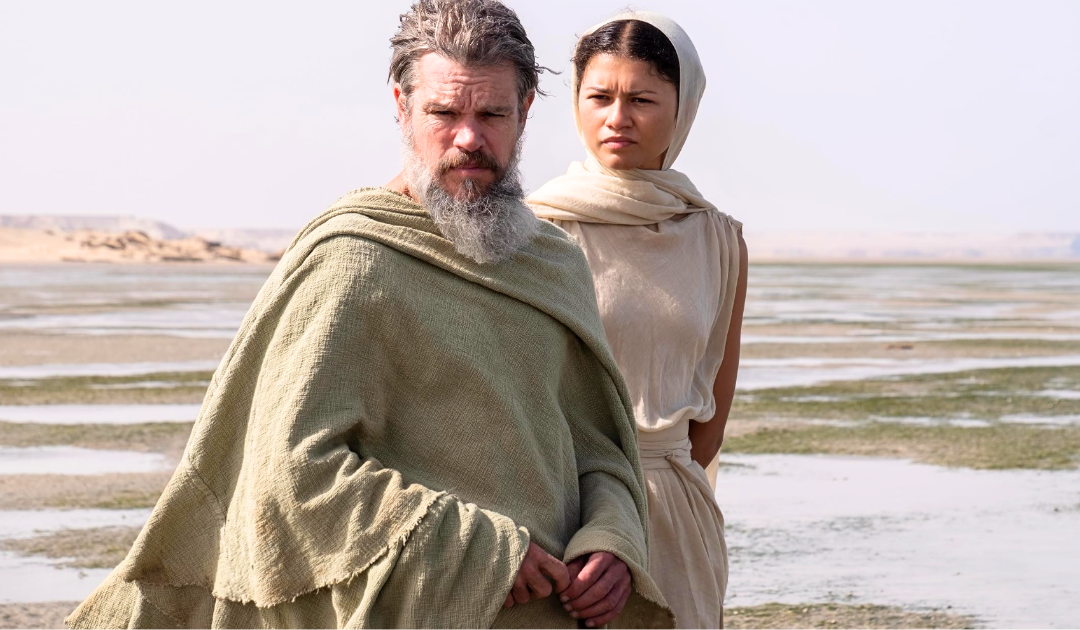
Nolan, through Matt Damon’s worn and weather-beaten Odysseus, seeks the healing of conscience. Yet the gospel of Jesus Christ proclaims something greater still: that the God whose order has been violated most profoundly is also the God who, in Christ, reconciles sinners to Himself and thereby makes genuine homecoming possible. In that sense, Nolan’s Odyssey is not a Christian film. It is, however unwittingly, a powerfully Augustinian one that tells the story of a restless heart that discovers, darkly and dimly, that no journey home can be completed until the question of guilt has first been answered. —Cole Burgett
Cole Burgett is a graduate of Dallas Theological Seminary and the Moody Bible Institute. He currently serves as the Assistant Director of Online and Nontraditional Learning at Corban University, as well as an Assistant Professor of Theology. He writes extensively about theology and popular culture.
NOTES
- The term deconstruction derives principally from Jacques Derrida’s philosophical project, which questioned the stability of language, meaning, and binary oppositions that Western thought had long assumed fixed. Rather than accepting texts as possessing a single, stable meaning, deconstruction examines the internal tensions and assumptions that undermine claims to certainty. By deconstructor, I refer not to a strict adherent of Derrida’s philosophy, but to an artist whose work habitually dismantles inherited narrative conventions, assumptions, and heroic archetypes before reconstructing them in new forms. See Jacques Derrida, Of Grammatology, trans. Gayatri Chakravorty Spivak (Johns Hopkins University Press, 1976, 2016).
- I borrow the phrase postmodern condition from Jean-François Lyotard, who famously characterized postmodernity by its “incredulity toward metanarratives”; that is, a growing skepticism toward comprehensive accounts of truth, history, and, ultimately, meaning. Within this intellectual climate, Derrida’s method of deconstruction became one of postmodernity’s most influential critical practices by exposing the instability of language and questioning claims to fixed meaning. While postmodernism encompasses far more than deconstructionism, the latter has become one of its defining interpretive methods. See Jean-François Lyotard, The Postmodern Condition: A Report on Knowledge, trans. Geoff Bennington and Brian Massumi, Theory and History of Literature, Vol. 10 (University of Minnesota Press, 1984).
- George Lucas filmed the sophomore film of his Star Wars prequel trilogy entirely using Sony HDW-F900 digital cameras, making it the first major blockbuster produced through a fully digital cinematic workflow. Lucas regarded digital acquisition as the future of filmmaking, and his pioneering efforts fundamentally reshaped the filmmaking industry. See Lucas O. Seastrom, “Lucasfilm Originals: Digital Cinema,” Lucasfilm, May 16, 2022, https://www.lucasfilm.com/news/lucasfilm-originals-digital-cinema/. See also Richard Lewis, “From Star Wars to Palme d’Or: Sony Supports Filmmakers for More Than Three Decades,” Sony, August 18, 2015, https://pro.sony/en_GB/press/1237493813747, which discusses the introduction of the Sony HDS-F900 CineAlta system and its effect upon digital cinematography.
- To make this possible, IMAX developed a new generation of quieter large-format cameras and an acoustic enclosure (“blimp”) capable of recording synchronized dialogue, overcoming one of the principal technical limitations that had previously prevented an all-IMAX dramatic feature. See Kenneth Turan, “The Intimate Odyssey of Christopher Nolan’s Latest Epic: ‘I’ve Been Telling This Story in All My Films,’” Los Angeles Times, July 7, 2026, https://www.latimes.com/entertainment-arts/movies/story/2026-07-07/christopher-nolan-explains-how-he-made-the-odyssey-interview. See also “The Odyssey’s IMAX Blimp Was So Big It Needed Mirrors for Actor Eyelines,” Y.M. Cinema Magazine, July 3, 2026, https://ymcinema.com/2026/07/03/the-odyssey-imax-blimp-mirror-system/.
- Critic Manohla Dargis acknowledges the film’s “Old Hollywood” sensibilities in her review for The New York Times. See Manohla Dargis, “‘The Odyssey’ Review: Passion in Every Frame,” The New York Times, July 15, 2026, https://www.nytimes.com/2026/07/15/movies/the-odyssey-review.html.
- See Melena Ryzik, “Christopher Nolan on the Sheer Feat of Filming ‘The Odyssey,’” The New York Times, July 17, 2026, https://www.nytimes.com/2026/07/17/movies/the-odyssey-christopher-nolan.html.
- The Homeric Sirens differ considerably from their familiar portrayal in popular culture as beautiful, often mermaid-like women who lure sailors through sexual allure. In Homer’s Odyssey 12.184–91, their temptation is explicitly intellectual: they promise Odysseus knowledge of all that happened at Troy and of “all that comes to be upon the bountiful earth” (translation mine). The danger they represent lies in the offer of extraordinary knowledge at the cost of abandoning one’s proper course and, ultimately, of never returning home.
- Homer, Odyssey trans. Robert Fagles (Penguin Books, 1996); Alfred Heubeck, Stephanie West, and J. B. Hainsworth, eds., A Commentary on Homer’s Odyssey, 3 vols. (Clarendon Press, 1988–1992); and M. I. Finley, The World of Odysseus, 2nd ed. (Penguin Books, 1978).
- The Greek νόστος (nostos) means “return” or “homecoming,” particularly the return of a hero from war. In the epic tradition, the term came to describe the homeward journeys of the Greek heroes after the fall of Troy; the Odyssey is the ultimate surviving example of a nostos narrative in the Western literary canon.
- If I were to recommend only one secondary work for readers wishing to understand Homer and his world, it would be Robert Fowler, ed., The Cambridge Companion to Homer (Cambridge University Press, 2004). Few volumes combine such breadth, scholarly rigor, and readability, making it perhaps the finest single-volume introduction to Homer currently available.
- As Bryan Adams perceptively argues, Nolan’s adaptation reframes Odysseus’ journey as a reckoning with the consequences of his own actions. The monsters of the journey thus become, in part, reflections of a disorder to which Odysseus himself has contributed, making his nostos not only a return home, but also a confrontation with “the monster within” the hero himself. See Bryan Adams, “Christopher Nolan’s ‘The Odyssey’ Finds the Monster Within Its Hero,” The Credits, July 16, 2026, Motion Picture Association, https://www.motionpictures.org/2026/07/christopher-nolans-the-odyssey-finds-the-monster-within-its-hero/.
- The Greek institution of xenia (“guest-friendship” or “ritualized hospitality”) was regarded as sacred because it fell under the protection of Zeus Xenios — Zeus in his capacity as guardian of strangers and guests. Far more than etiquette, xenia established reciprocal obligations between host and guest that formed a cornerstone of social and political order in the Homeric world. Homer presents violations of xenia as offenses against both humanity and the gods, most notably in the Cyclops episode (Od. 9.266–80), where Polyphemus rejects the authority of Zeus Xenios before devouring his guests, and in the conduct of Penelope’s suitors, whose abuse of Odysseus’s household precipitates the poem’s final judgment (Od. 1.106–12; 16.418–33). See also Il. 6.119–236 (the guest-friendship of Diomedes and Glaucus); and Gabriel Herman, Ritualised Friendship and the Greek City (Cambridge University Press, 1987).
- The contrast is especially striking because Homer does not treat the Trojan Horse as the source of Odysseus’s guilt. In the Odyssey, the stratagem is recalled as evidence of his extraordinary mētis: Helen recounts Odysseus’s infiltration of Troy before the city’s fall (4.240–64), while Demodocus sings of the wooden horse and the Greeks whom Odysseus led within it (8.492–520). Odysseus weeps upon hearing the latter song, but Homer associates his grief with the suffering and memory of war rather than remorse for having devised the stratagem itself. Nolan seems to reverse the moral significance of Odysseus’s defining gift — what Homer remembers as the cunning by which Troy was conquered becomes, in Nolan’s interpretation, the act that leaves its architect both morally and psychologically wounded.
- Bible quotations are taken from the ESV.
- It is of utmost and absolute importance to understand that this ethic is not peripheral to Jesus’ understanding of the Law; in fact, it lies at the very heart of it. When asked to identify “the great commandment,” Jesus joins Deuteronomy 6:5 (“You shall love the LORD your God”) with Leviticus 19:18 (“you shall love your neighbor as yourself”), declaring, “On these two commandments depend all the Law and the Prophets” (Matthew 22:37–40, cf. Mark 12:28–34). Paul similarly writes that “love is the fulfilling of the law” (Romans 13:8–10; cf. Galatians 5:14). Jesus’ command to love one’s enemies (Matthew 5:43–48) should therefore be understood not as the rejection of the Old Testament’s moral vision but as its radical culmination: the covenant people of God are called to reflect the character of God Himself, whose goodness is extended even to the undeserving. See also Deuteronomy 10:17–19, where Israel’s obligation to love the gēr (“sojourner” or “resident alien”) is explicitly grounded in God’s own love for the gēr.
- For context, the conventional designation “Sea Peoples” derives from modern scholarship rather than from a single ancient ethnonym and refers to several groups named in Egyptian records, most famously in the inscriptions and reliefs of Ramesses III at Medinet Habu, which describe the conflicts with people arriving by land and sea in the earthly twelfth century B.C. These movements coincided with the broader disruption of the Late Bronze Age eastern Mediterranean, including the destruction or abandonment of major centers and the fragmentation of long-established political and commercial networks. See the inscriptions of Ramesses III at Medinet Habu in William F. Edgerton and John A. Wilson, Historical Records of Ramses III: The Texts in Medinet Habu, Volumes I and II (University of Chicago Press, 1936); and Eric H. Cline, 1177 B.C.: The Year Civilization Collapsed, rev. and updated ed. (Princeton University Press, 2021, 2015).