Listen to this article (21:24 min)
When you support the Journal, you join the team and help provide the resources at equip.org that minister to people worldwide. These resources include our ever-growing database of more than 2,500 articles and Bible Answers, as well as our free Postmodern Realities podcast.
Another way you can support our online articles is by leaving us a tip. A tip is just a small amount, like $3, $5, or $10, which is the cost of a latte, lunch out, or coffee drink. To leave a tip, click here.
[Editor’s Note: This review contains spoilers for Wicked and Wicked: For Good.]
Wicked (2024) and Wicked: For Good (2025)
Directed by John M. Chu
Screenplay by Winnie Holzman and Dana Fox
(Universal Pictures)
Rated PG
Originally a 1995 novel adapted into a Broadway musical, Wicked (2024) and Wicked: For Good (2025) together form Acts 1 and 2 of the theatrical production’s storyline. The films are mostly family-friendly apart from a couple of scenes. Wicked opens with a moderately steamy scene implying a sexual love affair. In Wicked: For Good there is a sensual scene where two characters are preparing to go to bed together. Parents should also consider the depictions of sorcery and the movies’ messaging.
Part of what makes evaluating the worldview messages behind the Wicked movies so challenging is that there is plenty of room for the audience’s personal interpretation. There is a strong rationale for this. Depictions of the world of Oz and its characters have been reconceived many times by a variety of creatives. The Wicked movies are adaptations of reimaginings of reimaginings. To clarify: the films are adaptations of Broadway’s musical Wicked,1 which is a reimagining of Gregory Maguire’s 1995 mature (sexually explicit) novel Wicked: The Life and Times of the Wicked Witch of the West (ReganBooks). The novel is a reimagining of the classic movie The Wizard of Oz (1939), which is based on L. Frank Baum’s 1900 children’s book The Wizard of Oz. As each new rendition is developed, the possibilities expand. Regarding the Oz mythos, there is much to be explored.
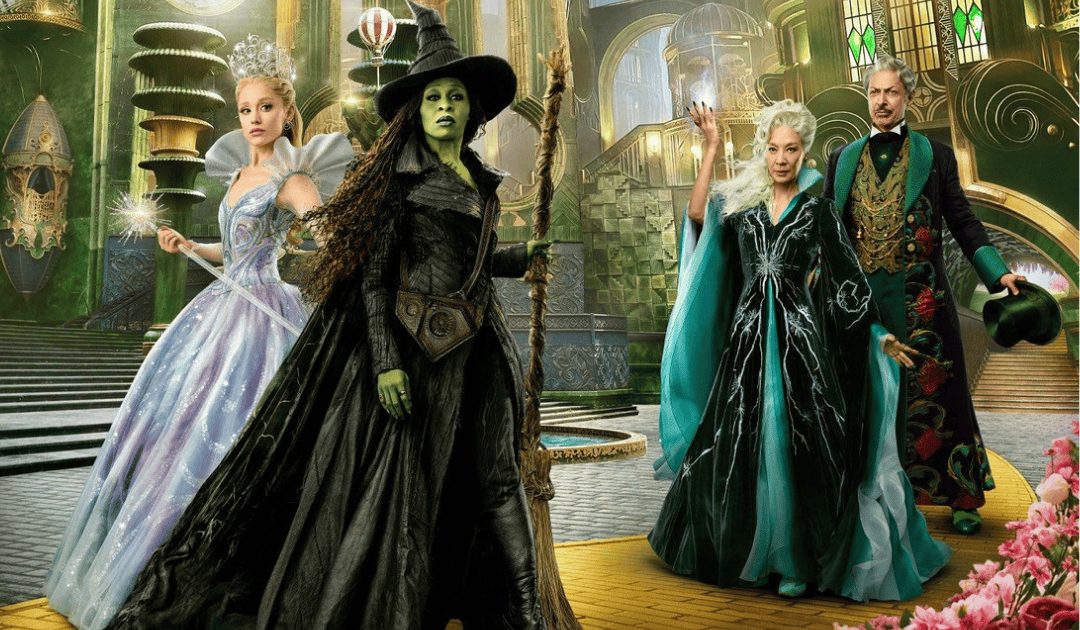
Do the Films Promote Witchcraft? But for a few notable scenes, there is limited focus on magic and sorcery in the films. The focus is primarily on the relationship between the main characters. Wicked and Wicked: For Good together make up a spin-off of the classic The Wizard of Oz, telling the origin story of two seemingly disparate witches: Elphaba, the green Wicked Witch of the West, and Glinda, the “good” witch. Glinda and Elphaba meet at Shiz University and initially loathe each other but eventually form a deep bond of friendship. Elphaba is apprenticed by headmistress Madame Morrible to learn to control her unique innate magical power through sorcery. Glinda dreams of being a sorcerer but seems to have no magical ability at all. One day, Elphaba is summoned to the Land of Oz to meet the Wizard. She convinces Glinda to join her. There, Elphaba discovers that she is merely a pawn in the Wizard and Madam Morrible’s wicked plan to oppress animals (specifically, rational animals who can speak). This revelation strikes her when the Wizard tricks her into performing a spell from a mysterious spellbook. The spell is cast upon the Wizard’s army of monkeys and causes wings to painfully erupt from their backs. Spiritually speaking, this is a considerably dark scene, especially when Elphaba utters the incantation. In Wicked: For Good two more similarly dark scenes occur when spells are being performed from the same book. In contrast to these uses of magic in the film being depicted as dark and negative, scenes such as Elphaba learning to fly on a broomstick seem to show that magic can also be used for good.
Beyond the films themselves, clips of actress Ariana Grande, who plays Glinda, went viral when in an interview she admitted to being “the witchiest witch.” She spoke of performing Tarot card readings on the set of Wicked and looking to astrology for guidance.2 What is especially interesting about this is the inherent notion that witches can be good, an idea presented in the original book The Wizard of Oz with Glinda the Good. Glinda is allegedly inspired by Baum’s mother-in-law, Matilda Joslyn Gage. Gage was a radical feminist activist who studied historical witch hunts and defended women accused of witchcraft.3 It is a valid concern that an ideology in which witches and witchcraft can be seen in a positive light is threaded throughout the iterations of the Oz stories, including the Wicked movies.
Profoundly Postmodern. I surmise that the Wicked story, in its various iterations, remains true to this postmodern culture and as such is meant to be an exploration of ideas rather than an attempt to advance specific ones. In fact, Gregory Maguire explains that the writing process was his way of thinking through the topic of good versus evil, since he had not formed conclusive opinions.4 Embedded in Maguire’s explanation is a postmodern assumption that one must form his own personal ideas about good and evil through exploration, rather than the biblical truth that such knowledge is revealed to humanity by God. Maguire also explains that he purposely stayed out of the process when his story was being rewritten as a musical. Since his story was an adaptation of another’s work, he felt he didn’t have the right to dictate how someone else would adapt his own work.5 Since many creative minds have been involved in the evolution of the stories of Oz, a variety of propositions have been made as to the main messaging of the Wicked films.
Some reviewers see the movies as primarily a commentary on racism and discrimination.6 In the films, Elphaba is an outcast because of her green skin color. Those who meet her have an immediate prejudice against her. Glinda, on the other hand, gains instant popularity through her privilege of being white, beautiful, and wealthy. It has been suggested that the films offer criticism toward white women who insincerely present themselves as allies to those who are in marginalized groups.7 This position is justified by pointing out that Glinda rarely supports Elphaba when it would actually cost her. For example, when Elphaba rejects the Wizard, Glinda chooses not to join Elphaba in order to remain in the Wizard’s good graces. Also, Glinda shallowly offers to change her name from “Galinda” to “Glinda” in a gesture of what she called “solidarity” with her animal professor who had been arrested. Presented as comedic, it is obvious in the film that she did this for attention and accolades. This is being compared to white women who make gestures of allyship with those who are marginalized but who refuse to do anything that would actually be costly.8
Others have found the Wicked films to be predominantly a political commentary. In fact, a CNN article named Wicked: For Good “one of the most political films of the year.”9 Reviewers note parallels in the story to the U.S. immigration conflicts, as well as the government’s use of propaganda to further its self-serving narratives. Many argue that the films expose the dangers of authoritarianism and fascism.10 The Wizard maintains his power not through upholding truth and justice, but through controlling the dissemination of information and using Elphaba as his scapegoat. Some commentators compare this to governments scapegoating marginalized groups, such as immigrants, people who identify as transgender, and Muslims.11
There is no doubt that criticism of authoritarianism has been embedded in the Oz stories from the very beginning. Dorothy’s arrival to Emerald City perfectly illustrates this in Baum’s original novel, The Wizard of Oz. Before entry through the gate into the city, Dorothy and her friends are forced to wear green-lens glasses which lock onto their faces. The city is not actually emerald, yet everyone there believes that it is because the Wizard of Oz commands that they wear the green glasses under the pretense that without them they will be blinded by the emeralds’ brilliance. The Wizard controls the peoples’ very perception of reality. Wicked and Wicked: For Good continue this messaging. The Wizard and Madame Morrible use propaganda and lies to control the people’s perception of reality.
In essence, the films explore the concepts of perception, truth, and authority. The audience is challenged to change their perception from what they thought was the real story in The Wizard of Oz movie and the book it was based upon in which the Wicked Witch of the West was presented as evil. Perhaps she was just misunderstood. This raises the question: can the truth ever be known? Is there always another perspective to consider? The messaging seems to be founded on the assumption that the answers to these profound questions can never be fully uncovered. Elphaba and Glinda’s final duet, a song called “For Good,” reflects on how their lives have changed and conveys that no one can know for sure whether that change was good.
Postmodern perspectives such as this are inherently contradictory, as one must affirm the truth that truth cannot be known. The movies follow this same inconsistency, for in their denial of objective truth and objective goodness as put forth in the song lyrics, the films clearly intend for the viewer to walk away knowing that Elphaba is righteous, Glinda has a good heart, and that Madame Morrible and the Wizard are truly wicked. Nevertheless, this attempted upheaval of objective truth in favor of validating everyone’s perspectives naturally leads to criticizing cultural norms, especially norms surrounding sexuality and gender.
Queer Themes. The word “queer” has several definitions. While it originally meant strange or odd, in today’s culture, it has become a general term that refers to a sexuality and/or gender identity that does not conform to sex and gender norms. According to Glinda actress Ariana Grande, “Oz is a very queer place, and has always been. Even from the L. Frank Baum books, it’s always been queer.”12 What Grande is presumably referring to is Baum’s frequent use of the word “queer” in his children’s book series about Oz. Whether or not LGBTQ+ ideology is purposely promoted through the Wicked films, the musical, the book, and the original The Wizard of Oz book series is, to me, unclear. What is clear, however, is that many people who identify as “queer” are resonating with what they see as “queer-coding” (subtle clues and nods to indicate a queer subtext) in the films.
It is important to separate the facts from subjective interpretation. It is true that many significant figures in the creation of all-things-Oz have claimed identities somewhere under the queer rainbow. A few examples include Judy Garland, who played Dorothy in The Wizard of Oz and has long been recognized as a “gay icon”;13 Gregory Maguire, author of Wicked: The Life and Times of the Wicked Witch of the West;14 and several actors in the Wicked films, including Cynthia Erivo (Elphaba)15 and Jonathan Bailey (Prince Fiyero).16 It is also true that some of these contributors have made suggestions as to the queer subtext of the story. Grande and Erivo positively affirm the possibility that their characters Glinda and Elphaba could fall in love. Grande even says her character might be “a little in the closet.”17 Without explicitly declaring the characters as definitely in a romantic relationship, Maguire suggested that in his book, it may be that Glinda and Elphaba had sex on the train on the way to Emerald City. He leaves the interpretation up to the reader’s imagination.18
I would argue that whether or not the writers and filmmakers intended to queer-code the Wicked movies, the messaging is not inherently queer. Those who push this interpretation see Elphaba’s story as a queer journey, citing examples such as: Elphaba is an outsider and outcast, and must learn to love and accept herself for who she is;19 both men and women are infatuated with Prince Fiyero;20 and the relationship between Elphaba and Glinda is seemingly stronger and more significant than even Elphaba’s romantic long-awaited relationship with Prince Fiyero.21 Fiyero’s flirtations with both men and women may be an attempt to normalize “queerness,” but it could also be argued that the point was to comedically depict just how attractive Fiyero was — he made even the men swoon!
I have noticed that Wicked is frequently used to promote LGBTQ+ ideology online. One reviewer for The Daily Beast writes, “The story of Wicked has become a resonant allegory for many marginalized communities, particularly the LGBTQ+. Elphaba’s story is one of ‘othering,’ as she’s ostracized for traits she cannot, will not, and should not change about herself.”22 The discerning believer notes the assumption that one’s sexual identity “cannot” and “should not” be changed. This is in every way ideological and is rooted in an unbiblical worldview. When a believer submits to Christ, he takes on the new identity given to him by God. One’s sexual and gender identity is informed by the biology God has created him with. The movies absolutely portray the life‘s journey of someone who is victim to prejudice and injustice, but those themes are broader than sexuality. People can be ostracized and marginalized for traits that don’t have to do with one’s sexual identity. I see no inherent reason to read “queerness” into the story.
To press upon this point, a popular theory about Elphaba and Glinda’s relationship needs addressing. Many Wicked fans insist the two characters are, in fact, lovers. One must ask the question: can’t Elphaba and Glinda just be dear friends? The insistence I have seen online to “queer” these characters and read romance into their friendship is quite a stretch. Love is not always sexual or romantic. Romans 12:10 reads, “Love one another with brotherly affection. Outdo one another in showing honor” (ESV). The Greek word translated as “love” in this verse is philia, and it depicts a type of love between close friends that is warm and affectionate, not sexual. A biblical example of this kind of relationship can be found in David and Jonathan (see 1 Samuel 18:1–3).
Unfortunately, it is culturally acceptable to promote exploration of one’s feelings to decide on a sexual identity. If a person has love and affection for a friend of their same sex, they might be encouraged to consider whether they are “queer.” Of course, there is no need for this. Affection does not equal romance or sexual attraction. It is unwise and unbiblical to open the door to sexual confusion, especially when there is a perfectly good option on the table: one loves his friend with a brotherly love. A queer reading of the Wicked movies is an option, but it is ultimately unnecessary.
How Wicked Is Wicked? The individual’s personal perception seems to affect how each person reads the messages within the films. Regardless, one thing the fans agree on is that the story succeeds at piercing the heart. Background knowledge of the preceding iterations helps to identify why there are so many different perspectives and interpretations. But when evaluating the movies themselves in isolation, some of the problematic ideology, such as queer themes, need not be read into the story. Ultimately, in my view, Wicked is about overcoming superficial differences and forming sincere friendships. And in that respect, Wicked is actually very good.
Alexa Cramer is a Christian apologist, writer, and podcast contributor for Mama Bear Apologetics. She has a B.A. in Communications and Film.
NOTES
- Wicked: The Untold Story of the Witches of Oz (musical), music and lyrics by Stephen Schwartz, book by Winnie Holzman, premiered on Broadway, October 30, 2003.
- See Zach Sang Show, “Ariana Grande | ‘Eternal Sunshine’ Track by Track Breakdown [Part 2],” March 12, 2024, YouTube, video 53:24, quotation at 49:25, https://www.youtube.com/watch?v=dEp1T8GKWaI.
- Zanita E. Fenton, “No Witch Is a Bad Witch: A Commentary on the Erasure of Matilda Joslyn Gage,” Southern California Interdisciplinary Law Journal 20 (2010): 21.
- See TuftsAlumni, “Gregory Maguire, AG90: What Inspired You to Write Wicked?,” February 23, 2015, YouTube, video 4:29, https://www.youtube.com/watch?v=680izhY_y2I.
- See GBH News, “WICKED Author Gregory Maguire on Bringing Oz to the Big Screen, Again,” April 10, 2024, YouTube, video 56:56, statement at 6:50ff., https://www.youtube.com/watch?v=siVPbCv8rH8.
- “When Black Girls Watch ‘Wicked,’ It Hits Differently,” Successful Black Parenting, January 7, 2025, https://successfulblackparenting.com/2025/01/07/when-black-girls-see-wicked/.
- See Chrissie, “Wicked: The Symbolism & Optics That Nobody Wants to Talk About,” December 7, 2025, YouTube, video 27:36, https://www.youtube.com/watch?v=LONM3OC3gQk.
- Crazy Stupid Podcast, “Wicked Review (2024) | Glinda’s Subtle Racism,” December 2, 2024, YouTube, video 27:37, https://youtu.be/e5yu4pyeRLA?si=_PhuKOqk6CpwVzOB.
- Dan Hechlng, “Wicked: For Good’ Is One of the Most Political Films of the Year,” CNN Entertainment, November 23, 2025, https://www.cnn.com/2025/11/22/entertainment/wicked-for-good-politics-immigration.
- See, e.g., Jen Chaney, “‘Wicked: For Good’ Arrives with a Message on Fighting Fascism,” MS NOW, November 22, 2025, https://www.ms.now/opinion/wicked-for-good-movie-fascism-message.
- See, e.g., Michael Woolf, “The New Movie ‘Wicked’ Is a Parable of Our Politics of Scapegoating,” Religion News Service, November 25, 2024, https://religionnews.com/2024/11/25/the-new-movie-wicked-is-a-parable-of-our-politics-of-scapegoating/.
- See GLAAD, “‘Oz Is a Very Queer Place’ Ariana Grande and Cynthia Erivo Talk to GLAAD About Wicked,” November 14, 2024, YouTube, video 4:04, quotation at 1:38, https://youtu.be/z5FBshrxuIA?si=zHnj1IKP9L9uOCO4.
- Rebecca Kumar, “Judy Garland,” Turner Classic Movies, May 12, 2022, https://www.tcm.com/articles/featured-actors/021613/star-of-the-month-judy-garland.
- Maxwell Kuzma, “The Father of ‘Wicked’ Is a Gay Catholic,” National Catholic Reporter, March 1, 2025, https://www.ncronline.org/culture/father-wicked-gay-catholic.
- Michele Theil, “Wicked Star Cynthia Erivo Explains Why She Keeps Her Love Life Private,” PinkNews, October 6, 2024, https://www.thepinknews.com/2024/10/06/wicked-star-cynthia-erivo-explains-why-she-keeps-her-love-life-private.
- Desiree Anello, “Cynthia Erivo Reacts to Wicked Costar Jonathan Bailey’s Sexiest Man Alive Title — and We Couldn’t Be Happier,” People, November 8, 2025, https://people.com/cynthia-erivo-reacts-to-wicked-costar-jonathan-bailey-sexiest-man-alive-title-11846331.
- See Gay Times, “Wicked Interview: Ariana Grande and Cynthia Erivo on ‘Gelphie’ and ‘Glinda in the Closet,’” November 21, 2024, YouTube, video 4:38, quote at 4:07, https://www.youtube.com/watch?v=G6gzsTBWWuk.
- Mathew Rodriguez, “Wicked Author Gregory Maguire Says Elphaba and Glinda’s Sexual Tension Was ‘Intentional,’” Them, December 9, 2024, https://www.them.us/story/wicked-gregory-maguire-elphaba-glinda-lesbian-intersex.
- Pat Mullen, “Is ‘Wicked: For Good’ Really What Queer and Trans People Need Right Now?,” Xtra Magazine, November 21, 2025, https://xtramagazine.com/culture/wicked-for-good-jon-m-chu-278128.
- James Kleinmann, “It’s Not Easy Being Green — Film Review: Wicked Part One,” The Queer Review, November 19, 2024, https://thequeerreview.com/2024/11/19/film-review-wicked-part-one/.
- Christina Tucker, “‘Wicked’ Has Always Been Queer,” Autostraddle, November 26, 2024, https://www.autostraddle.com/wicked-has-always-been-queer/.
- Eddie Mouradian, “The ‘Wicked’ Movie Is Even Gayer Than Anyone Could Have Imagined,” The Daily Beast, November 26, 2024, https://www.thedailybeast.com/obsessed/the-wicked-movie-is-even-gayer-than-anyone-could-have-imagined/.