Listen to this article (11:28 min)
Cultural Critique Column
This article was published exclusively online in the Christian Research Journal, volume 49, number 01 (2026).
When you support the Journal, you join the team and help provide the resources at equip.org that minister to people worldwide. These resources include our ever-growing database of more than 2,000 articles, as well as our free Postmodern Realities podcast.
Another way you can support our online articles is by leaving us a tip. A tip is just a small amount, like $3, $5, or $10, which is the cost of a latte, lunch out, or coffee drink. To leave a tip, click here
Honor your father and your mother, so that you may live long in the land the Lord your God is giving you.1
—Exodus 20:12
When someone tells you to consult mediums and spiritists, who whisper and mutter, should not a people inquire of their God? Why consult the dead on behalf of the living? Consult God’s instruction and the testimony of warning. If anyone does not speak according to this word, they have no light of dawn.
—Isaiah 8:19–20
Will artificial intelligence (AI) open up a portal to communicate with our departed loved ones (or others)? Might a personality be rendered digital through moving images and conversation so that one’s death is not the end of their interactive influence with the living? Let us first consider death and its effects on the living before answering this question.
Death Under the Sun. Most who have lived are now dead, billions of men, women, and children spanning millennia. Every city has its graveyard. All now living will die, unless Jesus comes first. With death comes deep loss to those still living under the sun as well as to the deceased. It was never put better than in the Book of Ecclesiastes.
So I reflected on all this and concluded that the righteous and the wise and what they do are in God’s hands, but no one knows whether love or hate awaits them. All share a common destiny — the righteous and the wicked, the good and the bad, the clean and the unclean, those who offer sacrifices and those who do not.
As it is with the good,
so with the sinful;
as it is with those who take oaths,
so with those who are afraid to take them.This is the evil in everything that happens under the sun: The same destiny overtakes all. The hearts of people, moreover, are full of evil and there is madness in their hearts while they live, and afterward they join the dead. Anyone who is among the living has hope — even a live dog is better off than a dead lion!
For the living know that they will die,
but the dead know nothing;
they have no further reward,
and even their name is forgotten.
Their love, their hate
and their jealousy have long since vanished;
never again will they have a part
in anything that happens under the sun. (Ecclesiastes 9:1–6)
All philosophies of life — secular and religious, from East to West — must give an account of life, death, and perhaps the afterlife, if the worldview permits. If not, then it must make do with mortality without immortality, with life that ends at death.
Because we were divinely made for community, friendship, family, and fellowship, the separation of death is usually a rupture, a breaking of a bond meant to be unbroken. We feel this even with pets, but how much more for a grandparent who dies old, as mine did, or a father who dies young at forty, as mine did?
Digital Necromancy. Now we are told that we can use AI to alleviate the pain of death and separation. “AI ghosts (also called deathbots, griefbots, AI clones, death avatars, and postmortem avatars) are large language models built on available information about the deceased, such as social media, letters, photos, diaries, and videos,” which are created and marshalled to interact with interested parties for a fee.2 One writer says that AI can eclipse the occult in reaching the dead: “To raise my father from the dead, I could have tried a medium, a Ouija board or an ectoplasm-detecting camera. But it’s 2025. I used artificial intelligence.”3
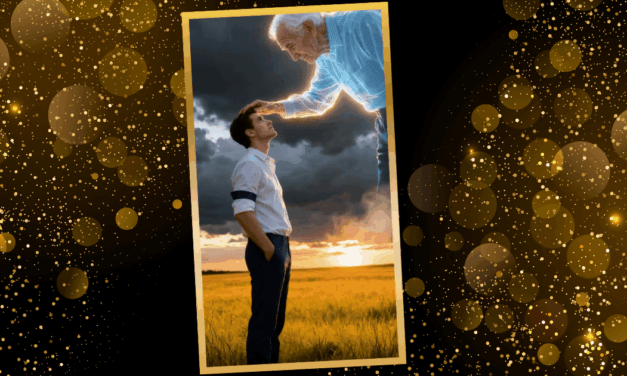
A moving advertisement shows a mother telling her pregnant daughter that the daughter can comfort her kicking preborn child by placing her hands on her womb while humming a comforting tune. We then see an image of the women talking to the toddler child, and then to him when he is about ten years old. Finally, the child becomes a father. The grandmother is the same age as in the first scene for all these conversations. She and the man are talking about his wife’s concern that her preborn baby is kicking a lot. The grandma gives the same advice to her grandson as she did to her daughter: the pregnant mother should put her hands on her womb and hum a calming tune to the baby. Then we find that the older woman had her image and voice recorded and put into an AI in order to simulate her responses to conversations after her death.4 It has been called “digital necromancy”5 or “interactive personality constructs of the dead.”6
This new AI technology allows for video of a person to be stored then redeployed after that person’s death through an avatar that speaks for the dead person. It is a deep fake that is known to be fake but is supposed to provide advice and solace, nonetheless. At the end of the advertisement, the grandson, in a moment of lucidity, says, talking to an image of his dead mother-in-law, “You would have loved this moment.” The virtual grandmother says, “Call anytime.”7 Some will contact the company to provide this service of digital solace through postmortem advice.
This desire to lessen the sting of death makes sense to mortals living under the sun and east of Eden. We yearn for continued contact and even conversation with our dead loved ones or others. What might Winston Churchill say about the Israel–Palestinian conflict today? Or what might John Coltrane say about the present state of jazz? We would love to know. But more personally, what might my father, who died at age forty in 1968, think about me and my accomplishments? What advice might he give to his only child?
A Biblical Perspective. The Bible warns us not to consult the dead in several places, particularly in Deuteronomy where God tells His people not to imitate the practices of the Canaanites. “When you enter the land the Lord your God is giving you, do not learn to imitate the detestable ways of the nations there. Let no one be found among you who sacrifices their son or daughter in the fire, who practices divination or sorcery, interprets omens, engages in witchcraft, or casts spells, or who is a medium or spiritist or who consults the dead” (Deuteronomy 18:9–11; see also Exodus 22:18; Leviticus 19:31, 20:6, 27).
After King Saul summoned the spirit of the prophet Samuel (1 Samuel 28:3–25), he was punished severely by God for his disobedience. Instead of repenting and seeking God, he sought the dead prophet in disobedience to God. As the prophet Isaiah warned, we should not consult the dead on behalf of the living but instead seek knowledge from God’s revelation in Scripture (Isaiah 8:19–20). Although the deceased Elijah and Moses appear with Jesus on the Mount of Transfiguration, they were not summoned by anyone, nor are we privy to any new information from them (Matthew 17:1–9). Thus, this supernatural event provides no justification for consulting the dead, as taught by spiritism.
God’s prohibition on literal necromancy — consulting the spirits of the dead — also bears on the digital necromancy offered by AI programs. First, there is no need for any information from the dead, since we have God’s living and active word at our disposal (Hebrews 4:12) and the Holy Spirit of truth to guide us (John 14:16–17). We also have our godly friends and the fellowship of the church to guide us in life. Digital necromancy takes us to the wrong place to find counsel and fellowship — to a world of pseudo-enchantment, the digital masquerade of the dead appearing to be alive for the sake of the living.
Second, we must face death in Christian terms. The writer of Ecclesiastes, whom I consulted above, viewed death grimly from the perspective of earth “under the sun.” What he said was not wrong but incomplete. The New Testament fills in the picture, both concerning the cause and cure of death. Human mortality occurs because of the Fall, the effects of sin on all humanity (Romans 5:12). “The sting of death is sin” (1 Corinthians 15:56). We grieve the loss of our loved ones to death, but we don’t grieve as those without hope, since we follow a resurrected Jesus Christ (1 Thessalonians 4:13–14). Yet death severs contact and leaves us with only memories, whether in mind or recordings of some kind. The sadness and loneliness can be overwhelming, as even the great apologist C. S. Lewis related in his lament, A Grief Observed (1961). But this is the sting of death in God’s world, a world still groaning in anticipation of its final redemption at Christ’s Second Coming (Romans 8:18–27). It is faith in the living Christ that lessens this sting of death, not AI impersonations.
Third, digital necromancy assigns to an impersonal computer program the challenging human work of memory, appreciation, judgment, and imagination. I have some vivid memories of my father, who died long ago. I also have photos and may be able to transfer to another medium some old home movies in which he appears. When my mother was alive, we would reminisce about him. She assured me long ago that he would be proud of my accomplishments. We sometimes spoke of my similarities to Dad — being opinionated, crusaders for our causes, good public speakers, prone to live large and be outspoken (sometimes too much so). I would rather think and reflect on my father than simulate a conversation. That time is long past.
To assign this work of reflection and judgment to an AI avatar is to cheapen the memory of our loved ones, to reduce them to algorithms. We exchange memory and tradition for video simulations. No matter how life-like they may seem, they depict the dead in a digital zombie existence. The representations, of course, have no consciousness. They aren’t saying anything, since they are not there as persons. Rather, a program is manipulating their images to speak based on digital guesswork.
Lastly, using the AI replica does not honor our deceased mothers, fathers, or anyone who has passed from this life to the next. We should honor all our elders and give honor to whomever it is due (Exodus 20:12; Leviticus 19:32; Romans 13:7). We honor them by remembering who they were, giving thanks for their gifts, and refusing to gossip about their real or alleged failures — a practice that has become popular with some authors, such as Frank Schaeffer, who has turned it into a sordid second career.8
The capacities of AI are growing at a rate often greater than the discernment needed to evaluate them logically and biblically. Exhilaration and hype often exceed sober judgment. However, for the Christian, digital necromancy is a clear case of a technology to be refused for something far better — God’s truth about life, death, and the afterlife (2 Timothy 3:15–17).
Douglas Groothuis, PhD, is Distinguished Professor at Cornerstone University and Cornerstone Theological Seminary.
NOTES
- All Bible quotations are from NIV.
- Craig Klugman, “Griefbots Are Here, Raising Questions of Privacy and Well-Being,” The Hastings Center, July 1, 2024, https://www.thehastingscenter.org/griefbots-are-here-raising-questions-of-privacy-and-well-being.
- David Berreby, “Can Digital Ghosts Help Us Heal?” Scientific American, November 18, 2025, https://www.scientificamerican.com/article/can-ai-griefbots-help-us-heal.
- Calum Worthy (@CalumWorthy), “Baby Charlie,” X post, November 11, 2025, https://x.com/CalumWorthy/status/1988283207138324487.
- See, e.g., Michael Mair, “‘Digital Necromancy’: Why Bringing People Back from the Dead with AI Is Just an Extension of Our Grieving Practices,” Phys.Org, September 19, 2023, https://phys.org/news/2023-09-digital-necromancy-people-dead-ai.html.
- See, e.g., Adam Buben, “Digital Replacement of the Dead: A Legitimate Worry?,” Philosophy and Technology 38, no. 90 (2025), https://doi.org/10.1007/s13347-025-00913-5.
- Worthy, “Baby Charlie.”
- See especially Frank Schaeffer, Crazy for God (Carroll and Graf, 2007). See my review, “Franky Plays Schaeffer Card, Again,” The Pearcey Report, December 2007, https://www.pearceyreport.com/archives/2007/12/franky_plays_sc_1.php.