Listen to this audio (20:49 min)
Fringe Files Column
This article was published exclusively online in the Christian Research Journal, Volume 49, number 02 (2026).
When you support the Journal, you join the team and help provide the resources at equip.org that minister to people worldwide. These resources include our ever-growing database of more than 2,500 articles and Bible Answers, as well as our free Postmodern Realities podcast.
Another way you can support our online articles is by leaving us a tip. A tip is just a small amount, like $3, $5, or $10, which is the cost of a latte, lunch out, or coffee drink. To leave a tip, click here.
If we were to characterize in one word the Chinese way of life for the last two thousand years, the word could be “Confucian.” —de Bary, Sources of Chinese Tradition1
Growing up, I always thought that Eastern religions were basically all the same, kind of the way people in the West tend to lump Christian denominations into the same bucket. It was my understanding that Confucianism was only slightly different from Taoism, Buddhism, and Hinduism. I was wrong. As I’ve studied Eastern worldviews over the years, I’ve learned that important differences exist between the various religions and philosophies, and studying just one doesn’t mean you’ll understand them all. Although they may be connected in numerous ways, they are not the same.
Like many in the West, my earliest impressions of Confucianism came primarily through popular culture, from film and television references to books and blogs. In the West, we tend to think of Confucius (K’ung Tzu) as a Yoda-type who speaks in pithy maxims to drive home an important point. As a child it was common to hear statements like, “Confucius says…” followed by something funny, like “Man who throws clock watches time fly.” However, Confucianism is much more philosophically and culturally rich than brief sayings about life. For more than 2,500 years, Confucian thought has shaped families, education, and government across East Asia. Yet many Christians reduce Confucianism to ancestor worship or rigid moralism. Before we evaluate it, we need to understand it. This article will highlight Confucianism’s history and its core philosophical teachings, as well as its differences with other Eastern worldviews and how Christians can respond.
Confucianism’s History
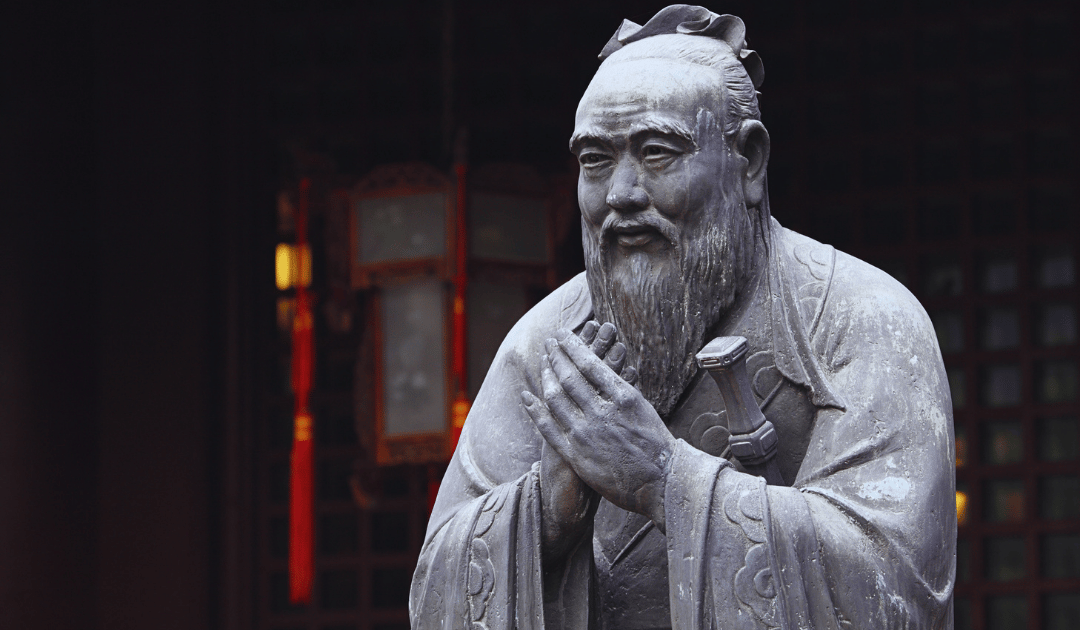
Confucianism is based on the teachings of Confucius (551–479 BC), China’s most popular philosopher and sage. His father died when Confucius was young, so he was primarily raised by his mother. Confucius got married at nineteen, and he had a couple of different jobs as a young adult, including as a governmental bookkeeper and a farmhand. Even as a teenager, he “gained a reputation for knowledge and propriety,”2 which served him well, especially after his mother died.
Perhaps you’re wondering how he became one of the most influential philosophers from such humble beginnings? Well, that story begins with his entry into politics. Because of his caste, he had access to higher-level families. His place in history was during a time of instability, both politically and morally, and he started sharing various teachings about ethical principles. In time, he was given a lower-level political position and ultimately was appointed Minister of Crime. During his leadership, he was interested in diplomacy and generally opposed violence and war. He eventually resigned but continued to try to influence various states of China through his teachings. In his late sixties he returned to his homeland and primarily focused on teaching. He died in his early seventies.
As historians have noted about Confucius, he is best known not for his political prowess but for his desire to educate “all young men with a thirst for knowledge.”3 Because of his persistence as a moral teacher, his impact on Chinese culture over the centuries cannot be overstated. As Confucian scholars Ch’u Chai and Winberg Chai explain, “His doctrines were accepted as state teachings; his works were regarded as the Canonical Books to be studied by students in school; his cardinal virtues were regarded as the norms of society.”4 Although these observations primarily describe Confucianism’s influence throughout imperial Chinese history, Confucian values continue to shape Chinese culture today. This is especially noteworthy in modern China, where the state is officially atheist and only five religions are formally recognized: Buddhism, Taoism, Christianity (Protestantism and Catholicism), and Islam. Confucianism is not among them because in the East it is considered more than a religion; it’s an ethical way of life. This isn’t to say that religions don’t form the basis for the way we live, but Confucians don’t have a deity or a formal church structure; instead, they focus on how they live through their relationships with others, aiming to achieve social harmony rather than salvation. In the West, we’re much more likely to call Confucianism a religion, but that isn’t often the case in the East. It’s not necessarily wrong to refer to it as a religion, but we should be aware that not everyone believes it to be so.
Mencius (The Second Sage). Mencius (c. 371–281 BC) was part of Confucius’s fourth generation of disciples and called the Second Sage. Not only did Mencius live by Confucius’s teachings, but he also worked to create more disciples and spread Confucianism far and wide. In fact, his teachings are now considered foundational within the philosophy. Perhaps his most famous doctrine has to do with innate goodness, which differed slightly from Confucian theory. Mencius believed that “human nature is good” and that “humans have within them the inclination to the good and the innate capacities for goodness.”5 This differed from Confucius’s belief that “humans were similar by nature but separate by practice.”6 In other words, while Confucius thought humanity could be trained to be good, Mencius believed humans were born with an inherent propensity toward goodness. He illustrated this through a story about a child who fell into a well. Anyone witnessing such an event would instinctively feel “alarm and compassion,” not to win the favor of anyone but out of their natural tendency toward goodness. For Mencius, this reaction demonstrates one of the “four beginnings” or innate moral “sprouts” present in every person. He identified these four beginnings as compassion, shame, modesty, and moral discernment:
The mind’s feeling of pity and compassion is the beginning of humaneness (ren); the mind’s feeling of shame and aversion is the beginning of rightness (yi); the mind’s feeling of modesty and compliance is the beginning of propriety; and the mind’s sense of right and wrong is the beginning of wisdom. Human beings have these four beginnings just as they have four limbs….When we know how to enlarge and bring to fulfillment these four beginnings that are within us, it will be like a fire beginning to burn or a spring finding an outlet.7
Despite some differences in thought, Mencius carried forward most of Confucius’s ideas, which are discussed in much more detail below.
The Five Classics and the Four Books. The Five Classics and the Four Books offer a clear perspective on Confucian philosophy, morality, politics, and history. They are a compilation of Confucius’s thoughts, as well as those of his disciples, and they were put together about 300 years after Confucius’s death. These texts have historically been used as textbooks for civil service examinations in China.
The Five Classics are formational in Chinese culture, and they were first referenced in the Book of Zhuangzi,8 a Taoist book. The Classics included the Books of Odes, Documents, Rites, Changes (the I Ching), and Spring and Autumn Annals. Collectively, these are considered “the primary source of the Confucian Learning which unfolds interrelated visions for human life: poetic, historic, politic, metaphysical and ethical.”9
In addition to the Confucian Classics, the Four Books offer direct and didactic foundations for Confucianism. They include Great Learning, Doctrine of the Mean, the Analects, and Mencius. The foundational text of the Four Books is widely considered the Analects, which scholar Xinzhong Yao describes as “the primary source by which we know Confucius and his teaching.”10 The Analects emphasize morality, ethics, and proper governance. A good comparison for Westerners would be the Proverbs in the Bible, which are a collection of short pieces of advice and wisdom for a life well lived. Taken together, the Five Classics and the Four Books create a “full picture of Confucianism,”11 emphasizing harmony and morality throughout.
Core Beliefs of Confucianism
Within Confucianism exist three primary virtues: jen, yi, and li. Jen is “the Confucian ideal of cultivating human relations, developing human faculties, sublimating one’s personality, and upholding human rights.”12 In simple terms, jen is about how we treat others. Yi, on the other hand, is righteousness and acting appropriately, and it comes from Mencius rather than Confucius. As Chai and Chai explain, “jen is the proper basis for inner feelings, while yi is the proper way of guiding external conduct.”13 Finally, li is what Confucians believe is “a great ethical system” that maintains social order and is the norm of social conduct and propriety.14 The Confucian view of family, which will be discussed below, derives from li. Confucius emphasized five primary relationships, and if those relationships are handled correctly by all involved, the society would function correctly.15 Those relationships are: father-son, elder brother-younger brother, husband-wife, elder-junior, and ruler-subject. As Winfried Corduan explains, “Each partner in each relationship is expected to exhibit one particular attitude.”16 For example, a father should show his son kindness, while the son should demonstrate filial piety toward the father. A ruler should be benevolent, while a subject should be loyal. If these roles are firm, social order is correct, and harmony can be attained.
It is also important to note that Confucian “harmony” is a rich concept referring to a structured relational order formed by hierarchy, role ethics, social obligations, and ritual propriety, grounded in a broader moral order associated with heaven (Tian, discussed below). In this sense, harmony denotes the proper alignment of relationships within family and society according to established roles and duties.
Tian and Shen (Heaven and Divinity). From the outset, you should know that mortality and morality are of paramount importance in Confucianism, which means that God and the afterlife take a backseat.17 Keep in mind that most Confucians are non-theists; that is, they do not believe in a personal God like Christians do. Instead, Confucians focus on the harmony found between the three dimensions of heaven, earth, and humanity.18 They believe that there should be oneness, especially between heaven and humankind.
Tian (heaven) is of high value in Confucianism, but finding a single definition of it is difficult. Ultimately, there is agreement that it has “multidimensional implications,” including metaphysical, spiritual, and moral.19 Put more simply, heaven is of utmost importance and guides Confucians in their everyday living. In fact, heaven may be most like the God that Christians would understand — though not personal. As Yao explains, “Heaven is believed to have the power to determine the course of the natural and the human world.”20 Heaven is what guides Confucians to make good, moral choices, bringing humanity into harmony with the divine consciousness and spirit (shen). With regard to the afterlife, then, Confucians don’t dwell on it. They also don’t have a concept of salvation. Instead, the lasting impact of a person (and their harmony with others and heaven) is paramount. This may help explain why ancestral veneration is so important.
Ancestor Veneration. I grew up in a predominantly Catholic and Hispanic area and celebrating Día de los Muertos (the Day of the Dead) was common. The holiday, which is traditionally celebrated on November 1 and 2, centers around the remembrance of deceased loved ones. Altars were typically put up in homes, and family and friends often spent that day reminiscing and visiting gravesites. When I initially heard about ancestral veneration in Chinese culture, I thought it might be similar to Día de los Muertos. It is not. In fact, as scholar Laurence G. Thompson explains, ancestor veneration in China reflects a fundamentally different religious structure centered on the family itself:
The family is, of course, important in Western religion, with its sacrament of marriage, its commandment to honor the parents, and its duty to raise the children in the true faith. But the religious character of the Chinese family goes far beyond these aspects. This character, developing out of something called ancestor worship, makes religion in China more a family matter than an individual choice. Family religion is basic; individual and communal religion are secondary.21 (emphasis in original)
In other words, family is at the core of Chinese religion, and ancestral veneration is fundamental, not simply a ritual performed once a year. Certainly, in Confucianism, “reverence and glorification of one’s ancestors is seen not only as one’s greatest duty but also one’s greatest honour.”22 Confucius felt that “filial piety is not merely a domestic virtue; it diffuses its influence through all actions of life, whether moral, political or social.”23 Loving one’s parents first leads to loving everyone else (jen).
As professor of Asian studies Jeffrey Richey explains, ancestral veneration is a lifelong pursuit, and it is evidenced by “communication with, and sacrifice to one’s deceased relations.”24 This type of filial veneration originated in ancient times but continues into modernity. One important aspect of this is the funeral rite itself, which is often a hurried event in Western culture, but is much more involved in Eastern culture. According to Thompson, the funeral is the “binding force that holds together the family and the clan as a religious corporation through the generations.”25
As for sacrifices, traditionally, animals were offered, but today, food, wine, and money are often tendered to honor the deceased family members. These rituals can be performed in the home, at the gravesite, or in Confucian temples or ancestral halls. Ultimately, the family is important, which makes sense in a philosophy centered around harmony and social order.
Confucianism Compared with Other Eastern Worldviews
Just as we don’t want people to assume all Western religions and worldviews are the same, we shouldn’t assume that all Eastern philosophies and religions are the same. While there are certainly intersections between the different belief systems, each bears its own unique ideas about humanity, morality, and the afterlife. Let’s consider two primary Eastern religions, Taoism and Buddhism, and compare them briefly with Confucianism.26
Taoism. One core similarity between Taoism and Confucianism is the fundamental ideal of The Way. Yao explains that Confucians “focus on how to apply the principles of Heaven and Earth to human life and society and on how to find the Way to maintain or restore the harmony of the world.”27 The Way for Confucians prioritizes morality and proper relationships, while Taoism’s Way is primarily about simplicity and non-striving (wu wei). Confucians are generally more rigid about rituals and social order, while Taoists have a more go-with-the-flow attitude that emphasizes harmony with the natural order.28
Buddhism. Originating in India with Gautama Buddha, Buddhism focuses mostly on suffering, desire, detachment, and nirvana (liberation and freedom). Buddhists generally believe that humanity suffers because it desires too much, so humans must follow a particular path to wake up and be set free. Confucians, with their emphasis on social harmony, are generally less individualist in that they care greatly about family and society. Buddhism stresses personal freedom and detachment from societal roles. This doesn’t mean that Buddhists don’t care about relationships or that Confucians don’t care about inner cultivation — it just means that their priorities are often different.29
Confucianism in the West
Although fewer than one percent of Asian Americans are Confucian, ten percent say they resonate with the philosophy because of their culture or ancestral background. The percentage goes up when we look at Chinese Americans specifically — one percent claim Confucianism as their religion and twenty-four percent feel connected to the worldview.30 Despite the low number of practicing Confucians, we still see evidence of the philosophy in education and ethics and in celebrations like the Chinese New Year (or Spring Festival). One particular adaptation of Confucianism in the West is Boston Confucianism, an intellectual movement of the late twentieth century. Adherents often blend a Western religion, like Christianity, with Confucianism. Their goal, it seems, is to remove the belief that Confucianism can only exist in East Asia.31
The Christian Response
It could be easy to shrug off worldviews like Confucianism because so few people in the West practice it, however, I always think about the possibility of meeting someone from a particular religion or philosophy and how that interaction might go. This doesn’t mean that I think Christians should be experts in all religions, especially with thousands in existence worldwide, but my perspective is that if you expect to meet someone who practices a particular religion, you should have an underlying understanding of what they believe. Then, you can ask thoughtful questions about their specific beliefs. All that to say, if you think you might interact with a Confucian, the Christian response is fairly straightforward.
Christians believe in a personal, eternal God, while most Confucians do not believe in a god at all. Christians also believe salvation from sin is necessary in order for humanity to reconcile and restore our relationship with God. Confucianism relies on works to achieve social order, which only comes through properly aligned human relationships, ritual practice, and ethical self-discipline. It focuses on avoiding social disorder and maintaining harmony in every level of life. As Christians, we believe that humans are sinners separated from God, which is why we live in a world of condemnation, corruption, and death. The Bible describes not merely human moral weakness but spiritual deadness (Ephesians 2:1–3), meaning that what is needed is not simply moral improvement, but new life in union with Christ, given by divine grace rather than self-cultivation alone. Confucians, though, don’t really have a concept of salvation or a need for a savior. It’s hard to see a need for a savior if humanity can achieve order and harmony without one. The problem is that sin exists whether we recognize it or not.
Moreover, as Corduan explains, filial piety actually stands as a barrier to conversion to Christianity for many Confucians: “Many Chinese find it impossible to give up what they would consider their most important obligation.”32 What’s more, leaving Chinese religion and philosophies can result in broken family relationships. Christians need to be understanding of this. That said, truth is still truth, even if we must lose everything for it. Christ explained this to His followers and disciples in Matthew 10. As Christians, we must keep in mind that Christ embodies perfect filial obedience to the Father and thus, perfectly fulfills filial piety. In other words, Christianity positively fulfills honor toward parents and family.
The good news is that we continue to see Christian church stability in China,33 which is evidence that at least some are open to the gospel. If you meet a Confucian, ask them what they believe, with a willingness to listen and learn. Then, respond with gentleness and respect (1 Peter 3:15). Show them how the gospel offers harmony with a personal, Creator God through the atoning sacrifice of Jesus, God’s only Son. Emphasize the relationship between God the Father and Jesus Christ, noting that God wants to be in community with us, too (John 17:21). Further, tell them that the Bible prioritizes harmony, also, especially among the body of Christ (see Psalm 133:1 and Romans 12:16). Finally, we find this in Paul’s epistle to the Colossians: “Bear with one another and forgive any complaint you may have against someone else. Forgive as the Lord forgave you. And over all these virtues put on love, which is the bond of perfect unity” (3:13–14). Christianity not only offers a place of peace, love, and joy, but unity with the Father through His Son. There is hope, and as Christians, we should exclaim that hope far and wide, even into the East. Indeed, it is good news!
Lindsey Medenwaldt is an assistant professor of business and economics at Northwestern College and the author of Bridge-Building Apologetics (Harvest Apologetics, 2024) and co-author with Douglas Groothuis of the forthcoming book, What If Jesus Is Right? (Tyndale Elevate, 2026). She holds a master’s in apologetics and ethics from Denver Seminary, a JD from St. Mary’s School of Law, and a master’s in public administration from Midwestern State University.
NOTES
- William Theodore de Bary and Richard Lufrano, eds., Sources of Chinese Tradition: From 1600 Through the Twentieth Century, vol. 2, 2nd ed. (Columbia University Press, 1999), 15.
- Ch’u Chai and Winberg Chai, eds. and trans., The Sacred Books of Confucius and Other Confucian Classics (University Books, 1965), 21.
- Chai and Chai, The Sacred Books of Confucius, 22.
- Chai and Chai, The Sacred Books of Confucius, 22.
- Xinzhong Yao, An Introduction to Confucianism (Cambridge University Press, 2000), 75
- Yao, An Introduction to Confucianism, 74.
- William Theodore de Bary and Irene Bloom, eds., Sources of Chinese Tradition: From Earliest Times to 1600, vol. 1, 2nd ed. (Columbia University Press, 1960), 129.
- To learn more about the Zhuangzi and its author, Zhuang Zhu, see Lindsey Medenwaldt, “Taoism: The Way to Ultimate Reality? A Christian Response,” Christian Research Journal, last updated April 29, 2026, https://www.equip.org/articles/taoism-the-way-to-ultimate-reality-a-christian-response/.
- Yao, An Introduction to Confucianism, 57.
- Yao, An Introduction to Confucianism, 65.
- Yao, An Introduction to Confucianism, 47.
- Chai and Chai, The Sacred Books of Confucius, 1.
- Chai and Chai, The Sacred Books of Confucius, 2.
- Chai and Chai, The Sacred Books of Confucius, 3.
- Winfried Corduan, Neighboring Faiths: A Christian Introduction to World Religions, 3rd ed. (IVP Academic, 2024), 447.
- Corduan, Neighboring Faiths, 447.
- Alonzo Gaskill, “Does Confucianism Have a God?” Patheos, last accessed May 6, 2026, https://www.patheos.com/answers/does-confucianism-have-a-god.
- Yao, An Introduction to Confucianism, 139.
- Yao, An Introduction to Confucianism, 142
- Yao, An Introduction to Confucianism, 143.
- Laurence G. Thompson, Chinese Religion: An Introduction, 5th ed. (Wadsworth Publishing Co., 1996), 31.
- Yao, An Introduction to Confucianism, 199.
- Chai and Chai, The Sacred Books of Confucius, 326.
- Jeffrey Richey, “Rites and Ceremonies,” Rituals and Worship, Patheos, last accessed May 7, 2026, https://www.patheos.com/library/confucianism/ritual-worship-devotion-symbolism/rites-and-ceremonies.
- Thompson, Chinese Religion, 45.
- Confucianism, Taoism, and Buddhism are considered the “Three Teachings” (sanjiao) in East Asia. They are distinct yet historically intertwined with one another.
- Yao, An Introduction to Confucianism, 139.
- For an introductory overview and evangelical Christian critique of Taoism, see Medenwaldt, “Taoism.”
- For an evangelical Christian worldview critique of Buddhism, see J. Isamu Yamamoto, “Buddhism in North America (Part One): The Buddha and What He Taught,” Christian Research Journal, Spring 1994, https://www.equip.org/articles/buddhism-and-christianity-the-buddha-and-what-he-taught/; for a helpful worldview comparison between Buddhism and Christianity focusing on ultimate human purpose, see Daniel McCoy, “Why Do We Exist? Opposite Answers from Buddhism and Christianity,” Christian Research Journal 46, no. 01/02 (2023), https://www.equip.org/articles/why-do-we-exist-opposite-answers-from-buddhism-and-christianity/.
- “Confucianism and Daoism Among Asian Americans,” Pew Research Center, October 11, 2023, https://www.pewresearch.org/religion/2023/10/11/confucianism-and-daoism-among-asian-americans/.
- For more about Boston Confucianism, see “Boston Confucianism,” The Pluralism Project, Harvard University, accessed May 7, 2026, https://pluralism.org/boston-confucianism.
- Corduan, Neighboring Faiths, 461.
- Conrad Hackett, “China’s Christian Population Appears to Have Stopped Growing After Rising Rapidly in the 1980s and ’90s,” Pew Research Center, December 12, 2023, https://www.pewresearch.org/short-reads/2023/12/12/chinas-christian-population-appears-to-have-stopped-growing-after-rising-rapidly-in-the-1980s-and-90s/.