Listen to this article (17:56 min)
Ethical Apologetics Column
This article was published exclusively online in the Christian Research Journal, Volume 49, number 02 (2026).
When you support the Journal, you join the team and help provide the resources at equip.org that minister to people worldwide. These resources include our ever-growing database of more than 2,500 articles and Bible Answers, as well as our free Postmodern Realities podcast.
Another way you can support our online articles is by leaving us a tip. A tip is just a small amount, like $3, $5, or $10, which is the cost of a latte, lunch out, or coffee drink. To leave a tip, click here.
A Christian apologist recently posted a question to followers on Facebook about Christians deconstructing their faith, moving from believers to non-believers through a process of reassessing their core beliefs. One man commented at length about his deconversion or deconstruction process. Much of his process fell into the category of autobiographical information; he went years praying for God to demonstrate His existence through direct intervening action to no avail. God never answered his prayers, never encouraged him, never provided a shred of evidence concerning God’s reality.
The phenomenon known as “the dark night of the soul,” a term coined by 16th-century Spanish monk John of the Cross, has been a major focus of mine. The frustration and pain associated with feeling distant from God, having lost an intimacy with God, significantly impacts more people than I imagined. The sense that God is absent in our trials, particularly for someone fighting to maintain their faith, can be spiritually debilitating. They often draw one of two conclusions: God is indifferent to my struggle, or God is not there. The former is often harder to accept than the latter.
The deconstructed Christian landed on an extreme position. In his view, the world looks exactly as we would expect it to look if God did not exist at all. Prayer has the same effectiveness in dealing with sickness and hardship as no prayer. Nothing happens in the world that is consistent with a world where God exists. Every philosophical and historical argument for theism and Christian particularism fails. A more qualified statement could be understandable; the author sees no evidence, the author remains unconvinced, but he made no qualifications. Instead, he makes universal negative statements. No prayers are ever answered, no supernatural events have ever occurred, and no philosophical arguments succeed in demonstrating anything toward the truth of theism.
The Rules. The Aristotelian square of opposition illustrates the basic relationships between categorical propositional statements, declarative statements that are either true or false. Any statement of a Universal Negative, No S are P, is contradicted by the Particular Affirmative statement, Some S are P. Contradictory statements (contradictories) are statements that can’t both be true, and they can’t both be false (see Figure 1).
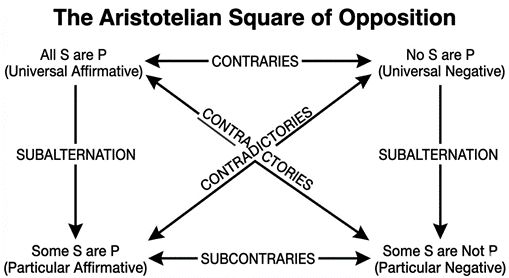
Figure 1 (Generated with Google AI)
It isn’t necessary to prove All S are P (Universal Affirmative), or all prayers are heard and answered, to defeat the Universal Negative statement that no prayers are heard and answered. If some prayers are answered, even if one prayer was ever answered, then the Universal Negative is defeated. This is precisely why professional academics might seem hesitant to make absolute claims — they are difficult to defend. In light of this, universal claims about theism and Christianity must be evaluated on those terms. God’s intervention doesn’t need to be constant or ubiquitous. It can be rare, focused, subtle, and even singular in nature, and the absolute claims fail. The defender could retreat to a more qualified Particular Negative, Some S is Not P, but that statement avails him nothing. The more limited statement “God doesn’t exist because some prayers are not answered” makes no sense. He must demonstrate “NO prayer is ever answered.” This is an all-or-nothing game.
Does Prayer Have the Same Results as No Prayer? Unanswered prayers are common and, in and of themselves, prove nothing. It could be true they are the result of God not existing. It could also be true that our requests are unanswerable by God for any number of reasons. As C. S. Lewis wrote during his grief over the death of his wife: “Can a mortal ask questions which God finds unanswerable? Quite easily, I should think. All nonsense questions are unanswerable. How many hours are there in a mile? Is yellow square or round? Probably half the questions we ask — half our great theological and metaphysical problems — are like that.”1 They could be nonsense prayers, selfish prayers, or prayers for ineffectual ends. Perhaps an omniscient God knows honoring the request would not produce the desired results. As a pastor told me, unanswered prayers are still a form of communication and not proof there is no God.
Skeptics and Miracles. Skepticism over miracles isn’t groundbreaking. When I was younger, I strongly identified with 18th-century Scottish philosopher David Hume’s position: anyone reporting a miracle is more likely to be mistaken or lying, as it is beyond our common experience that miracles occur. One of the first cracks in the foundation of my atheism came when I realized miracles may be beyond my common experience and David Hume’s common experience, but other people reported supernatural events all the time. By adopting Hume’s position, I wasn’t disproving the existence of supernatural events but dismissing any need to consider them at all. This approach may be comforting, but it certainly isn’t intellectual. Examination of miracle claims is necessary at some point.
There have been efforts to study the effects of prayers on psychological, emotional, and medical health. The results do not support the view that prayer never produces significant results, as those who pray tend to enjoy greater health in the former two categories.2 Detractors could argue that prayer has a placebo effect, but then they find themselves in the position of explaining away exactly what they claim does not exist, positive results from prayer.
The detractor could point to studies like the one published in 2006 which ran ten years of data where outcomes of 1,800 patients were evaluated after being prayed for by congregations and prayer groups of various denominational backgrounds. This study claimed that the prayers of strangers offered no positive effects on medical outcomes.3 The problem with such a study, however, is that it commits a category error. Applying the scientific method to test personal divine intervention is silly. It assumes that God must respond to prayers, some of which were scripted by the designers of the study. The only thing those studies definitively prove is that God, if He does exist, has no interest in participating in a study under those conditions. Given the impossibility of testing God like any other natural phenomenon — the impossibility of predicting when and why God may intervene — perhaps it is better to evaluate so-called miraculous events which have already happened. After all, if prayer has no causal efficacy, then we should not expect random chance to generate clusters of instantaneous, medically unexplainable recoveries that coincide with prayer.
New York Times columnist David French shares his story of suffering from advanced ulcerative colitis and experiencing a sudden and miraculous recovery after a praying friend called him in his hospital room and told him he was healed. His condition has never returned as of this writing.4 The Catholic Church submits candidates for sainthood into an evaluation process which includes verifying miracles prayed through their name as intercessors before God. The miracles purportedly demonstrate that the prospective saint holds a special place among the departed. Most of the miracles are medical in nature and are required to meet certain criteria including that the miracle must have occurred immediately in response to the prayer, the healing must be enduring, and the event must be beyond the medical explanation of secular doctors chosen by the Catholic Church as devil’s advocates. They take an equally strict approach to verifying reported miracles at the Marion shrine of Our Lady of Lourdes in France, where more than 7,000 healings have been claimed but only 72 have been recognized as miraculous by the Catholic Church.5
Christian scholar Craig Keener published a two-volume treatment of this subject called Miracles: The Credibility of the New Testament Accounts. He lists miracle stories throughout history and around the world. Stories of spontaneous healings of heart defects,6 terminal cancer,7 a clubbed foot,8 third degree burns,9 blindness,10 a broken ankle,11 paralysis,12 and even death.13 Many of these happened in the presence of medical professionals, and some with accompanying scans and X-rays to testify to the original pathology. It’s possible for the skeptic to read these accounts and remain unconvinced, but only if the entire evaluative process is managed through the lens of a worldview that dismisses the idea of miraculous intervention from the outset. We must meet the burden of proof necessary to sustain a Universal Negative claim. Every single account of the hundreds shared by Keener must be a mistake or a deception. If even one truly qualifies as a miracle, an event that defies explanation in a materialistic naturalistic worldview, then the categorical negative statement fails. Evidence suggests some prayers produce miraculous results. It simply is not true that all prayers are ineffectual.
God Answering Some Prayers May Not Be a Comfort. The idea that God answers prayers with direct supernatural action on rare occasions may not be the comfort it first appears. For some people, those who deconstruct their faith, those who abandon their faith, and those who walk through the dark night of the soul, a protracted period of feeling the absence of God is agonizing. God is willing to do miracles for others but not willing to show me that He is there when I need Him most, when I am growing convinced my world is falling apart, my faith is waning, or my hope is dying. It may be preferable to believe the silence indicates absence rather than perceived indifference. The God who will let me battle my way through the mess of my spiritual life to find a deeper and more enduring relationship with Him is hard to accept.
The Absolute Failure of Philosophy Revisited. The deconstructed critic claims every philosophical argument in support of theism fails. This reeks of hubris. Consider a quote by William Lane Craig discussing the broad category of cosmological arguments: “The cosmological argument is a family of arguments that seek to demonstrate the existence of a Sufficient Reason or First Cause of the existence of the cosmos. The roll of the defenders of this argument reads like a Who’s Who of western philosophy: Plato, Aristotle, ibn Sina, al-Ghazali, Maimonides, Anselm, Aquinas, Scotus, Descartes, Spinoza, Leibniz and Locke, to name but some.”14
Add to that list the modern philosophers of religion who have updated and expanded on that work, such as Alvin Plantinga, Richard Swinburne, Alexander Pruss, and Craig himself. Craig spent decades defending the kalam cosmological argument in debates against skeptical PhDs on college campuses, while publishing numerous articles and books. Plantinga and Swinburne are giants in the field of philosophical religious studies and respected throughout the academic world. Would the critic have us believe they weighed the claims of all these intellectual luminaries and demonstrated they all failed?
The question “Why does something exist rather than nothing?” may be the most fundamental philosophical question. That single question confronts us with a host of problems, including how to explain creation out of nothing, the problem of an infinite regression of physical events in a beginningless universe, and how to determine the first cause in an unfolding series of physical causes and effects. A plethora of philosophers of religion argue these issues are best resolved by appeal to a creator. These philosophers forward sound philosophical arguments to make the case that the best explanation for existence as we experience it is a personal, necessary, transcendent, unfathomably intelligent and powerful creative being — in other words, God. Similarly, philosophers of religion forward sound and persuasive arguments to show how the Christian worldview best explains the moral nature of human community, the apparent fine tuning of the initial conditions of the universe which makes life possible, the remarkable conditions which exist on Earth allowing for intelligent life to thrive, and the mystery of human consciousness.
Some of the greatest minds in history wrestled with these arguments precisely because they are difficult. Anyone claiming the universal failure of every iteration of every category of argument by every great philosopher arguing that aspects of existence point to a creator rushes in where angels fear to tread. To remain unconvinced is defensible, but to proclaim every argument fails demonstrates a staggering lack of epistemic humility. Further, contrasting the original claim, it is obvious many brilliant people use philosophy to argue that the world looks exactly as we would expect it to look if theism were true.
Historical Arguments. Black Holes cannot be seen — not directly. Our vision and technology detect visible light frequencies, gamma rays, ultraviolet, infrared, and radio waves, but the gravity of a black hole is so powerful that even light cannot escape. We find black holes by looking for things like the event horizon, the boundary beyond which the escape velocity is faster than the speed of light, which causes a visible red edge as everything collapses into the singularity. Black holes reveal themselves by their effects — how they impact everything around them.
We can no more see the resurrection of Jesus through direct observation than we can see a black hole, so we gather evidence to explain why history unfolded as it did. The universal negative claim that all historical arguments for the resurrection of Jesus fail would require every strategy for arguing for the resurrection of Jesus as a historical event being either demonstrably false or less likely to be true than alternative explanations for the surrounding series of events.
Historian and theologian N. T. Wright argued that the best explanation for the change in the first-century Jewish understanding of resurrection — the transformation from it being understood as a universal event at the end of days to something that could happen to Jesus alone within history — was the Easter event. The bodily resurrection of Jesus upended prior beliefs.15 Michael Licona and Gary Habermas argue that there are a set of accepted core historical facts: Jesus’s burial, the empty tomb, the claims of the early church to have seen a resurrected Jesus, and the conversions in the early church (particularly those of James the brother of Jesus and Saul of Tarsus, two people who came to believe in the divinity of Jesus only after the resurrection). The best explanation of those facts is the historical resurrection of Jesus. They call this the Minimal Facts argument. Lydia McGrew counters with the Maximal Data argument, claiming the New Testament authors demonstrate consistency in seemingly unimportant details across the four gospel accounts, the book of Acts, and Paul’s epistles, as well as convey reliable cultural and geographical knowledge of first-century Israel. They have proven to be trustworthy, therefore their testimony of the resurrection of Jesus should not be dismissed due to a philosophical rejection of miracles. Others argue the original disciples’ universal commitment to the truth of the resurrection under torture and threat of execution is best explained by a genuine shared belief in a resurrected Jesus. They saw Him alive.
The skeptic may reject all of this, but what he cannot claim is they are all demonstrably false or that other explanations for the early belief in a resurrected Jesus and all concomitant events are more plausible. The sheer volume of information anyone would have to address to make such a universal claim is mind boggling, and the ability to defeat all resurrection arguments would be a staggering academic achievement. It is far more likely the critic is unfamiliar with all the literature on this subject than it is they have a knockdown argument against the evidence for the resurrection of Jesus.
If Jesus resurrected Himself, if He defeated death, and the impact of that event left its mark on history, then arguments for the exclusive truth of Christianity over other beliefs endure. As I once heard Wright say in a presentation, if Jesus was resurrected, all the rest is just rock and roll.
Conclusion. None of this is intended to trivialize the experiences of people who claim to deconstruct their faith. Reconsidering our views is healthy. The point is that claiming the world looks exactly as we would expect it to look if there were no God and all prayers are equally unanswered is demonstrably false. It is impossible in this limited space to enumerate the centuries of work cataloging miraculous claims associated with prayers, the miracles at Lourdes, the many accounts in Keener’s books, or two thousand years of philosophical and historical arguments from a wide array of philosophers and faith traditions. This essay defends a simple proposition; it is true that the world is full of people praying to God and receiving no answer. Other stories abound as well. Stories about people who suffer less depression through prayer, heal faster through prayer, and see unremitting and incurable diseases vanquished through prayer. Stories of brilliant people who think deeply about our world and see God as a necessary explanation for many facets of our existence. I don’t know exactly what I am to conclude when God doesn’t answer my prayers, but it is a step too far to conclude that His silence and my resulting pain indicate His non-existence.
Jay Watts is the founder and president of Merely Human Ministries, Inc., an organization committed to equipping Christians and pro-life advocates to defend the intrinsic dignity of all human life.
NOTES
- C. S. Lewis (1961), A Grief Observed (Harper One, 1989), 81–82.
- Rob Whitley, “Prayer and Mental Health,” Psychology Today, December 3, 2019, https://www.psychologytoday.com/us/blog/talking-about-men/201912/prayer-and-mental-health; Ying Chen, Tyler J VanderWeele, “Associations of Religious Upbringing with Subsequent Health and Well-Being from Adolescence to Young Adulthood: An Outcome-Wide Analysis,” American Journal of Epidemiology 187, no. 11 (2018): 2355–2364, https://academic.oup.com/aje/article/187/11/2355/5094534.
- Herbert Benson, Jeffery A. Dusek, Jane B. Sherwood et al., “Study of the Therapeutic Effects of Intercessory Prayer (STEP) in Cardiac Bypass Patients: A Multicenter Randomized Trial of Uncertainty and Certainty of Receiving Intercessory Prayer,” American Heart Journal 151, no. 4 (2006): 934–42, https://doi.org/10.1016/j.ahj.2005.05.028.
- David French, “I Believe in Miracles. Just Not All of Them,” The New York Times, November 2024, https://www.nytimes.com/2024/11/14/opinion/christianity-spirituality-psychedelics-trump.html.
- Caroline De Sury, “New Miracle Confirmed from Lourdes Sanctuary,” Catholic Review, April 17, 2025, https://catholicreview.org/new-miracle-confirmed-from-lourdes-sanctuary/.
- Craig S. Keener, Miracles: The Credibility of the New Testament Accounts (Baker Academic, 2011), 430–32.
- Keener, Miracles, 435.
- Keener, Miracles, 463.
- Keener, Miracles, 440–41.
- Keener, Miracles, 510–22.
- Keener, Miracles, 440.
- Keener, Miracles, 438, 522–36
- Keener, Miracles, 575–79.
- J. P. Moreland and William Lane Craig, Philosophical Foundations for a Christian Worldview (InterVarsity Press, 2003), 465.
- N. T. Wright, “Christian Origins and the Resurrection of Jesus: The Resurrection of Jesus as a Historical Problem,” N. T. Wright Online, https://ntwrightpage.com/2016/07/12/christian-origins-and-the-resurrection-of-jesus-the-resurrection-of-jesus-as-a-historical-problem/.