Listen to this article (11:58 min)
Theological Trends Column
This article was published exclusively online in the Christian Research Journal, Volume 48, number 02 (2025).
When you support the Journal, you join the team and help provide the resources at equip.org that minister to people worldwide. These resources include our ever-growing database of more than 2,500 articles and Bible Answers, as well as our free Postmodern Realities podcast.
Another way you can support our online articles is by leaving us a tip. A tip is just a small amount, like $3, $5, or $10, which is the cost of a latte, lunch out, or coffee drink. To leave a tip, click here.
(Editor’s Note: This article contains spoilers for the live-action film Snow White.)
Snow White
Directed by Marc Webb
Written by Erin Cressida Wilson, adapted from the fairy tale told by Jacob and Wilhelm Grimm
Produced by Jared LeBoff, Marc Platt, Russell Allen, Ben Howarth, Callum McDougall
Starring Rachel Zegler, Gal Gadot, Andrew Burnap
Walt Disney Studios, 2025
Feature Film (rated PG)
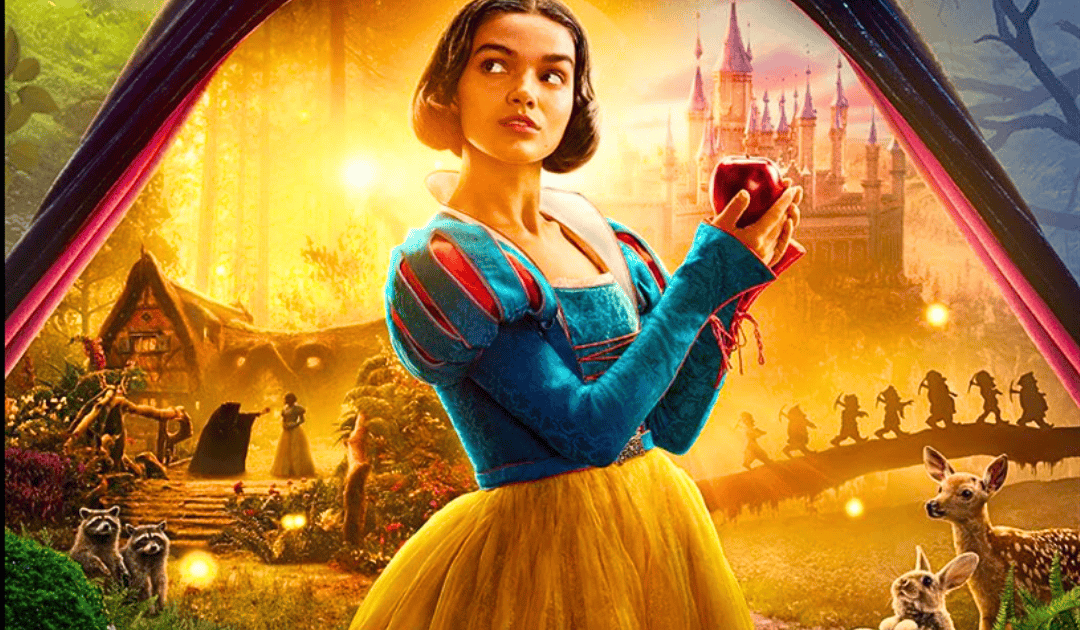
“I just want to be the fairest of them all,” menaces the Evil Queen, played by Gal Gadot in Disney’s live-action remake of Snow White.1 The scene is shadowy. The Queen looms over Snow White, played by Rachel Zegler. Fair, you see, can mean both beauty and just dealings with other people. Disney, perhaps, expected this play on words to amaze the viewer, but the line falls flat. Later, traipsing around the magical forest with the Bandit Jonathan, played by Andrew Burnap, Snow White attempts to musically spar with him over the question of fairness. Zegler is clad in an ill-fitting approximation of the iconic Snow White costume — lurid yellow skirt, blue-green bodice, and stiff sleeves. The song is cut short when the Queen’s guards show up and Jonathan takes an arrow meant for Snow White. This act of supreme self-sacrifice does not appear to rattle her in the least, or cause her any particular grief.
Nearly three years ago, Zegler caused an enormous backlash against the film after shooting had almost been completed by announcing to the public that “All of Andrew’s scenes could get cut. Who knows? It’s Hollywood Baby,” and this version wouldn’t be “weird, weird,” encumbered by a creepy prince who rescues the princess.2 Instead, Snow White would become “the leader she knows she can be.”3
What fascinates me is that Disney did very little, at first, to restrain Zegler, but did attempt multiple rewrites so that the final product feels like a patchwork of conflicting ideological commitments.4 Why didn’t Disney stick with the original script for the live-action remake? Or, finding themselves mired in controversy, why not start over with a more coherent artistic vision? Not being privy to the inner workings of Hollywood, I can’t say for sure. But I do think the film represents an uncomfortable moment in time. The dueling narratives combined with Disney’s attitude towards their audience show a profound cultural and spiritual shift in American life.
The Apple of Fairness. It is widely agreed that Rachel Zegler can at least sing and that Gal Gadot — the evil stepmother — is at least beautiful. On the whole, however, Disney’s effort was barely adequate. Zegler handled herself reasonably well vocally, and Gadot did her best to be menacing, her natural beauty tempered by dated and cheap costuming. The problem, for me, was that Zegler and Gadot appeared to have no chemistry, and neither did any of the other characters.
And this I take to be because Disney placed their full narrative weight on an assumption of shared cultural knowledge without demonstrating or deepening any of it. The trope of a prince and princess who find each other against the odds of evil magic, wicked stepmothers, and bitter death is an ancient script written upon the Western soul. When little girls put on big fluffy dresses and stand in line to meet their favorite princess at Disney World, their little hearts are struck, as with a tuning fork. They thrill to a world they intuitively understand. They know that it is special to occupy a position of love and exultation, that the clothes represent affection and belonging, that the good always triumphs over the bad.
Disney depends on this narrative for their films to increase their billion-dollar market share, and yet, at an intuitive level, they don’t believe it anymore. Instead, they want the heroine to be special for who she is in herself, and not because of her relationships to other people. Her dominance over others and the natural world is the most important thing about her. She is full of power, though with very little majesty and only a thimbleful of love.
This shift in narrative focus robs the very rich symbols that drive the story towards its longed-for resolution of their meaning and power. They become husks of themselves. The apple, for example, that Snow White takes and eats in the original story, for viewers even vaguely familiar with the Bible, offers a potent moment of symbolic recognition. Here is a beautiful young girl in the security of a lush garden beset by an enemy who hates her and desires her destruction. Snow White is deceived and eats the fruit, causing the hearts of all who love her to break apart. And yet, at the crucial moment, when all is lost, a man from a far country rides up and raises her back to life.
By contrast, in the new live-action Disney remake, the apple is present, but not as a symbol that points, recognizably, to the Christian gospel. Instead, it is simply a sign of sharing. In the beginning of the film, the town celebrates a festival of pie. Snow White can be seen in a kitchen heaped with apples, baking. Why is she, a small princess, single-handedly baking pie for the whole town? It is unclear. When the evil queen arrives and sends the king off to be killed in war, the villagers may have no more pie. The queen won’t share any of her food with them. Later, in the forest, the Bandit, Jonathan, eats an apple and sings about people sharing with each other. He is not for “fairness,” but Snow White is. They fall in love anyway, in a sort of half-hearted, emotionless way. Finally, at the end, the wicked stepmother arrives with a poisoned apple and Snow White is persuaded to take a bite. The apple represents equity and fairness at first, and death later, but that’s about as far as it goes. It has no particular relationship to the narrative, except as a vestigial reminder that, in the old one, Snow White ate a poisoned apple.
Whistle While You Rush. It is widely reported that even before filming had begun, Peter Dinklage criticized Disney’s plans to make a film with “dwarves.”5 A little person himself with a substantial and acclaimed acting career to his credit, he couldn’t understand why Disney would be so regressive. It is believed that Dinklage’s outrage precipitated one of the many rewrites. The Dwarves were replaced by a band of ruffians of various heights and ethnicities. A promotional picture was released and the public revolted. Why couldn’t they be dwarves? What was Disney’s problem? Disney responded by writing the Dwarves back in. In an effort to save time and heartbreak, though, the little creatures were generated by CGI. The result was, to put it mildly, horrifying. The heads of all the dwarves are far too large, and both too human and not human enough, producing an Uncanny Valley sensation.6
The progress of the movie is so rushed that Snow White doesn’t get to know anyone along the way and is changed by no encounters with any other character. Each action she takes is frictionless. She easily teaches Bashful to whistle. She easily frees Jonathan from the palace gate where he’s been tied. She easily persuades the palace guards not to kill her at the end by remembering their names and professions. In fact, every action taken by almost everyone is, in the words of brilliant movie critic Ryan George, “Super easy, barely an inconvenience.”7
The general feel of the film overall, and each scene, is one of clutter and hurry. No sense of delight, fear, satisfaction, or wonder is permitted to develop and grow. The colors are a cinematic mess. One of the young people who agreed to accompany me to the theater for our ‘hate watching’ adventure emerged from the darkened theater into the golden afternoon sunlight, kicking up her heels. With a gentle and mocking laugh, she said of Snow White: “I have all the primary colors on me in bright array.”
And No One Waited in Line. When all the filming was over, Zegler conferred a few more public relations nightmares upon the film. In August of 2024, she tweeted “Free Palestine”8 in spite of her co-actor, Gal Gadot, being an Israeli citizen. This was followed, a few months later, by a message to all Trump voters that she desired they “never know peace.”9 Disney assigned her a social media “guru” to “vet any posts before the film’s March 21 bow.”10 Later, video emerged of a teary Zegler comparing herself to the Winged Victory in the Louvre, whom thousands of people stand in line to see every year.11 When the movie was released in theaters, she posted a clip of herself watching the film, screaming with delight as her name appeared in the final credits. The theater appeared to be empty.12
And so, I must return to my initial questions: why did Disney do this to themselves? To have built an empire over 80 years, launched by the treasured original animated 1937 film, and then to throw it all away in a sort of slow-motion cinematic trainwreck — why? Wasn’t there plenty of time along the way to back up and try again? I wish I had real answers to these questions, and perhaps they will emerge in the months and years ahead.
I do have one theory. It is as though Disney itself is the story we are watching unfold. Standing on the outside, observing some beloved person or society or enterprise slowly and persistently self-immolate is one of the most uncomfortable experiences of being a human. You stand biting your fingernails, watching it go by on the screen, ready to scream with frustration. It is an experience I have all the time when I am reading the Old Testament, watching the “heroes” of my faith fall into ruin and trouble.
For this is the other narrative structure undergirding all human civilizations — that sin and pride gradually bring every institution and civilization to ruin. A dramatic example of this is the life of Samson. He might be the closest biblical personality to someone like Ms. Zegler than anyone else I can think of. He is born as though under a star, called by God before his birth to lead and judge Israel. He was endowed not with beauty, but with strength. He is supposed to exercise some measure of control over himself, but he never manages it. Whatever he feels in the moment is his governing principle. In arrogance, he takes everything personally. The final scene of his life — humiliated, blind, ruined, enslaved — ought to be the end. And yet he makes it into the New Testament “Hall of Faith.”
“And what more shall I say?” asks the writer, “For time would fail me to tell of Gideon, Barak, Samson, Jephthah, of David and Samuel and the prophets — who through faith conquered kingdoms, enforced justice, obtained promises, stopped the mouths of lions, quenched the power of fire, escaped the edge of the sword, were made strong out of weakness, became mighty in war, put foreign armies to flight” (Hebrews 11:32–34 ESV). The reader pauses in astonishment because all of these people failed, often at the crucial moment, to be faithful. Indeed, some of the people named in Hebrews feel like anti-types. The way they function in the narrative is to set into pictorial relief the promised Savior.
Jesus is nothing like Samson. And the old Snow White is nothing like the new one. Both make me long for the true thing, the story that displays a Kingdom set upon a hill to which all unhappy and wicked people may ascend, not through their own powers, but because a King came down to rescue and help them. Disney tried really hard not to tell this story, but in the end, in the most ironic and scandalous way, they themselves demonstrated its inescapable truth. Now pass me the popcorn while I watch and wait for someone to come along and save them.
—Anne Kennedy
Anne Kennedy, MDiv, is the author of Nailed It: 365 Readings for Angry or Worn-Out People, rev. Ed. (Square Halo Books, 2020). She blogs about current events and theological trends on her Substack, Demotivations with Anne.
NOTES
- Snow White, directed by Marc Webb, written by Erin Cressida Wilson, adapted from the fairy tale told by Jacob and Wilhelm Grimm, Walt Disney Studios, 2025.
- “WEIRD: Snow White actress says there’s a ‘different approach’ to the remake,” Larry O’Connor (@LarrywithLarryOConnor), Townhall, YouTube, August 14, 2023, https://www.youtube.com/shorts/rOasZrTskQA.
- “Rachel Zegler and Gal Gadot on Bringing a New Modern Edge to ‘Snow White,’” Variety, YouTube, September 10, 2022, https://youtu.be/2RVg3yetTE4?t=120.
- Tatiana Siegel, “Inside Disney’s ‘Snow White’ Fiasco: Death Threats, Beefed-Up Security and a Social Media Guru for Rachel Zegler,” Variety, March 25, 2025, https://variety.com/2025/film/news/snow-white-death-threats-zegler-social-media-guru-1236347433/.
- “Peter Dinklage Criticizes Disney’s ‘Snow White and the Seven Dwarfs’ Remake,” Entertainment Tonight, YouTube, January 26, 2022, https://www.youtube.com/watch?v=hdEekedAwRU.
- Jon Brady, “Snow White and the Seven Virtue Signals: How Disney Fairytale Turned into a Nightmare Fall Out Between Stars Rachel Zegler and Gal Gadot over Their Entrenched Opinions on the Israel-Palestine Conflict,” The Daily Mail, March 27, 2025, https://www.dailymail.co.uk/news/article-14542445/snow-white-rachel-zegler-gal-gadot-israel-palestine.html.
- Ryan George, “Snow White Pitch Meeting,” Pitch Meeting, YouTube, March 27, 2025, https://www.youtube.com/watch?v=x0nSFVT-hs0.
- Rachel Zegler (@rachelzegler), “and always remember, free Palestine,” X, August 12, 2024, https://x.com/rachelzegler/status/1823146134769893534.
- End Wokeness (@EndWokeness), “Disney’s Snow White (Rachel Zegler) says she hopes harm befalls Trump and all his voters,” X, November 13, 2024, https://x.com/EndWokeness/status/1856779822682574854.
- Tatiana Siegel, “Inside Disney’s ‘Snow White’ Fiasco: Death Threats, Beefed-Up Security and a Social Media Guru for Rachel Zegler,” Variety, March 25, 2025, https://variety.com/2025/film/news/snow-white-death-threats-zegler-social-media-guru-1236347433/.
- End Wokeness (@EndWokeness), “Disney’s Snow White (Rachel Zegler) has a lot of talent. How do you make an apology video this insufferable?” X, November 20, 2024, https://x.com/EndWokeness/status/1859344286283710639.
- 12 Internet hall of fame (@InternetH0fF), “Rachel Zegler watching Snow White in an empty theater by herself,” X, March 31, 2025, https://x.com/InternetH0F/status/1906617558607745257.