Listen to this article (11:36 min)
Cultural Apologetics Column
This article was published exclusively online in the Christian Research Journal, Volume 48, number 04 (2025).
When you support the Journal, you join the team and help provide the resources at equip.org that minister to people worldwide. These resources include our ever-growing database of more than 2,500 articles and Bible Answers, as well as our free Postmodern Realities podcast.
Another way you can support our online articles is by leaving us a tip. A tip is just a small amount, like $3, $5, or $10, which is the cost of a latte, lunch out, or coffee drink. To leave a tip, click here.
[Editor’s Note: This review contains spoilers for
Guillermo del Toro’s Frankenstein on Netflix.]
Frankenstein
Directed by Guillermo del Toro
Screenplay by Guillermo del Toro
Based on Frankenstein by Mary Shelley
Produced by Guillermo del Toro, J. Miles Dale, and Scott Stuber
Starring Oscar Isaac, Jacob Elordi, Mia Goth, and Christoph Waltz
Feature Film (R)
(Netflix, 2025)
It’s safe to say that few works of literature have proven to be as enduring (or as prophetic) as Mary Wollstonecraft Shelley’s Frankenstein; or, The Modern Prometheus.1 Written in 1818 by a teenager amid the intellectual warp and woof of the Romantic era, Shelley’s gothic tale anticipated the pressures and anxieties faced by the modern world with uncanny precision. Long before the rise of ChatGPT and artificial intelligence, CRISPR-Cas9 and biotechnologies, or the twentieth-century industrial machine, Frankenstein, as a novel, told a new version of the Promethean myth that examined the tension between human creativity and moral responsibility, asking whether the pursuit of knowledge, when divorced from virtue, could lead to creation or only to ruin.
In the two centuries since its publication, Shelley’s myth has become a kind of cultural scripture in and of itself, retold in every age of technological wonder and dread. Scientists, artists, writers, and filmmakers alike return to it because it tells a mythic story that transcends any one time or place or culture. It goes straight back to the question humans were faced with in Eden (see Genesis 1–3) — the question of forbidden knowledge. It speaks to the perpetual unease of progress, the sense that our works, our inventions, may one day outgrow us, become unwieldy, become the very things that destroy us.2 Now, as Guillermo del Toro takes up the story in his long-anticipated adaptation, he is grafted into a lineage of storytellers that includes the likes of James Whale and Terence Fisher, who grapple with what Shelley foresaw: that the true horror of Frankenstein is not so much the monster’s grotesque form as it is the mirror it holds up to the monster’s creator.
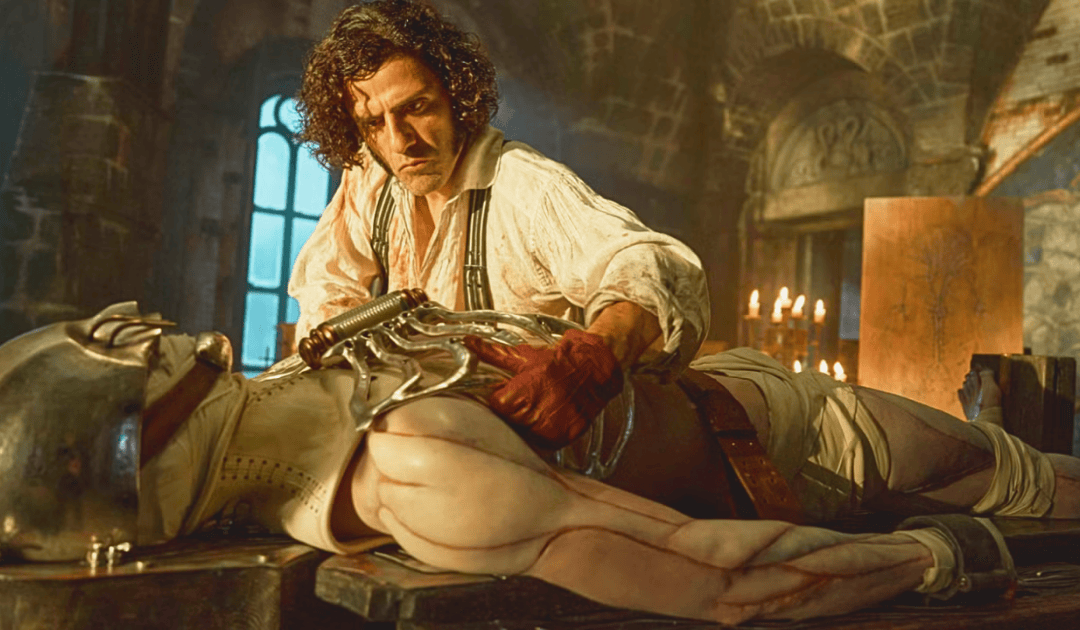
The Perfect Director. Guillermo del Toro has, in some respects, been circling Frankenstein (2025) his entire career. From the tragic innocence of the faun in Pan’s Labyrinth (2006) to the doomed romance of The Shape of Water (2017), there is a sense in which the shadow cast by the lumbering monster of Shelley’s imagination darkens almost every frame of his filmography. For more than two decades, Frankenstein has been his great unmade film, and it’s not difficult to see why — few contemporary directors have treated monsters with the same reverence that del Toro does.
This is due largely to his upbringing, which was steeped in Mexican Catholicism.3 His movies often employ the language and iconography of saints and sinners, and his creatures often bear the stigmata of their creators, at once victims and reflections of very human sin. The worlds he creates tend to be profoundly incarnational, in which matter is charged with meaning, which is perhaps why his lenses frequently linger on the flesh — the body as a site of both horror and holiness.
It’s within that theological vision that Frankenstein finds a new interpreter. Del Toro understands that Shelley’s creation is a cautionary tale about hubris, as well as a meditation on the image of God defaced and remade by human hands. His adaptation, then, is less about reanimation in the scientific sense, and more about resurrection in the moral and spiritual one, about the perennial struggle to love the thing we have made, and to see, within its ruin, the faint outline of our own soul.
If there is one thread that has quietly bound del Toro’s body of work together, it is his preoccupation with fathers and the children who inherit their failures. His stories are haunted by absent or broken patriarchs, and this, of course, is also tied to his upbringing.4 In this, Frankenstein is almost tailor-made for him, as Shelley’s novel is as much a story about a father who recoils from the life he has made as it is a parable of science run amok.
Fathers and Sons. In a sense, Victor Frankenstein is the prodigal son of Enlightenment rationalism, a child of a cold intellectual father who prizes reason over affection. The Enlightenment, after all, was an age that enthroned reason as the highest virtue, representing a major epistemological shift that sought to banish mystery and emotion in favor of logic and empirical truth.5 Nature was no longer a realm of divine wonder, but something closer to a mechanism meant to be dissected and understood. Human progress became synonymous with control — the belief that, through the proper application of knowledge, humankind could perfect itself and its world. Shelley’s novel emerged as something of a Romantic counterpoint to that idea. In Victor, she envisioned the hubris of the human intellect, the lonely child of a movement that had learned to explain everything but had forgotten emotion and (most importantly) love.
In Frankenstein the novel, Shelley gives us a lineage of estrangement: Victor’s father is distant and moralizing, offering correction but never warmth. Victor internalizes this model of parenthood and repeats it in grotesque form. In giving life to his Creature, he is son and father at once — imitating the detached creation of the Enlightenment deity while reenacting his own father’s neglect. His horror at the monster’s appearance is the moment the cycle begins to repeat, the moment the sins of the father are visited upon the son.
This becomes del Toro’s on-ramp to the version of the story he seeks to tell. He has long understood that horror, at its best, is a kind of art of empathy. His monsters are not content to be simple villains; rather, they are akin to wounded children reaching out for guidance and love. His Frankenstein places this idea front and center, becoming a culmination of a lifelong meditation on the strangeness of paternity, and how creation demands responsibility, and how love withheld can turn even the miraculous into something monstrous.
Fire and Ice. It is in the film’s final moments, when Victor (Oscar Isaac) is broken and near death and seeks forgiveness from the Creature (Jacob Elordi), that del Toro’s Frankenstein reveals the full measure of its humanity. In Shelley’s novel, reconciliation remains forever out of reach. Victor dies unrepentant, having vowed to continue hunting the monster, consumed by the same obsession and pride that gave rise to his tragedy. The Creature, discovering his maker’s corpse, laments in despair, as his creator’s death robs him of purpose: “Farewell, Frankenstein! If thou wert yet alive and cherished a desire of revenge against me, it would be better satiated in my life than in my destruction….Blasted as thou wert, my agony was still superior to thine, for the bitter sting of remorse will not cease to rankle in my wounds until death shall close them for ever.”6
The novel’s closing lines, in which the Creature “was soon borne away by the waves and lost in darkness and distance,” leave us with an image of exile, the monster as a being condemned to wander, unseen and unloved, until even the memory of him fades.7 It’s an ending of loneliness, a closing of the circle of alienation that defined both Victor and the Creature.
Del Toro breaks that circle.8 Very few of the monster’s atrocities in the book are carried out here. And Victor, in his last moments, finally sees in his creation a reflection of his own capacity for both cruelty and compassion. He seeks forgiveness, and the Creature, in turn, forgives him. It’s the kind of ending that could (and perhaps does) come across as sentimental, though it’s worth pointing out that del Toro’s monster is not the Creature of Shelley’s book. The framework of the narrative in del Toro’s retelling has made this ending possible because the Creature was never shown to be as monstrous as its original incarnation. Here, both Victor and the Creature are victims of the same longing to be seen and loved, and this mutual forgiveness transforms the narrative into something different, but not entirely wrong. Where Shelley’s Enlightenment tragedy ends in cold isolation, del Toro’s version contains a faint, redemptive warmth. It does not end in darkness and distance, but in the light of dawn, and the Creature’s act of mercy restores what Victor’s science could never give him.
This shift speaks volumes about del Toro’s ethos as a storyteller. Time and again he returns to the idea that salvation comes through compassion, where horror is not so much abolished as it is transfigured. Shelley’s cold warning becomes, in del Toro’s hands, a plea for mercy. It comes at the expense of collapsing the novel’s dynamic between the man and the monster, but it nevertheless serves to make a point.9
The Final Word. Whatever else might be said, Frankenstein feels like a deeply personal triumph for Guillermo del Toro. It is, quite simply, a beautiful film. Sumptuously lit, painterly in its compositions, given the kind of texture and color that could come from a director of only del Toro’s caliber. The film feels, in its totality, like a kind of exorcism, an artist wrestling with the demons that have haunted his work for decades.
And yet the question lingers: is del Toro’s ending better than Shelley’s? Perhaps that is the wrong question. His film is not Shelley’s novel. What he has made is less an adaptation than an interpretation, a meditation on the same moral terrain through a different lens. Shelley wrote from within the shadow of the Enlightenment, and her instinct was prophetic: to warn that human mastery unmoored from moral responsibility would birth monsters we could not control. The past century has proven her right. Her Creature runs amok because it must; it is the inevitable consequence of creation without compassion and knowledge without wisdom. Del Toro’s impulse is decidedly pastoral by comparison. His Creature forgives, and Victor lowers himself to be the necessary recipient of that forgiveness. The monster’s face, whether raging or forgiving, is still our own.
Still, Shelley’s darker vision may be the truer mirror. Ours remains an age intoxicated by the dream of control — of machines that think, of life edited in the genome, of consciousness uploaded to the cloud. Her warning is one we have yet to heed: that the desire to be as gods carries within it the seed of our own undoing. In Genesis 3, the serpent’s temptation is not merely to attain knowledge, but to become like Yahweh, to know and to create and to command without accountability. Del Toro’s film offers a mercy Shelley could not, but her admonition still stands.
Scripture is not naïve about the nature of evil. The biblical texts recognize that what damns humanity is not ignorance, but the will to power disguised as enlightenment. Evil, in the biblical imagination, is rarely monstrous at first glance. It is rational, creative, and, ultimately, self-justifying. It builds towers to heaven; it names itself progress; and it wears the face of Victor Frankenstein.
That is why Shelley’s original story still lingers. Her boldness lies in letting Victor die unrepentant. There is no moral restoration, no final reconciliation. It is a biblical irony, of course, the sinner left to wander east of Eden. While del Toro’s film gestures toward mercy and grace, Shelley’s novel, in denying it, forces us to reckon with our need for it. Her vision may not comfort, but it convicts. And that, perhaps, is why her monster still walks among us.
—Cole Burgett
Cole Burgett is a graduate of Dallas Theological Seminary and the Moody Bible Institute. He currently serves as the Assistant Director of Online and Nontraditional Learning at Corban University, as well as an Assistant Professor of Theology. He writes extensively about theology and popular culture.
NOTES
- See my discussion of Frankenstein and its importance to the development of the horror genre in Cole Burgett, “Oh, the Horror! One Christian’s Analysis of a Controversial Genre,” Christian Research Journal 46, no. 04 (2023), https://www.equip.org/articles/oh-the-horror-one-christians-analysis-of-a-controversial-genre/.
- For a fairly substantial look at this idea, check out Paul Sherwin, “Frankenstein: Creation as Catastrophe,” PMLA 96, no. 5 (1981): 883–903, https://www.jstor.org/stable/462130.
- Check out del Toro’s comments on his upbringing to IndieWire on their Filmmaker Toolkit podcast: Chris O’Falt, “After Finally Making His ‘Frankenstein,’ Guillermo del Toro is Ready to Leave His Movie Monsters for Something New,” Filmmaker Toolkit, November 7, 2025, IndieWire, https://www.indiewire.com/features/podcast/netflix-frankenstein-guillermo-del-toro-last-monster-movie-1235159294/.
- See del Toro’s comments about his father in Nick Romano, “Guillermo del Toro Gets Personal About How His Father’s Kidnapping Shaped Frankenstein: ‘A Grudge Takes 2 Prisoners,’” Entertainment Weekly, September 8, 2025, https://ew.com/frankenstein-influenced-by-guillermo-del-toro-father-kidnapping-11805444.
- For an overview of the Enlightenment, see William Bristow, “Enlightenment,” The Stanford Encyclopedia of Philosophy (Fall 2023 Edition), ed. Edward N. Zalta and Uri Nodelman, https://plato.stanford.edu/archives/fall2023/entries/enlightenment.
- Mary Shelley, Frankenstein; or, The Modern Prometheus (1818; Arcturus Publishing, 2019), 204.
- Shelley, Frankenstein, 205.
- See Megan McCluskey, “Guillermo del Toro’s Frankenstein Serves Up a Creature Mary Shelley Might Not Recognize,” Time, October 17, 2025, https://time.com/7325765/frankenstein-movie-guillermo-del-toro-creature-ending/.
- For a more comprehensive look at the differences between the film and the novel, see Dani Di Placido, “The Ending of Guillermo Del Toro’s ‘Frankenstein,’ Explained,” Forbes, November 7, 2025, https://www.forbes.com/sites/danidiplacido/2025/11/07/the-ending-of-guillermo-del-toros-frankenstein-explained/.