Listen to this article (21:47 min)
Cultural Apologetics Column
This article was published exclusively online in the Christian Research Journal, Volume 49, number 02 (2026).
When you support the Journal, you join the team and help provide the resources at equip.org that minister to people worldwide. These resources include our ever-growing database of more than 2,500 articles and Bible Answers, as well as our free Postmodern Realities podcast.
Another way you can support our online articles is by leaving us a tip. A tip is just a small amount, like $3, $5, or $10, which is the cost of a latte, lunch out, or coffee drink. To leave a tip, click here.
[Editor’s Note: This review contains spoilers for The Mandalorian and Grogu.]
Star Wars: The Mandalorian and Grogu
Directed by Jon Favreau
Written by Jon Favreau, Dave Filoni, and Noah Kloor
Based on characters by George Lucas
Produced by Jon Favreau, Dave Filoni, Kathleen Kennedy, and Ian Bryce
Starring Pedro Pascal, Jeremy Allen White, Jonny Coyne, Martin Scorsese, and Sigourney Weaver
Feature Film (PG–13)
(Disney, 2026)
There is something almost fascinating about the recurring panic that erupts every time audiences rediscover that Star Wars was never designed to belong exclusively to adults. The cycle has become so predictable that it now feels borderline ritualistic. A new project arrives. Critics and longtime fans begin measuring it against some imagined idealized version of the franchise they carry in memory. Complaints emerge about tonal inconsistency or excessive silliness, strange creatures and broad humor, simplistic morality or juvenile adventure plotting. Then, almost inevitably, someone (usually one of the filmmakers) comes along to point out the obvious truth in plain sight, which is that this entire saga was built from the beginning as a children’s space fantasy assembled out of pulp serials, Flash Gordon cliffhangers, samurai films, comic strips, toy-box archetypes, and Saturday matinee adventure storytelling.1
That tension remains as taut as ever with the release of Star Wars: The Mandalorian and Grogu (2026), a film that has already generated notably tepid responses from certain corners of criticism despite audiences seeming largely delighted simply to spend time with these characters again.2 Yet the muted critical reception should not surprise anyone familiar with the long history of Star Wars itself.3 The franchise has always occupied an uneasy cultural space where enormous mythic significance collides with fairly unserious material. For every moment of transcendence or sublimity, there is a tiny green goblin creature stealing food, malfunctioning robots bickering, or aliens with rubbery faces wandering through brightly lit marketplaces. Star Wars has, for half a century, swung between cosmic pseudo-spirituality and pulp nonsense because that combination is exactly what George Lucas put together in 1977.
Part of the confusion surrounding The Mandalorian and Grogu comes from the fact that audiences increasingly treat Star Wars as though it must justify itself through prestige storytelling. The original television series, debuting in 2019, largely escaped this problem because it borrowed heavily from westerns, lone gunslinger narratives, and wandering samurai stories. Din Djarin (Pedro Pascal) moved through dusty frontier spaces with emotional restraint and shouldering moral ambiguity in ways modern viewers instinctively associate with “serious” genre fiction.4 That series, at least in the early days, felt small and tactile in ways Star Wars had not been since the original trilogy (1977–1983).
Return to Pulp Adventure. The new film, however, pivots toward some other strands of DNA contained within Star Wars. This is not fundamentally a western. It is episodic pulp science fiction in the tradition Lucas always loved: fast-moving adventures, eccentric alien encounters, serialized storytelling, broad emotional beats, and childlike spectacle. The film is simply less interested in psychological realism than momentum, wonder, creatures, and archetypal emotion. In many ways, it resembles the spirit of A New Hope (1977) or Return of the Jedi (1983) far more than the grounded atmosphere of prestige streaming television.5
This raises a question that modern audiences may not entirely know how to answer anymore. What exactly do people want Star Wars to be? Because for all the online insistence that the franchise has somehow “lost its way,” The Mandalorian and Grogu may actually be doing something surprisingly faithful to its roots. The film seems to remember that Star Wars was never meant to be “cool” in the modern prestige-drama sense, where seriousness is measured through cynicism or moral ambiguity. In many ways, this film is the perfect opposite of the likes of Andor (2022–2025), operating under the older assumption that wonder matters and children deserve stories filled with monsters and heroic derring-do. In times that seem almost embarrassed by innocence, there is something culturally revealing about how often audiences demand that even fantasy franchises “grow up” by becoming more self-conscious and ironic. Yet Christianity itself has long understood that childlike imagination is not the opposite of truth, but often one of the ways human beings remain open to it. Taken on these terms, The Mandalorian and Grogu succeeds by remembering that Star Wars was designed to feel magical to children first, and profound to adults almost accidentally afterward.
The New Republic After Empire. The Mandalorian and Grogu opens with a galaxy attempting to convince itself that peace has finally arrived. The Empire is gone, at least officially, and the New Republic now stretches awkwardly across the stars trying to impose order on a civilization weary after decades of Imperial oppression and resistance. Yet like so much of Star Wars, the political backdrop matters less as governmental worldbuilding than as emotional atmosphere. The New Republic (and the film) is more about transition itself, with aging warriors growing older, former revolutions becoming institutions in and of themselves, and fathers beginning to realize the children they protected are capable of becoming people in their own right, capable of stepping into danger on their own terms.6
The plot itself is relatively straightforward in classic pulp adventure fashion. Din Djarin and Grogu are recruited into a New Republic mission involving the rescue of Rotta the Hutt (Jeremy Allen White), the estranged son of the late crime lord Jabba the Hutt, whose disappearance threatens to destabilize already fragile galactic politics. In exchange, Din receives intelligence connecting to lingering Imperial warlords still operating in the shadows of a post-Empire galaxy. The story moves along rapidly with the kind of momentum of old science fiction matinees once embraced unapologetically. This is not a film interested in labyrinthine plotting or political complexity. Instead, the narrative operates primarily as a framework for character movement.
Parenthood, Mortality, and Generational Transition. What gives the film its weight is the growing realization that Din and Grogu’s relationship can no longer remain static. The television series initially built its emotional force around the image of reluctant fatherhood. Din Djarin did not seek responsibility, and like many adoptive fathers throughout fiction, he stumbled into parenthood through something like obligation before slowly discovering genuine love somewhere beneath all the beskar and sense of duty. Grogu softened him, humanized him, and forced a man trained through violence and creed to become emotionally vulnerable again. This film develops these ideas further by dealing with something equally true about parenthood — eventually, protection itself becomes a limitation.
The realization is made more pointed here by Din’s growing awareness of his own mortality. For perhaps the first time in this story, Din comes face-to-face with the possibility that he may not always be there to protect Grogu. The third act of the film sees him very nearly killed, and parenthood changes the meaning of mortality itself. A single man may think about death abstractly, but a father thinks about what happens to his child if he does not come home.
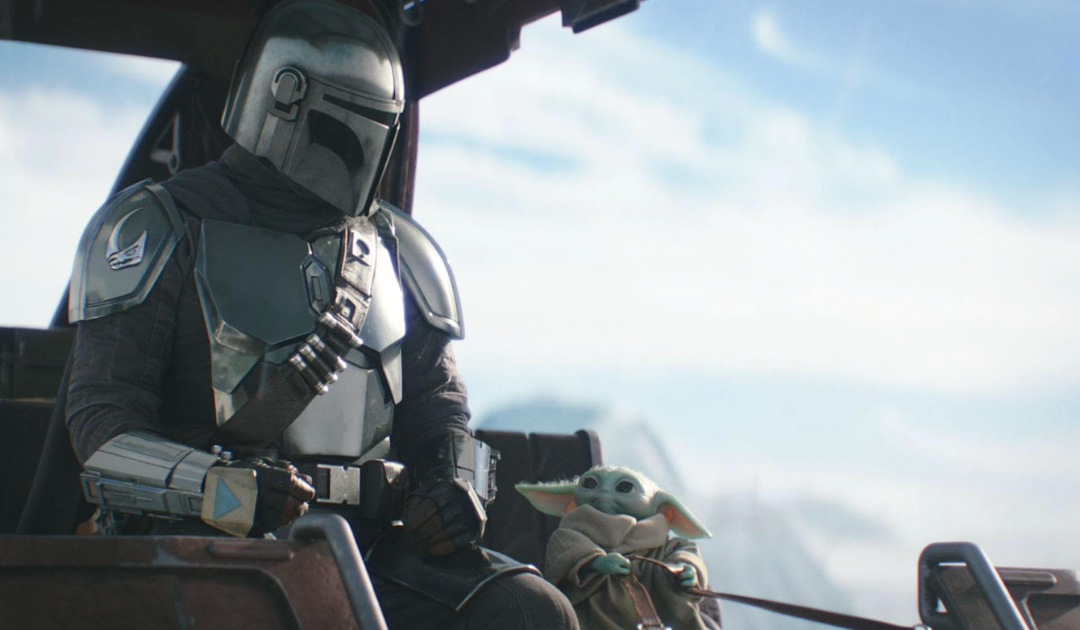
This tension is signaled almost immediately. Early on, Din physically forces Grogu into the backseat of their new ship, strapping him into a seatbelt while warning him not to interfere. It’s an unmistakably parental beat that calls back to similar moments from the television show, but it also highlights how Din still sees Grogu primarily as someone fragile, someone who must be controlled for his own safety. By the film’s conclusion, however, Din begins allowing Grogu to help navigate and partially pilot the ship himself. The same child once buckled safely into the passenger seat is now learning how to steer. Dad is letting the kid figure out how to drive because he has recognized that love cannot always manifest as shielding children from danger. Sometimes love means preparing them to survive a world where you may no longer be present.
These themes of parenthood are also explored through the figure of Rotta the Hutt. One of the film’s more surprising decisions is revealing that Jabba’s son is fundamentally unlike his father in both temperament and moral instinct. Where Jabba was all appetite without restraint, a grotesque embodiment of greed, cruelty and indulgence, Rotta seems burdened by the inheritance attached to his name. He resents the violence and ruthlessness that defined his father’s empire and expresses little desire to become another version of Jabba. Instead, Rotta wants distance from that legacy altogether. He wants freedom to become his own person.
That choice reinforces the film’s larger preoccupation with generational transition. Nearly every major relationship in The Mandalorian and Grogu revolves around children confronting the legacies handed to them by their fathers, while fathers themselves struggle to determine whether love means preservation or release. Din must learn that Grogu cannot remain permanently sheltered. Rotta must decide whether lineage determines identity. Even the New Republic itself exists in the shadow of prior generations, attempting to build something better from the ruins left behind by the Empire.
Thematically, these are ideas Star Wars returns to time and again. Luke Skywalker fears becoming his father. Ben Solo falters beneath the weight of Vader’s legacy and Han’s self-doubt. Entire galactic conflicts emerge because of what sons inherit from their fathers. True to franchise form, The Mandalorian and Grogu pushes against fatalism. Rotta may carry Jabba’s name, but he does not carry Jabba’s soul.
Fatherhood and the Crisis of Masculine Formation. In this film, parenthood is not portrayed as cloning oneself into the next generation, nor as preserving children in permanent dependence. Good fatherhood instead involves preparing children to become morally distinct people capable of choosing rightly for themselves. Din’s loosening of control over Grogu mirrors Rotta’s desire to step outside the gravitational pull of Jabba’s shadow. Both arcs reject the idea that identity must remain trapped inside inherited patterns.
In this sense, the film’s optimism almost comes across as countercultural. There is a fundamentally human conviction in the midst of the blaster fire, which is that children are not doomed to become their fathers, and fathers honor their children best not by controlling them forever, but by helping them become fully themselves. That idea should resonate far beyond the boundaries of the silver screen. Scripture repeatedly presents parenthood as stewardship, not ownership. Children are not extensions of parental ego, nor projects through which adults attempt to relieve their own unresolved longings. They are image-bearers entrusted temporarily into human hands. Paul in Ephesians 6:4 warns fathers not to provoke their children to anger, but to raise them with nurture and godly wisdom. That command itself assumes that children possess inner worlds that can be damaged, distorted, or crushed by domination masquerading as protection. Biblical fatherhood is therefore never about authority alone; rather, it is about cultivating maturity without extinguishing personhood.
But domination isn’t really our central problem anymore, is it? Modern Western culture suffers from almost the opposite crisis. We do not primarily live in an age of hard fathers so much as absent ones, passive ones, confused ones, frightened ones, and emotionally adolescent ones. Ours is a culture that is simultaneously obsessed with children and terrified of actually raising them into adulthood.7 The result is a strange contradiction: children are emotionally overprotected while being spiritually under-formed (or, in many cases, malformed). We shield them from difficulty, risk, discipline, responsibility, and discomfort, yet expose them constantly to anxiety, confusion, instability, technological addiction, and existential chaos. We extend childhood indefinitely while stripping childhood itself of innocence.
Hardness Without Virtue, Softness Without Courage. In many ways, masculinity has been snared by two particularly destructive distortions.8 On one side stands the caricature of domineering masculinity, the man who performs hardness because he mistakes intimidation for strength. You all know this guy, he who carefully cultivates the aesthetic of aggression: tactical gear and hyper-masculine branding, “alpha” or “sigma” rhetoric, cigars, whiskey, beards, firearms posed like personality traits, podcasts fueled by grievance and perpetual outrage. He begins sentences with words like, “Well, as a man,” and his entire identity becomes a theater of control. He talks constantly about “strength” while seemingly lacking the self-awareness to detect the extraordinary fragility underneath it all, unable to suffer disagreement or vulnerability or — gasp! — consider what repentance might actually look like. Because what could he possibly have to repent of when he “does life” so rightly? His wife and children become extensions of his ego, props within a personal kingdom rather than souls entrusted through his care. He rules through sheer force of personality, baptizing insecurity as “leadership.”
The irony in the modern church, of course, is the men who condemn that caricature while producing its opposite counterpart: the perpetually adolescent man who confuses niceness for virtue and emotional softness for holiness. This man performs sensitivity the way the other performs aggression. He speaks endlessly in therapeutic language, constantly processing feelings, is endlessly (and exhaustingly) self-referential, incapable of decisive action because he has been taught that masculinity itself is vaguely suspect. He dresses and behaves with studied harmlessness, curating this permanently approachable persona built around comfort and humor, consumer hobbies, ironic detachment, and emotional reassurance. He may know every Marvel release date, spend thousands on collectibles, disappear endlessly into online discourse, and speak confidently about “safe spaces,” yet remain unable to confront evil directly or endure hardship by shutting his mouth for a change.
Therapeutic Evangelicalism and Counterfeit Masculinity. And make no mistake, churches often reward this. Modern evangelical culture frequently elevates men who are endlessly accommodating, endlessly “relatable,” endlessly emotionally expressive, yet weirdly incapable of moral gravity. Entire leadership cultures now revolve around approachability rather than authority, sentimentality rather than conviction. Pastors dress perpetually adolescent, speak in cadences of lifestyle influencers, and carefully manage “authenticity” while avoiding anything that might sound demanding of a congregation, or even remotely dangerous. Sermons become TED talks with Bible verses attached. Worship becomes emotional mood curation. Masculine formation disappears almost entirely because churches fear being perceived as harsh more than they fear producing weak men.
And this is precisely where the church deserves far more scrutiny than it usually receives, because modern evangelicalism loves talking about masculinity while producing counterfeit versions of it. Entire conferences, podcasts, men’s ministries, and publishing industries now revolve around “biblical manhood,” yet much of what passes for masculine formation inside the church is little more than aesthetic tribalism painted over with prooftexts, and the result is disastrous.
Churches increasingly produce men who know how to discuss feelings but not how to bear masculine responsibility specifically. Men fluent in vulnerability language yet incapable of initiating, leading, protecting, building, correcting, or enduring without applause. Men who confuse passivity for gentleness because they have never been taught that goodness often requires stepping forward into discomfort rather than endlessly curating emotional safety. They are taught to “share,” but not to lead family worship when nobody feels like it. Taught to “process,” but not to make difficult decisions that may disappoint people. Taught to be emotionally available, but not to become the kind of fathers whose wives and children feel genuinely secure in their presence.
How many pulpits now openly treat adulthood itself as vaguely oppressive? Frankly, in my church-hopping tenure, I lost count. How many sermons hold up God as a therapeutic life coach whose primary role is validating congregants emotionally? How often is sin discussed concretely rather than euphemized into “brokenness” or “messiness” or “struggle?” How often are fathers actually called to duties that are concrete and costly: cultivating order within the home, restraining destructive impulses, modeling courage under pressure, accepting sacrificial responsibility for the spiritual condition of the family, disciplining children patiently rather than outsourcing formation to mothers, schools, screens, or churches? They hover around adulthood cosmetically while remaining psychologically adolescent — present physically but absent structurally. And churches often reinforce this by treating masculinity primarily as an aesthetic identity to recover rather than a vocation requiring responsibility, gravity, and moral authority ordered toward the flourishing of others.9
The irony is devastating. The church seems to speak endlessly about masculinity while refusing to demand the actual substance of mature manhood. Biblically speaking, fathers are not called to raise permanent children — they are called to raise future adults. Mature masculinity is not aesthetic — you can take the gun off your hip, champ — it is costly responsibility. It is the ability to absorb hardship without becoming cruel. It is stability in the midst of chaos. It is self-command. It is the willingness to tell the truth when lying would be easier, to protect without smothering, to love your children enough to prepare them for reality instead of endlessly cushioning them from it. That means teaching sons and daughters courage rather than emotional dependency, discipline instead of self-absorption, wisdom instead of impulse, and — pay real close attention to this one, Millennials — reverence instead of irony.
Children Do Not Drift Toward Wisdom. Scripture understands this far better than modern churches often do. Proverbs in particular treats fatherhood as the formation of wisdom within a child preparing to enter a dangerous world. “Hear, my son, your father’s instruction,” the text declares (1:8).10 Why? Because wisdom is not automatic. Self-control is not automatic. A child left entirely to himself, Proverbs warns, “brings shame to his mother” (29:15). That verse should sound almost scandalous to our ears because of how discipline itself is treated as emotionally suspect. Yet the father in Proverbs is constantly speaking because formation requires speech. He warns against folly, lust, laziness, pride, violence, envy, and impulsiveness because children do not naturally drift toward wisdom any more than gardens naturally drift away from weeds. Formation requires deliberate cultivation. What I can’t seem to figure out — as a teacher who interacts with young men each and every day — is why the modern church seems so embarrassed by this. But if I have to sit through another sermon aimed at “young adults” that talks a lot about affirmation while saying very little about virtue, I might just have to let my “alpha male” side flip a table or two.
Because, dads, as someone who teaches your children, let me let you in on a little secret: they notice.
Children can detect almost instantly whether the adults around them actually believe in anything solid enough to build a life upon. They know when fathers are emotionally absent behind screens, hobbies, addictions, sports obsessions (don’t even get me started on that one), or perpetual distraction. They know when churches substitute sentimentality for conviction. They know when pastors speak endlessly about “relevance” because they no longer trust Scripture itself. Which is why the modern obsession with “relatability” feels so spiritually thin. Proverbs never presents wisdom as cool, trendy, ironic, or curated. Wisdom is presented as demanding, rooted, sometimes uncomfortable, and absolutely necessary for survival. The fear of Yahweh is the beginning of wisdom (9:10) — not emotional reassurance, not “manly” self-expression, and certainly not your therapeutic self-acceptance.
Maybe I am just in a mood. Maybe years spent teaching young men have made me increasingly impatient with the endless adolescence that now passes for adulthood in both the culture and the church. Maybe I am exhausted by fathers who want to be best friends instead of fathers, pastors who want to be influencers instead of shepherds, and churches that seem more interested in emotional atmosphere than moral formation. Maybe I am tired of irony masquerading as wisdom and sentimentality masquerading as love.
But The Mandalorian and Grogu put me there. —Cole Burgett
Cole Burgett is a graduate of Dallas Theological Seminary and the Moody Bible Institute. He currently serves as the Assistant Director of Online and Nontraditional Learning at Corban University, as well as an Assistant Professor of Theology. He writes extensively about theology and popular culture.
NOTES
- See original Star Wars creator George Lucas’s comments upon receiving an honorary Palme d’or at the 2024 Cannes Film Festival, as reported by Stephanie Kaloi, “George Lucas Defends ‘Star Wars’ Prequels: ‘It Was Supposed to Be a Kids Movie,’” The Wrap, May 25, 2024, https://www.thewrap.com/george-lucas-defends-star-wars-prequels/.
- The film is currently performing ahead of early box office projections and is set to put Disney firmly in the black on its investment. See Pamela McClintock and James Hibberd, “‘The Mandalorian & Grogu’ Won’t Lose Money. It May Not Rescue ‘Star Wars’ Either,” The Hollywood Reporter, May 22, 2026, https://www.hollywoodreporter.com/movies/movie-news/the-mandalorian-grogu-star-wars-box-office-1236604300/.
- See Tyler Aquilina, “Here’s What Critics Said About Every Star Wars Movie When It Came Out,” Entertainment Weekly, November 29, 2019, https://ew.com/movies/2019/11/29/reviews-every-star-wars-movie/.
- For reference, see CRI’s article on The Mandalorian: Philip Tallon, “This Is the Way…Or Is It?: Thinking About Religion in The Mandalorian,” Christian Research Journal, January 11, 2021, https://www.equip.org/articles/this-is-the-way-or-is-it-thinking-about-religion-in-the-mandalorian/.
- See comments made by director Jon Favreau in Kristin Baver, “Director Jon Favreau on Grogu’s Coming of Age in Star Wars: The Mandalorian and Grogu,” Star Wars, April 29, 2026, https://www.starwars.com/news/star-wars-the-mandalorian-and-grogu-jon-favreau-interview.
- For a helpful reading of the primary themes at play, see Anthony Breznican, “The Mandalorian and Grogu Is the Perfect Star Wars Film for These Dark Times,” Esquire, May 18, 2026, https://www.esquire.com/entertainment/movies/a71336532/mandalorian-grogu-star-wars-parenthood/.
- See David F. Lancy, The Anthropology of Childhood: Cherubs, Chattel, Changelings, 3rd ed. (Utah State University, 2022). Lancy, an anthropologist, describes modern Western societies as “neontocracies” cultures in which children become the emotional and organizational center of social life, absorbing extraordinary amounts of adult attention, energy, consumption, and protection in ways historically unusual for human societies.
- Sandra Connor et al.’s 2021 systematic review examines how contemporary Western men understand and perform masculinity, identifying four recurring themes: inclusivity, emotional intimacy, physicality, and resistance to older “orthodox” masculinity. The article is useful here because it reveals the instability and contested nature of masculine formation in contemporary culture. See Sandra Connor, Kristina Edvardsson, Evelien Spelten et al., “Perceptions and Interpretation of Contemporary Masculinities in Western Culture: A Systematic Review,” American Journal of Men’s Health 15, no. 6 (2021), https://doi.org/10.1177/15579883211061009.
- I find myself largely sympathetic to Adam Ch’ng’s review of Matt Fuller’s Reclaiming Masculinity. Though I have not read Fuller’s book itself, Ch’ng’s awareness of the cultural caricatures and anxieties surrounding masculinity discourse within the modern church suggests that the work may prove a worthwhile resource for Christians attempting to think through these issues more carefully and responsibly. See Adam Ch’ng, “Review: Reclaiming Masculinity: Seven Biblical Principles for Being the Man God Wants You to Be, Written by Matt Fuller,” Themelios 49, no. 3 (2024), https://www.thegospelcoalition.org/themelios/review/reclaiming-masculinity-eight-biblical-principles-for-being-the-man-god-wants-you-to-be/.
- Bible quotations are from the ESV.