Listen to this article (18:48 min)
This article was published exclusively online in the Christian Research Journal, volume 49, number 02 (2026).
When you support the Journal, you join the team and help provide the resources at equip.org that minister to people worldwide. These resources include our ever-growing database of more than 2,000 articles, as well as our free Postmodern Realities podcast.
Another way you can support our online articles is by leaving us a tip. A tip is just a small amount, like $3, $5, or $10, which is the cost of a latte, lunch out, or coffee drink. To leave a tip, click here
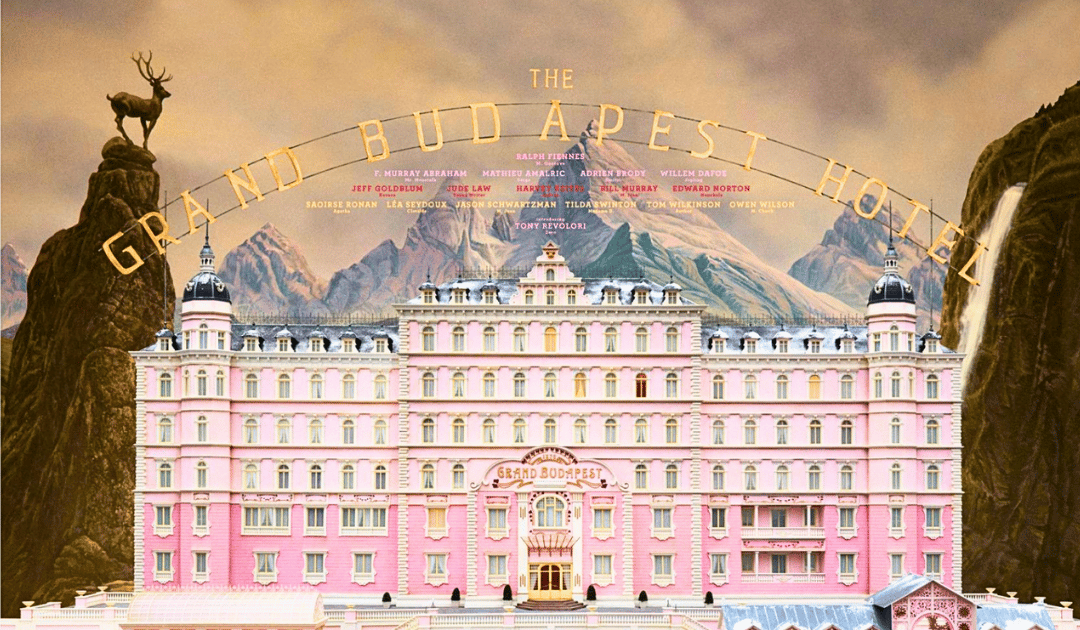
Artists who are easy to talk about get talked about a lot, because it’s easy. Of all American film auteurs, Wes Anderson may be the simplest to get an initial fingerhold on. Even if you’ve never watched one of Anderson’s wry tragicomedies, you’ve seen parodies on Instagram — e.g., “What if Wes Anderson directed The Lord of the Rings?” What follows will be a quick pastiche of the most obvious elements of his style: planimetric composition, pastel color schemes, compass-point camera movements, sans-serif fonts, and a recognizable set of faces from his acting troupe (Bill Murray, Jason Schwartzman, Tilda Swinton, Willem Dafoe, Owen Wilson, Jeff Goldblum, etc.).1
Critics of Anderson will sometimes regard the director’s career as a descent into self-parody.2 They will likely see Anderson as a pure stylist who refuses to grow beyond his diorama sets and cutesy playfulness. Even if one conceded the point, which I do not, and Anderson were nothing more than a stylist, his films would still be worth watching. If he were a one-trick pony, I’d gladly watch that trick for the rest of my life. Further, those who do not see the variations and growth in Anderson’s style may themselves be stuck on the most superficial similarities, missing the variation and maturation of his hallmark style.
A second, perhaps weightier, critique is that Anderson’s comedies handle weighty matters superficially. Anderson’s worlds often seem like miniatures of life that contain danger, depression, suicide, and heartbreak, but shrunk down to a manageable size. What would be a sword wound in another film is sometimes felt as a pinprick. The twee style of Anderson’s movies, one might argue, undercuts the substance of his themes. His deadpan humor frequently deflates the seriousness of the moment.3
This objection is more weighty because it gets to the heart of what makes Anderson such a distinctive artist. It is easy to latch onto Anderson’s aesthetic but miss how that aesthetic is deeply connected to his big ideas. There is simply no separation of style and substance in Anderson. You cannot pull apart his creativity from the meaning of the movies, because so much of his work is about the creation of meaning. This is one of the reasons why Wes Anderson has become a central figure in a budding discourse about metamodernism. For decades, Anderson’s style has been aesthetically important. But now, it seems, his style has become philosophically important.
A Brief Philosophical Excursion. Metamodernism as a term, like modernism and postmodernism, is best held loosely as a general descriptor of a set of attitudes and interests. Philosophically, we often use the term modernity and postmodernity to describe a tendency toward rationalistic anti-traditionalism (as with modernity) or a skeptical anti-rationalism (as with postmodernity). Artistically, there is kinship between the terms. Modernism in art broke with tradition to examine the fundamental principles of art in search of artistic meaning (as with abstract art). Postmodernism playfully deconstructed the artificial assumptions of artistic meaning (as with found-object art). Simplifying to the extreme, modern movements broke with tradition optimistically. Postmodern movements broke with modern movements pessimistically.
The term “metamodernism” was first coined and described by a pair of culture studies scholars, Timotheus Vermeulen and Robin van den Akker: “[Meta]modernism is characterized by the oscillation between a typically modern commitment and a markedly postmodern detachment.”4 The prefix “meta” is meant by Vermeulen and van den Akker to suggest that contemporary culture swings back and forth between the modernisms, and even beyond it. The drive for a way beyond postmodernism is the sense that the movement had exhausted itself. That one cannot live on skepticism and irony, as amusing as it may be.5 The result is a kind of willing naïveté, a desire to feel one’s way out of the blind alley of postmodernity, even if one cannot argue one’s way out of it.
Two more descriptions of metamodernism might be helpful before returning to Wes Anderson. Greg Dember, one of the creators of the website What Is Metamodern? and the author of Say Hello to Metamodernism! (Exact Rush Publishing, 2024), describes metamodernism in a way that evokes romanticism: “The central motivation of metamodernism is to protect interior, subjective felt experience from the ironic distance of postmodernism, the scientific reductionism of modernism, and the pre-personal inertia of tradition.”6 In Dember’s description, metamodernism is still safely located within postmodernism’s emphasis on experience, but it is straining to avoid the negative aspects of the zeitgeist. This is why I compare metamodernism to romanticism, which sought to locate meaning in emotionality, and to move toward transcendence. However, as Charles Taylor helpfully points out in Cosmic Connections, there is still a doubt as to whether romanticism has a sufficiently robust “underlying account” that will sustain the gesture.7 Like Don Quixote riding on a donkey with a rusty sword in search of adventure, metamodernism takes up arms against reductionisms on all sides. It is sustained not by a deep sense of reality, but by a strong desire for “more.”
The instability and longings of the metamodern moment can perhaps be seen in Vermeulen and van den Akker’s description of metamodernism.
[Metamodernism] oscillates between a modern enthusiasm and a postmodern irony, between hope and melancholy, between naïveté and knowingness, empathy and apathy, unity and plurality, totality and fragmentation, purity and ambiguity. Indeed, by oscillating to and fro or back and forth, the metamodern negotiates between the modern and the postmodern.8
Enthusiasm and irony. Hope and melancholy. Naïveté and knowingness. Empathy and apathy.9 These descriptors read so much like a Wes Anderson movie that one almost wonders, midway through their essay, if they were writing with the filmmaker in mind. Then, a few pages after these lines, one finds Anderson mentioned explicitly as an embodiment of the metamodern ethos.
Wes Anderson and Metamodernism. From the very beginning of his work, his first scene in his first movie, Wes Anderson places us in a world that oscillates between sad knowingness and childlike enthusiasm. In Bottle Rocket (1996), we open with Anthony, about to check out from a mental hospital after a self-imposed stay. He is young, good-looking, and popular with the other patients, but, like so many of Anderson’s characters, he is plagued by hyper-contemporary problems. In Anthony’s case, it’s depression. “You’ve never worked a day in your life,” Anthony’s little sister wonders, “How can you be exhausted?”
Many of Anderson’s other works assume a fundamental fragility and fragmentation. Parents in Anderson’s films are often dead, divorced, or neglectful (or some combination thereof). The only exception that comes to mind is The French Dispatch (2021), but I may just be forgetting something. The specter of suicide often haunts his stories as a looming possibility (cf. Richie in The Royal Tenenbaums [2001], Ned’s mother in The Life Aquatic with Steve Zissou [2004], Mr. Bishop in Moonrise Kingdom [2012], Midge in Asteroid City [2023]). Moses’s worry in The French Dispatch, “I think maybe it’s gonna be a suicide,” states the viewers’ worry for many of his depressed characters. Drug addiction also pops up in unexpected places. Though they struggle with their personal lives, mental illness, and drugs, money problems are almost never on the list. One might describe these as “first-world problems.” They are more precisely the kind of problems that come from living in a fragmented world, where the stable givens of life (family stability and personal meaning) cannot be taken for granted.
As in Bottle Rocket, the sad, depressed reality of modern life comes up against a counterbalancing force, a person with a project. In Anthony’s case, it’s his friend Dignan. Dignan appears hooting outside Anthony’s second-story room at the treatment center. He’s there to help break Anthony out. Even though Anthony’s time at the facility is up, and he checked himself in voluntarily, Anthony humors Dignan by climbing down a rope made of bed sheets. Dignan, cheerful with oblivious enthusiasm, is pleased that the escape plan is going smoothly. Spotting Anthony’s attending doctor lifting the bed sheet back up into the room, Dignan says, “Did you bribe the janitor? Smart. Smart.” He then waves to the doctor, who waves back with bemused indulgence.
On the bus ride away from the mental hospital, Dignan shows Anthony his plans for the next fifty years. It all starts with pulling off criminal heists, then “going legitimate,” finding wives, developing interests in art and science, and finally getting honorary degrees. It’s the kind of plan a kid might make. Though Anthony seems mostly amused by Dignan, he seems to go along with his plans for lack of anything better to do. Anthony’s sad knowingness is counterbalanced by Dignan’s childish enthusiasm. Dignan is Don Quixote to Anthony’s Sancho Panza.
Anderson’s second film, Rushmore (1998), will be the last to so clearly embody this dramatic dyad of naïveté and knowingness. (It will be more subtly embedded in all his later films.) Max Fischer’s grandiose schemes seem to inspire the melancholy Herman Blume, even after they briefly become rivals. Early on, Blume asks Fischer what his secret is: “I guess you’ve just gotta find something you love to do and then do it for the rest of your life. For me, it’s going to Rushmore.” As with Dignan, Max’s plan is insane. Apparently, Max’s secret is to attend school for the rest of his life. But Blume does not mock Max’s stupid statement. Instead, he seems inspired by it. Dragged down by the weariness of the world, Blume seems energized by Max’s silly projects. In a telling scene later on, Max attempts to reconcile with Blume by offering him one of his Rushmore pins. “That’s the perfect attendance award and the punctuality award,” Max says, “I thought you could choose which one you liked more. And you could wear that one, and I’d wear the other.” Blume regards Max with sad compassion. “I’ll take punctuality,” he says.
It’s a quick scene, but an important one. Anderson’s characters often invest fragmentary symbols with grander meanings. This is the natural evolution out of postmodernism. If postmodernism found meaning in the breaking of modern constructions, metamodernism finds meaning in the partial reassemblage of the fragments. Some examples of invested meaning in Anderson’s films include the Zissou Society’s Junior Member ring worn by Ned, a Khaki Scouts “highest commendation” from Moonrise Kingdom’s Scout Master Ward, and M. Gustave’s swearing on The Grand Budapest Hotel.
The reassemblage of partially meaningful symbols is necessary in Anderson’s worlds because traditional symbols do not carry significant weight. Religion is still acknowledged, but its power has faded. In The Darjeeling Limited (2007), brothers on a spiritual quest visit multiple shrines. Mostly they bicker and distract each other. In a telling scene, the brothers manage to focus their attention on prayer for a moment. Francis, the lead brother, asks, “Do you think it’s working? Do we feel something?” Peter responds, “I hope so.” Their halfhearted attempts at spirituality are a mix of Eastern and Western spirituality. Peter’s prayer at a shrine concludes with him crossing himself. They seem as interested in shopping as they are in praying, and even their praying looks a bit like shopping. And the shopping seems as meaningful as the praying.
Likewise, in Anderson’s latest film, The Phoenician Scheme (2025), we find the most explicit biblical imagery in his filmography, though it remains detached from a sense of divine revelation. God appears in the form of Bill Murray, offering judgment of the central rascal of the film, Zsa-Zsa Korda. Instead of quoting the words of Scripture, God repeats Zsa-Zsa’s daughter’s words back to him about the damnability of slavery. Later, Zsa-Zsa’s daughter, a novitiate planning to become a nun, reveals what happens when she prays: “When I pray no one answers. I only pretend he does. Then I do whatever I think God probably would’ve suggested. Usually, it’s obvious.”
This is the first significant way that Wes Anderson’s movies embody the metamodern ethos. They assume that the world is a sad, weary place. Traditional symbols of meaning have lost much of their value. But through the investment of passion and energy, the problems of postmodernism can be transcended, perhaps only briefly, by an obsession with a project in a found community. Thus, the central figure in most Anderson movies will be a driving force with a creative project who creates a community. Here is the list.10 Cue a music montage.
- Bottle Rocket’s Dignan with his ill-conceived heists
- Rushmore’s Max with his clubs, plays, and aquarium projects
- The Royal Tenenbaums’ Royal with his fake cancer diagnosis
- The Life Aquatic’s Steve Zissou with his boat, his film, and his quest to kill the Jaguar Shark
- The Darjeeling Limited’s Francis with his laminated agendas, peacock-feather ritual, and quest to find his mother
- Fantastic Mr. Fox’s Foxy with his criminal schemes
- Moonrise Kingdom’s Sam and Susy with their romance-on-the-run
- The Grand Budapest Hotel’s M. Gustav with his perfectly run hotel
- Isle of Dogs’ Atari with his quest to find his dog
- The French Dispatch’s Arthur Howitzer, Jr. with his literary magazine
- The Phoenician Scheme’s Zsa-Zsa Korda with his Phoenician scheme
The clearest analogue to any of these figures in the creative world is, of course, an auteur director. Such a director, through force of will and sheer passion, assembles a troupe to embark on an unnecessary task propelled by their specific vision. This brings us to the second, clear way that Wes Anderson’s work participates in the whole modern/postmodern discussion. His artistry continually draws the viewer’s attention to its status as an artwork. Most Hollywood cinema is highly immersive, allowing the viewer to glide along with a comfortable forgetfulness about the film’s artificial construction. Anderson’s work repeatedly, perhaps obsessively, reminds us of the artist constructing the artifact.
In the articulate YouTube analysis, “Why Do Wes Anderson Movies Look Like That?,” Thomas Flight starts off by noting that Anderson chose to use real animal fur for his stop-motion film Fantastic Mr. Fox (2009).11 He was warned by the animators that this would cause visible incongruities in the animal’s fur. The animators’ “fingerprints” would be felt by the audience. But Anderson insisted. As he shared with Matt Zoller Seitz, “what’s always appealed to me is a more handmade feeling. Or not a handmade feeling, just handmade.”12
This is just one example of the “visibility” of the artist’s fingerprints. There are hundreds. The act-break curtains and yearbook montage in Rushmore. The storybook chapters in The Royal Tenenbaums. The cutaway ship in The Life Aquatic. The shifting aspect ratios in the nested frame stories of The Grand Budapest Hotel (2014). The intermixing of styles of animation in Isle of Dogs (2018). The New Yorker–style magazine framing of The French Dispatch. The television film shot as a stage play and the stage play shot as a film in Asteroid City. I could go on all day about this. All of these playful elements remind the viewer that this is a work of art created by countless artists under the directorship of an auteur.
Anderson, however, does not use these touches as a way of exposing an artwork as merely a construction in order to prevent the audience from finding meaning. The presence of artificial elements is a reminder of the meaning the artist is creating. In The Wes Anderson Collection, the filmmaker describes why he put stop-motion animated sea creatures into his otherwise live-action film The Life Aquatic: “I think it’s such a magical way to make it seem as though these things are really alive. And you can see how the illusion is being created.”13 This is what makes Anderson’s work especially metamodern. For Anderson, meaning is something we make. And it is also somewhat illusory.
The irony of created meaning is that one can always recall it was created by a specific person. The fingerprints of the creator are still visible. There is more truth in metamodern hopefulness than in postmodern cynicism, to be sure, but the only lasting hope is rooted in a hopeful metanarrative.
Religion in Wes Anderson Films. I don’t know what Anderson’s deeper religious commitments truly are. He says that in his world, “God intervenes.”14 But his recent film Asteroid City seems to display a more accurate statement of his overall sense of life’s meaning. The film jumps between the backstage production of the titular play and the play itself, which is shot as a film. Jason Schwartzman’s character Augie Steenbeck is a grieving father who struggles to comfort his children. Their personal drama is interrupted by the arrival of an alien, which befuddles everyone. The actor playing Augie Steenbeck in the film confronts the play’s director, “I still don’t understand the play.” “Doesn’t matter,” says the director, “Just keep telling the story.”
Even the actor playing the alien seems confused by the meaning of the whole thing. The alien “who art in heaven,” as one boy sings of him, suggests a divine figure. Backstage at the play, the actor says, “I don’t play him as an alien, actually. I play him as a metaphor. That’s my interpretation.” Another actress wonders, “Metaphor for what?” The actor responds, “I don’t know yet. We don’t pin it down.” This seems like a fitting encapsulation of the metamodern response to a confusing universe. Just keep telling the story. Nothing is pinned down.
Phil Tallon (PhD) is an Associate Professor of Theology at Houston Christian University, where he also serves as Dean of the School of Christian Thought.
NOTES
- Planimetric composition was first applied to Anderson’s work by David Bordwell. He describes it like this: “The camera stands perpendicular to a rear surface, usually a wall. The characters are strung across the frame like clothes on a line. Sometimes they’re facing us, so the image looks like people in a police lineup.” David Bordwell, “Shot Consciousness,” Observations on Film Art, January 16, 2007, https://www.davidbordwell.net/blog/2007/01/16/shot-consciousness/.
- For an example, see The Quiet Axis, “The Wes Anderson Problem: Aesthetic Groupthink and the Need to Belong,” Medium, May 29, 2025, https://medium.com/@ryangreen_18606/why-wes-anderson-is-awful-aesthetic-groupthink-and-the-need-to-belong-a4958028dd19. Even Owen Wilson, Anderson’s early co-writer, seemed to have had this worry. After reading a scene from The Royal Tenenbaums (2001), he said, “The whole movie is like one of Max’s plays,” referring to Max Fischer in Rushmore (1998) and his somewhat self-indulgent stage spectacles, which handle adult subject matter with teenage understanding. Matt Zoller Seitz, The Wes Anderson Collection (Abrams, 2013), 102.
- “I guess we both have dead people in our family,” half-orphan Max Fischer says to Rosemary Cross after learning of her husband’s drowning (Rushmore). In The Darjeeling Limited (2007), three brothers attempt to save three drowning Indian boys. One of the boys dies. One of the brothers, Peter, says, “I didn’t save mine.” Both of these are examples of the interplay of earnestness and irony in Anderson’s tragicomic worlds. There are many more.
- Timotheus Vermeulen and Robin van den Akker, “Notes on Metamodernism,” Journal of Aesthetics & Culture 2, no. 1 (2010): 1–14, https://doi.org/10.3402/jac.v2i0.5677.
- The canary in the coal mine for this sort of sentiment seems to be David Foster Wallace’s 1993 essay “E Unibus Pluram: Television and U. S. Fiction,” where he talks about how “irony tyrannizes us” and that “persistent irony” is “tiresome.” David Foster Wallace, “E Unibus Pluram: Television and U.S. Fiction,” in A Supposedly Fun Thing I’ll Never Do Again: Essays and Arguments (Little, Brown and Company, 1997), 21–82.
- The best resource for all things metamodern is the website What Is Metamodern?, accessed May 29, 2026, whatismetamodern.com.
- Charles Taylor, Cosmic Connections: Poetry in the Age of Disenchantment (Belknap Press of Harvard University Press, 2024), 61.
- Vermeulen and van den Akker, “Notes on Metamodernism.”
- This oscillatory logic has also been explored in previous Christian Research Journal discussions of metamodern storytelling in film and television, particularly in reviews of Everything Everywhere All at Once and Mrs. Davis, which are read as navigating between fragmentation and renewed meaning. See Cole Burgett, “When the Hurlyburly’s Done: A Review of ‘Everything Everywhere All at Once,’” Christian Research Journal 45, nos. 1–2 (2022), https://www.equip.org/articles/when-the-hurlyburlys-done-a-review-of-everything-everywhere-all-at-once/; and Cole Burgett, “Mrs. Davis TV Series Review and Metamodernism,” Christian Research Journal 46, nos. 1–2 (2023), https://www.equip.org/articles/mrs-davis-and-the-crisis-of-storytelling-in-the-twenty-first-century/.
- I cannot fit Asteroid City into this scheme. There is a driving force who creates a community, the playwright Conrad Earp. But he is not the central figure.
- Thomas Flight, “Why Do Wes Anderson Movies Look Like That?,” video, 19:15, YouTube, October 9, 2020, https://www.youtube.com/watch?v=ba3c9KEuQ4A.
- Zoller Seitz, The Wes Anderson Collection, 244.
- Zoller Seitz, The Wes Anderson Collection, 187.
- Matt Zoller Seitz, The Wes Anderson Collection: The Grand Budapest Hotel (Abrams, 2015), 202.