This review first appeared in the Christian Research Journal, volume 30, number 02 (2007). For more information about the Christian Research Journal, click here.
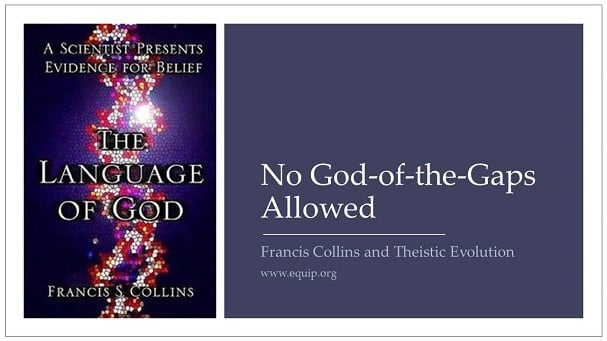
Geneticist Francis Collins, director of the Human Genome Project, is one of the world’s best‐known scientists. An outspoken Christian, he recently challenged equally outspoken Oxford zoologist and atheist Richard Dawkins in the pages of Time magazine. Collins’s book The Language of God: A Scientist Presents Evidence for Belief is equal parts autobiography, scientific reflection, theological speculation, and musings on bioethics. This review focuses on his beliefs about the philosophy of science and about evolutionary theory, as most of his main argument springs—albeit inconsistently, I will argue—from those beliefs. Collins chides “creationists” and intelligent design (ID) theorists for using what he calls“God‐of‐the‐gaps” reasoning, which he says the relentless forward sweep of scientific understanding has doomed to failure, yet his own “evidence for belief” is, arguably, an instance of God‐of‐the‐gaps reasoning.
Collins’s main argument in The Language of God makes three related claims:
- “Faith that places God in the gaps of current understanding about the natural world may be headed for crisis if advances in science subsequently fill those gaps” (p. 93). We cannot use causal action by a transcendent intelligence to explain puzzling natural phenomena. In short, no God‐of-the‐ gaps allowed.
- “Darwin’s framework of variation and natural selection,” but especially Darwin’s picture of a Tree of Life—the common ancestry of all organisms on Earth—“is unquestionably correct” (141). Universal common descent by natural processes is scientifically non‐negotiable. The theory of neo‐Darwinian evolution cannot rationally be doubted by any educated person.
- The best way to reconcile the propositional content of a transcendentally grounded morality with modern evolutionary theory is what Collins calls “BioLogos,” his renaming of “theistic evolution.” BioLogos is “not intended as a scientific theory” (204), but it is “by far the most scientifically consistent and spiritually satisfying” (210) of the alternatives in the science/religion debate (the others being atheism or agnosticism, young‐earth creation, and intelligent design). BioLogos “will not go out of style or be disproven by future scientific discoveries. It is intellectually rigorous [and] provides answers to many otherwise puzzling questions” (210). Given this, a reasonable Christian will find herself embracing theistic evolution—BioLogos—if she wishes to be heard in our current culture.
The former Calvin College physicist Howard Van Till prominently advocated a similar position, until his recent exodus from Christianity, in such books as The Fourth Day and Science Held Hostage. Brown University cell biologist Kenneth Miller argues in his book Finding Darwin’s God and in his extensive public lectures that Christian faith and neo‐Darwinian evolution are compatible, a view also held by a majority of the members of the American Scientific Affiliation (ASA), an organization of Christians in the sciences. As Collins notes, his position is the mainstream view for many believing scientists and scientifically informed theologians:
Theistic evolution is the dominant position of serious biologists who are also serious believers. That includes Asa Gray, Darwin’s chief advocate in the United States, and Theodosius Dobzhansky, the twentieth‐century architect of evolutionary theory. It is the view espoused by many Hindus, Muslims, Jews, and Christians, including Pope John Paul II. (199)
For Collins, a necessary condition of being seen as a “serious biologist” is acceptance of Darwin’s theory of common descent via random variation and natural selection, and the only rational stance for a Christian is acceptance of BioLogos or theistic evolution.
Collins fails to understand fully the real conflict in the origins debate—philosophical naturalism —or the extent of its grip on modern evolutionary theory. This leads him into the central flaw that winds its way into every corner of his argument.
He locates evidence for the God of Christian theism in the fine‐tuning of the universe itself and in the “Moral Law” that governs human behavior. Cosmological fine‐tuning falls outside the purview of neo‐Darwinian theory, whereas explanation of human behavior is one of its goals, so I will only consider the latter here. On what grounds does the existence of universal standards of “right” and “wrong” behavior —of consistent moral categories across human cultures—count as evidence for the existence of God?
For Collins, humans behave altruistically because they are governed by a divinely authored moral law. The evidential significance of altruism and the moral law arises from the inability of standard evolutionary theory to explain it. Collins argues:
Agape, or selfless altruism…cannot be accounted for by the drive of individual selfish genes to perpetuate themselves. Quite the contrary: it may lead humans to make sacrifices that lead to great personal suffering, injury, or death, without any evidence of benefit. (27)
This mode of reasoning resembles exactly what Collins elsewhere derides as God‐of‐the‐gaps thinking.
Would a Darwinian biologist agree with Collins? Let me explain why I think not, by recounting two revealing personal experiences I had with David Sloan Wilson, an evolutionary biologist at SUNY-Binghamton, and Elliott Sober, a philosopher of biology at the University of Wisconsin. Wilson and Sober are coauthors of Unto Others: The Evolution and Psychology of Unselfish Behavior (Harvard University Press, 1998), in which they attempt to explain human moral behavior generally and altruistic behavior in particular. The fact that humans are known to perform actions that appear not to benefit the actor, but someone else, is an explanatory puzzle for Darwinian evolutionary theory because such altruism appears not to be favored by natural selection.
I once spoke with Wilson about his views at a conference in Arizona. Human moral and religious behavior, he told me, is what makes us most distinctive as biological objects—and these are the characteristics of Homo sapiens most in need of evolutionary explanation. Does God Himself exist? I asked. Is there any being properly addressed as “Lord” truly out there in reality, as the object of the prayers of those people in church? No, he said to me. Once the task of evolutionary explanation is complete, under the philosophical guidance of naturalism, there is no unexplained remainder.
In the spring of 2006, in a seminar at the University of Wisconsin, I argued that naturalism cannot be reconciled with Christianity; one cannot pray to a God who does not exist. Sober, who served as a co-panelist, e‐mailed me some time later to say that I had misunderstood evolutionary theory. Explaining the causal origin of a biological characteristic such as moral or religious behavior, he wrote, does not prove that God does not exist. Evolutionary explanation, however, does destroy the evidential status of that behavior as pointing uniquely to a divine source.
In my experience, evolutionary biologists who are not already Christians—and that’s most of them—see Collins’s arguments about the divine origin of the Moral Law as wholly unpersuasive. If some humans pray or act sacrificially (say, in adopting handicapped children), then those actions, the biologists say, are facts about human biology that are in need of evolutionary explanation.
We may summarize the central flaw of Collins’s position as follows:
-
As a Christian, Collins cannot endorse philosophical naturalism. He indeed does not. He accepts, for instance, the historical reality of the Resurrection.
-
If philosophical naturalism fails, however, then methodological naturalism—its putatively or supposedly neutral cousin for the practice of science—must, for any Christian, fail, too. For Collins, that point of failure corresponds with the moral uniqueness of human beings. Evolutionary theory does not explain altruism or human moral categories such as “right” and “wrong.”
-
If methodological naturalism is unsound as a global rule for scientific practice, however, then defying naturalism for such puzzles as the origin of life or the Cambrian Explosion—as intelligent design theorists do—is not by itself a defect in one’s scientific reasoning. If there can be a “gap” in biological history at one location, as Collins argues is the case for the origin of human moral behavior, then there can be “gaps” elsewhere, and these could be discovered by science. Suspend methodological naturalism anywhere, and one has the right to suspend it elsewhere.
Science in the twenty‐first century could use many more such brave Christians as Collins who speak plainly, in high profile settings, about their faith. Collins needs to think much more deeply, however, about what his understanding of reality entails. Pressing methodological naturalism on others, as Collins does, when he rejects it himself, is bad practice for a proponent of science. It is my hope that as the science of intelligent design matures, Collins will revisit his current certainty about its inevitable failure. I expect he is in for a major (and pleasant) surprise.
— reviewed by Paul Nelson