This review first appeared in the Christian Research Journal, volume 30, number 4 (2007).
I admit, it is at best “Hollywood” for a professional writer to resort to punning and an exclamation mark to attract attention to a scathing critique he has written, but seriously, should I feel guilty about going over the top when the Christian Science Monitor finds it necessary to coin the word “docuganda,” (all documentary, all propaganda, all 96 minutes) in order to get a handle on what Al Gore is up to in his alarmist movie An Inconvenient Truth, for which he won an Oscar? Christopher C. Horner, Senior Fellow at the Competitive Enterprise Institute1 and author of The Politically Incorrect Guide to Global Warming and Environmentalism, isn’t even sure if “docuganda” quite captures the hype surrounding the film:
This 2006 movie… An Inconvenient Truth, is best described as a movie about a book (Earth in the Balance)—from which the author spent twenty years running away—the movie itself having immediately turned into a book (about a movie about a book, of course). We can only hope for the movie version of this latter book. Witness the joys of recycling.2
Confusing media aside, I have a confession to make. I deliberately confused a famous line from the film A Few Good Men with Gore’s An Inconvenient Truth (hereafter, AIT), because I thought it would give me an excuse to share my revised version of that famous scene from whence the line comes. Colonel Nathan Jessep (Jack Nicholson) is on the stand for cross‐examination, and Lieutenant Daniel Kaffee (Tom Cruise) is asking him the hard questions. In my revision, however, Vice President Gore is Jessep and I am Kaffee. Here it is:
Gore: You want answers?
Mayhall: I think I’m entitled to them.
Gore: You want answers?
Mayhall: I want the truth!
Gore: You can’t handle the truth! Son, we live in a world that is literally melting down. I believe it is appropriate to have an over‐representation of factual presentations on how dangerous [global warming] is, as a predicate for opening up the audience to listen to what the solutions are.3 Who’s gonna do it? You? I have a greater responsibility than you can possibly fathom. You weep for the vanishing polar bear and you curse the messenger. You have that luxury. You have the luxury of not knowing what I know. And my existence, while grotesque and incomprehensible to you, saves lives…You don’t want the truth. Because deep down, in places you don’t talk about at parties, you want me on that projector. You need to see my PowerPoint presentation. I have neither the time nor the inclination to explain myself to a man whose carbon footprint is laughable compared to mine,4 who dares question the manner in which I warn you of your impending doom! I’d rather you just said thank you and went on your way.
Mayhall: Okay, but did you exaggerate just a little?
Gore: (quietly) I did the job they sent me to do.
Mayhall: Right, but, and again I ask you, did you doctor the data?
Gore: You’re darn right I did!!
I, humbly, admit that even if I were socially adept enough to go to parties, I wouldn’t talk about Gore’s “colorfully illustrated j’accuse hurled at fossil‐energy‐based civilization wrapped in the form of a lawyer’s brief for global warming alarmism and energy rationing,”5 as I have learned by harsh example never to discuss politics, Christian apologetics, or how to pronounce hors d’oeuvres, when there’s a table laden with canapés and crudités in front of me. (Based on the brutal fallout after I tried this once at a barbeque, you would have thought I’d showed up to bowling night championships without my team jersey.)
An AIT Survival Guide: A Few Things You Can Do to Expose the Hype.
I doctored the subhead above to advance my agenda. The April 9, 2007, cover of a “Special Double Issue” of Time magazine reads “The Global Warming Survival Guide: 51 Things You Can Do to Make a Difference.” Above this foreboding title, just beneath the TIME masthead, a penguin, its wings poised in flight, faces forward with its adorable rotund underbelly, with its head turned to the side, beak skyward, as it teeters dangerously close to the edge of an ice cliff. But, alas, he is grounded, for, as you know, penguins can’t fly! I mention this because in the present climate wherein many who don’t have the time to question the agenda of global warming alarmists accept their assumptions as fact, those of us who dare challenge the issue find a strange, albeit comforting association with this iconic earthbound misfit of a bird.
Speaking of assumptions, it is important to distinguish between an inference and an assumption. At this point, an introduction to analytic thinking is in order, so as to soundly establish the fact that in AIT Gore jettisons the application of the standards of analytic thinking in order to foster a perception of reality that feeds off of the fact that “most people, having given up on getting a set of unadorned facts, align themselves with whichever spin outlet seems comfortable.”6
An inference concludes that something is true based on something else being or appearing true, and is either justified or unjustified. Inferences are based on assumptions, which often operate at the level of the unconscious, and justifiable assumptions lead to reasonable inferences. Uncovering these unconscious assumptions can reveal patterns of irrational thinking, such as prejudice, bias, and alarmism. Here is a simple breakdown:
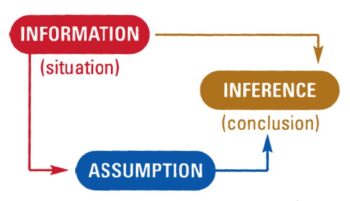
Consider an example:
Situation: Your best friend is in a conflict with another friend.
Inference: Your best friend is justified in this conflict.
Assumption: Your best friend is always justified in her conflicts with other friends.
Here’s another:
Situation: The penguin with its adorable rotund underbelly is dangerously close to the edge of an ice cliff.
Inference: The ice cliff is melting because of global warming.
Assumption: All penguins are poised dangerously close to the proverbial edge of the ice cliff of extinction because of global warming.
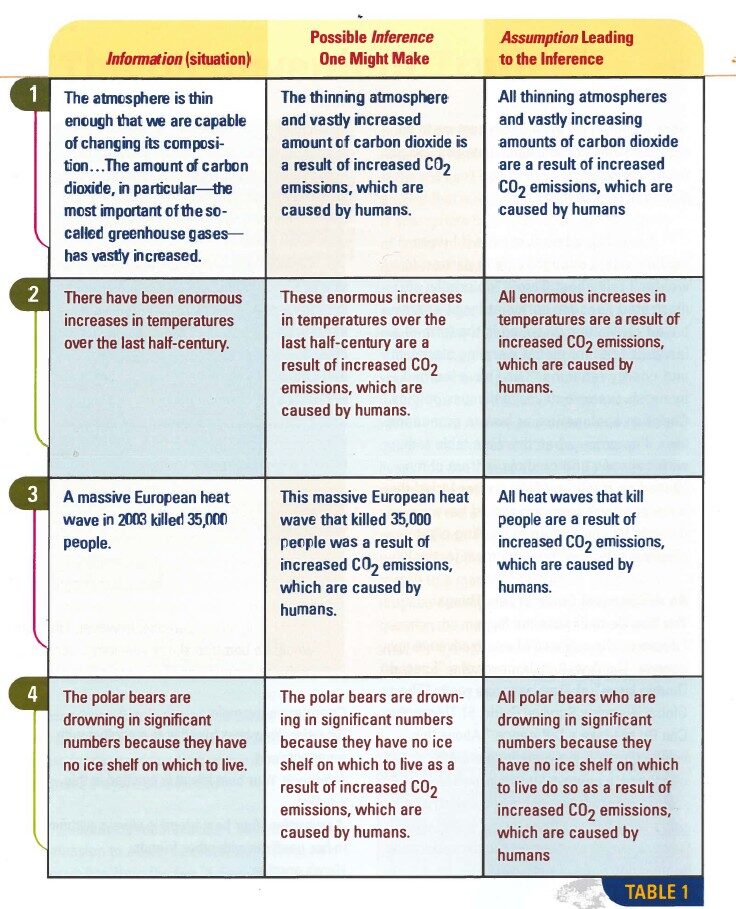
Be aware as you view AIT that Gore’s inferences follow from his assumptions. If his assumptions are faulty, his inferences will be, too. To identify inferences and assumptions in his thinking, first, given the information at hand, determine what he is inferring (either rationally or irrationally) in a particular claim. Next, figure out the generalization that led to his inference. This is the assumption. Table 1 offers a glimpse at just a few of the possible inferences and assumptions leading to the inferences that appear in AIT. (See Table 1 at the end of this article.)
Warning! Not for the Scientifically Squeamish.
Marlo Lewis, Jr.’s 129‐page user‐friendly Congressional Briefing Paper, “Al Gore’s Science Fiction: A Skeptic’s Guide to An Inconvenient Truth,” presents a user-friendly, point‐by‐point, running commentary on AIT. In defense of his paper, Lewis had this to say:
Two considerations impelled me to take a comprehensive approach [in this paper]. First, anything less than a point‐by‐point examination of AIT is too easy to dismiss as cherry picking. Confronted with a list of a dozen errors, or even two dozen errors, critics could accuse me of quibbling and plausibly claim that Gore’s most important points were correct. Second, AIT makes a powerful impression on audiences chiefly by the sheer number of assertions it makes and images it presents. A typical reaction is to conclude that if even half of what Gore says is true, then the planet is in serious trouble.7
Based on these two considerations, Lewis set out to foster a healthy skepticism concerning global warming alarmism and “the energy suppression agenda it allegedly justifies.”8 His commentary compiles a list of examples of egregious statements from the book and film that are either one‐sided, misleading, exaggerated, speculative, or just wrong, exposing them as ill‐suited to serve as reliable guides to climate science and climate policy for Americans. With his permission I offer a brief summary of these statements to refute the former vice president’s claim that AIT is a nonpartisan, nonideologic exposition of climate science and moral common sense that warrants “political action.”9
One Sided Claims—AIT:
- Presents a graph tracking CO2 levels and global temperatures during the past 650,000 years, but never mentions the most significant point: global temperatures were warmer than the present during each of the past four interglacial periods, even though CO2 levels were lower.
- Ignores the large role of natural variability in Arctic climate, never mentioning that Arctic temperatures in the 1930s equaled or exceeded those of the late 20th century, and that the Arctic during the early‐ to mid‐Holocene10 was significantly warmer than it is today.
- Shows a picture of a garbage‐strewn refuse dump in Mexico City to illustrate the “collision between our civilization and the Earth”—as if blight of mankind’s interaction with nature.
Misleading Claims—AIT:
- Implies that a two‐page photograph of Perito Moreno Glacier in Argentina shows that the glacier is melting away, even though the glacier’s terminal boundary has not changed in 90 years.
- Implies that, throughout the past 650,000 years, changes in CO2 levels preceded and largely caused changes in global temperature, whereas the causality mostly runs the other way, with CO2 changes trailing global temperature changes by hundreds to thousands of years.
- Blames global warming for the decline “since the 1960s” of the Emperor Penguin population in Antarctica, implying that the penguins are in peril, their numbers dwindling as the world warms. In fact, the population declined in the 1970s and has been stable since the late 1980s.
Exaggerated Claims—AIT:
- Claims polar bears “have been drowning in significant numbers,” based on a report that found four drowned polar bears in one month in one year, following an abrupt storm.
- Presents a graph suggesting that China’s new fuel economy standards are almost 30 percent more stringent than the current U.S. standards. According to the World Resources Institute, the Chinese standards are only about 5 percent more stringent.
Speculative Claims—AIT:
- Blames global warming for the record number of typhoons hitting Japan in 2004. Local meteorological conditions, not average global temperatures, determine the trajectory of particular storms, and data going back to 1950 show a greater number of tropical cyclones in the Western North Pacific during the late 1960s and early 1970s than in recent decades.
- Blames global warming for the record‐breaking 37‐inch downpour in Mumbai, India, in July 2005, even though there has been no trend in Mumbai rainfall for the month of July in 45 years.
Wrong Claims—AIT:
- Claims Thompson’s reconstruction of climate history proves the Medieval Warm Period was “tiny” compared to the warming observed in recent decades. It doesn’t. Four of Thompson’s six ice cores indicate that several decades of the Medieval Warm Period were as warm as or warmer than any recent decade.
- Claims that 2004 set an all‐time record for the number of tornadoes in the United States. Tornado frequency has not increased; rather, the detection of smaller tornadoes has increased. If we consider the tornadoes that have been detectable for many decades (F‐3 or greater), there is actually a downward trend since 1950.
Due to space constraints, I chose to list without backing what allegedly are faulty assumptions that have led to faulty inferences from otherwise neutral data. I realize this makes me guilty of the very crime I am accusing Gore of committing. In my defense, however, I thought it would be better to shock you with a summary of the sheer number of what Lewis is alleging are distortions in Gore’s reasoning than to bog you down in any one particularly detailed instance. You may fault me for this, but interpreting the raw data that makes up the details of global warming information isn’t for the scientifically squeamish.
For example, in AIT Gore claims that the “greenhouse gases on Venus are so thick that its temperatures are far too hot for humans,” and that “the greenhouse gases surrounding Mars are almost nonexistent, so the temperature there is far too cold.” This claim totally exaggerates CO2’s importance in driving climate. This is because, as Lewis states:
Literally hundreds of scientific studies show that rising CO2 levels help trees, crops, and green things generally grow faster and larger, produce more fruit, use water more efficiently, and resist stress from air pollution—the real stuff.
Based on experimental data, the Center for the Study of Carbon Dioxide and Global change estimates that the 100‐ppm increase in CO2 levels since pre‐industrial times has increased average crop yields by 60% for wheat, 33% for fruits and melons, 62% for legumes, 67% for root and tuber crops, and 51% for vegetables.11
In other words, if AIT were a balanced presentation it would at least have acknowledged the benefits of CO2 emissions.
This summary critique began as a challenge I could not refuse. “If you can write a critique of An Inconvenient Truth without debunking global warming then, sure, go for it,” I was told by several Journal staff—at least one of whom believes global warming is the real deal—as we sat around the editorial board ideas meeting. Ah, the lively editorial board round table, where good ideas move on to become feature articles and controversial ideas move on to the Viewpoint column, which everyone knows carries the unwritten disclaimer, “The views expressed by the writer in this column do not necessarily represent those of the Christian Research Journal.”
As far as you know, I may or may not believe global warming is happening today. In the end, it is Gore’s rhetorical manipulation and rank selectivity in AIT that I am wholeheartedly against–that and the continuous shameless exploitation of my friend the penguin!— C. Wayne Mayhall
NOTES
- For this review, I am indebted to the Competitive Enterprise Institute (www.cei.org), a non‐profit public policy organization that is nationally recognized as a leader in addressing a broad range of regulatory issues, from free market approaches to environmental policy, and to the wealth of data mined by two of its Senior Fellows, Christopher C. Horner and Marlo Lewis, Jr.
- Christopher C. Horner, The Politically Incorrect Guide to Global Warming and Environmentalism(Washington, DC: Regnery Publishing, 2007), 210–11.
- Al Gore, quoted in David Roberts, “Al Revere: An Interview with Accidental Movie Star Al Gore,” Grist Magazine, May 8, 2008, Grist: Environmental News and Commentary, available at http://grist.org/news/maindish /2006/05/09/roberts/index.html.
- A carbon footprint, measured in units of CO2, is a representation of the effect your activities have on the climate in terms of the total amount of greenhouse gases you produce. The Tennessee Center for Policy Research analyzed Gore’s carbon footprint and found that it was fairly big. See Nicole Williams, ed., “Al Gore’s Personal Energy Use Is His Own ‘Inconvenient Truth’: Gore’s Home Uses More than 20 Times the National Average,” Tennessee Center for Policy Research, news release: February 26, 2007, available at http://www.tennesseepolicy.org/ main/article.php?article_id=367.
- Marlo Lewis, Jr., Congressional Working Paper, “Al Gore’s Science Fiction: A Skeptic’s Guide to An Inconvenient Truth,” Introduction, Competitive Enterprise Institute, available at http://www.cei.org/ pdf/5820.pdf. Hereafter, I will refer to Lewis’s paper as “A Skeptic’s Guide.”
- Daniel Henninger, “America’s Missing Voice: The Only Player Not in the Spin Game Is the USA,” The Wall Street Journal, May 7, 2004, available online at http://www.opinionjournal.com/columnists/dhenninger/?id=110005046.
- Mario Lewis, Jr., telephone conversation with author, April 13, 2007.
- Lewis, “A Skeptic’s Guide,” from “APPENDIX A, Summary of Distortions.”
- For brevity, and with the author’s permission, I present verbatim twelve of the one‐hundred claims that Lewis presents as they appear in “APPENDIX A: Summary of Distortions” of “A Skeptic’s Guide.” For the savvy reader I suggest accessing the
document in its entirety where there awaits a wealth of research to support this summary. - A geological period about 9600 BC.
- Lewis, “A Skeptic’s Guide,8.