
This article first appeared in the Christian Research Journal Special Print Issue, volume 48, number 02-03 (2025).
For further information on this issue please click here. To learn more about receiving this issue for your partnering gift please click here.
Contemporary xiejiao 邪教 (lit., evil teachings or religions)1 in China pose as legitimate religions but have caused sociological damage to the society at large. These xiejiao have not only adversely impacted the social order but also have attempted to infiltrate other law-abiding Christian groups and even global Chinese churches in various diasporas. As a result, the phenomenon of Chinese xiejiao has become an object of study domestically and internationally. Due to the differences in cultural background and social development between China and the West, the understanding of xiejiao in China shares some similarities but also differs significantly from the Western concept of cult.
Therefore, when deploying the concept of cult to study the phenomenon, Western scholars sometimes find it hard to accurately understand the real problem encountered in China. This article argues that terms such as xiejiao and cult should be used not interchangeably but complementarily to render an accurate understanding of the sophisticated problems caused by xiejiao in China, which have now gone global. To fulfill that goal, this article first reviews the historical trajectories of the concepts of xiejiao and cult. Then, this article analyzes The Church of Almighty God as a case study to illustrate the complex nature of the problem of xiejiao in China.
I. THE CHINESE CONCEPT OF XIEJIAO VS. WESTERN CONCEPT OF CULT
1. The Evolution of the Concept of Xiejiao in Chinese History
The Chinese term xiejiao 邪教 consists of two words, xie (evil) and jiao (teaching or religion). The antithesis of xie and “right” was first seen in the Analects of Confucius, which refers to “evil” as a threat to the social order. If some teachings are contrary to the doctrine of Confucian thought, these are called “heretical teachings” and must be stopped so as not to harm society.2
The earliest usage of the term xiejiao can be traced to the year 621, when Fu Yi 傅奕 (555–639), an atheist and imperial astronomer, petitioned the first Tang emperor, Li Yuan 李渊 (566–635), to abolish Buddhism: “I petition that the foreign Buddhism, being xiejiao, be expelled back to India, and that Buddhist monks and nuns return to [the task of ] planting and farming.”3 However, Fu’s proposal was dismissed by the emperor after being refuted by the Buddhist monk, Falin 法琳.4
This kind of inter-religious attack is nothing new. To use Daoism and Buddhism as examples, these two mostly mainstream folk religions in today’s Chinese society were once regarded as xiejiao by each other or by the rulers in Chinese history.5 Daoism first took shape in the “Way of the Taiping” and “Way of the Five Pecks of Rice” in the late Eastern Han Dynasty (25–220). With Huangdi and Laozi as their ancestors, Daoism was popular among the people for healing diseases with incantations.6 Around the same time, Buddhism was introduced into China as a foreign religion, which was initially incompatible with the native Daoism and society. It was not until the Northern and Southern Dynasties (420–589) that Buddhism spread widely and conflicted with Daoism, with the two religions treating each other as “weird and absurd.” During the Huichang period (840–846) of the Tang Dynasty, Emperor Wuzong 武宗 made great efforts to destroy Buddhism because of his dedication to Daoism, which historians refer to as the “Huichang Persecution of Buddhism.” Later, most emperors of the Song (960–1279) and Yuan (1271–1368) dynasties attached great importance to Buddhism, which made Buddhism popular again.
At the peak hour of Chinese folk religion, the Ming dynasty (1368–1644), the two most influential popular religions, the Luozu jiao 罗祖教 (Teaching of Patriarch Luo or Luoism) and the Bailian jiao 白莲教 (White Lotus Sect), were denounced as xiejiao by the ruling hierarchies. However, for scholars Mou Zhongjian 牟钟鉴 and Zhang Jian 张践, these movements represented a form of organization for the lower classes to help each other and resist oppression and exploitation. Therefore, these officially suppressed xiejiao actually “symbolized the people’s rebellious spirit and desire for self-salvation.”7
To use Luoism as an example, the group was founded by Luo Menghong 罗梦鸿 (1442–1527), who composed their canon based on Buddhist teaching (Zen Buddhism and Pure Land faith) and Daoism as well as the intellectual Daoist school. However, the Buddhist followers represented by renowned figures such as Deqing 德清 (1546–1623) vehemently criticized Luo and his teachings. The Ming government strictly banned the Sect and put it down whenever and wherever there was a Luo church. Precious scrolls ascribed to the Luo Sect were burnt, and the activities of the Luo Sect were prohibited. In official documents, the Luo Sect was always denounced as xiejiao.8
In general, the official documents referred to a xiejiao’s characteristics as “meeting at night and dispersing at dawn,” “indiscriminately mixing men and women,” and “practicing vegetarianism and worshipping.”9 One of the folk secret religions derived from the Pure Land Sect of Buddhism, which had launched many popular revolts in history and been suppressed many times, was the White Lotus religion. During the uprising, Zhu Yuanzhang 朱元璋 (1328–1398), the first emperor of the Ming Dynasty (1368–1644), realized that the White Lotus was a threat to society and issued an edict in 1397 prohibiting almost all forms of folk religious practice except Daoism and Buddhism.10 Since then, the concept of xiejiao has gradually taken shape, and the term is mainly used in the field of traditional religion, referring to the folk secret religious groups that are incompatible with social reality and affect social stability.11
In the early Qing dynasty (1636/1644–1911), the popular religions were more rebellious than those in the Ming era and often resorted to armed resistance. Holding on to a common ideology of “overthrowing Qing and restoring Ming,” hundreds of sects were labeled as xiejiao all over the Empire despite strict prohibitions and merciless crackdowns. In the late Qing dynasty, popular religions picked up a few new characteristics. First, the overwhelming majority of popular religious sects were involved in large-scale anti-Qing rebellions, such as Taiping, Nian, and the 1911 Revolution. Consequently, such sects gradually changed from being separate, local organizations to becoming integral parts of national movements. Second, in the final years of the Qing dynasty, quite a few sects were incorporated into Sun Yatsen’s revolution and assumed new significance in comparison with their counterparts of previous ages.12
In sum, this brief historical survey of the concept of xiejiao in Chinese history demonstrates a clear trajectory of evolution. It began as a government official’s biased personal attack of Buddhism, which had been recently introduced in China, and evolved into a political term deployed by the governments of the Ming and Qing dynasties to crack down on popular religions with political motives.
2. The Evolution of the Concept of Cult in the West
In Western contexts, the word cult is highly contentious.13 A broad spectrum of interpretations exists within popular culture and various academic disciplines. The origin of the word cult can be traced back to the French term culture and the Latin cultus, both meaning “love, respect, worship,” derived from the verb colere, which means “to cultivate.” In its early usage, the term cult was not applied in a derogatory manner and was not confined to religious discussions. According to Merriam-Webster’s Collegiate Dictionary, cult can be defined in four ways: (1) “formal religious worship” (“formal religious veneration”); (2) “a system of religious beliefs and rituals”; (3) “a religion regarded as unorthodox or spurious”; and (4) “a system for the cure of disease based on dogma set forth by its promulgator.”14 It is evident that the concept of cult is now intrinsically linked to religion, reflecting aspects of religious worship and ritual, and it does not inherently carry a negative connotation.
In the Western academic tradition, the term cult was first introduced by Ernst Troeltsch (1865–1923), a religious scholar active at the turn of the 20th century. For Troeltsch, the word cult did not carry any negative connotations; it was used alongside terms such as sect, church, and denomination to categorize the various mainstream and non-mainstream religious groups in Western culture. Over time, however, the meaning of cult has evolved significantly, straying from its initial interpretation. Sociologist Eileen Barker notes that a cult within the context of new religious movements can refer to anything from a small local organization with just a few members to a large international group boasting millions. They are termed new because they primarily emerged after World War II and religious because they address fundamental questions that mainstream religions also tackle, such as “Is there a God?” “Who am I?” “How do I find meaning in life?” and “Is there life after death?”15 Additionally, religious law scholar Natan Lerner defines a cult as “a community of individuals constituting a minority within a religion that has decided to separate from that religion.”16
J. Gordon Melton, a noted sociologist of religion, observes that the term cult is a controversial and often negative label aimed at certain religious groups that exist outside the mainstream religions in the West. He identifies three contexts in which the term is applied, each with its own definition. Firstly, social scientists typically use the term with less pejorative intent, viewing cults as religious organizations that adhere to a different structural framework than churches and sects, thus appearing foreign and distinct from prevalent religious communities. Secondly, within the Christian counter-cult movement, the term is predominantly employed by apologists to describe groups that have deviated from orthodox Christianity, opposing established theological norms, and rejecting the church’s historic teachings. Lastly, in the secular anti-cult movement, some parents use the label cult to describe the religious groups their children become involved with. They often believe these groups manipulate or brainwash their children, impair their rational judgment, and distance them from their families, fostering loyalty to the group’s leaders instead.17
In the early 1970s, some psychologists introduced the theory of “brainwashing and mind control,” positing that cults employ such techniques to ensure the loyalty of their members.18 Since then, the term cult has increasingly taken on a negative connotation. A notable example is the redefinition offered by Thomas Robbins and Dick Anthony in the early 1980s, who outlined characteristics of cults as manipulative, mind-controlling organizations that engage in systematic indoctrination and pose a threat to mental well-being.19 Clearly laden with emotional weight, these definitions are subjective and challenging to substantiate. Supported by a series of “anti-cult movements” in North America beginning in the late 1970s and amplified by the mass media, the term cult has become a significant source of fear in the public consciousness. In contrast, the term is typically translated in many European languages as sect. Once a minority group is labeled as a cult in the public eye, this designation is difficult to remove, even if it later proves to be a misunderstanding.20
Sociologists of religion James Richardson and Jane Dillon have both pointed out that the word cult has become an important “social weapon” in Western society, often used by opponents to label someone they do not like or agree with, most often the new religious movements. The power and hegemony of language can be seen in its use: the party with more “ideological resources” can use the power of language to brand the other party as a cult in order to portray itself as the winner before the public.21 Richardson and Massimo Introvigne point out that not only opponents but also many governments have used the term cult to negatively label new religious movements for political purposes, creating intense public hostility or fear toward them. The theory of “brainwashing and thought control” used by North American academics and anticult movements in the 1970s, although much of it was not accepted in North America, was later borrowed by many governments in Western Europe to understand emerging religious groups and enact laws against them.22
Even today, in the perception of an average evangelical Christian, the term cult is very negative. Although cult has a negative image in the public mind, Richardson argued in the late 1970s that in academic terms, cult actually refers to a religious group that has an “oppositional” role in society. A cult is a response to the prevailing cultural values of the time. Therefore, without any negative connotation, it can be applied to other fields, such as art, music, politics, medicine, and education.23 By the end of the 1980s, psychologists and sociologists had gradually abandoned the old theory of brainwashing and mind control. They argued that membership in new religious movements was essentially a rational choice. In order to maintain the long tradition of religious freedom in the West, many scholars tended to abandon the term cult altogether in favor of other, less judgmental terms, such as new religious movement, alternative religion, novel religion, or minority religious groups. Richardson even argues that the term cult should not be used in legal proceedings against any group for fear of prejudging or suppressing it. Other scholars have attempted to reinterpret the term, combining traditional and contemporary understandings, to restore the neutral meaning of the term to its original, non-pejorative meaning.24 To this day, cult is still a highly controversial term in the West.
3. Xiejiao vs. Cult: A Comparison
Based on the above survey of the two terms, it may be concluded that xiejiao and cult share some similarities but also possess sharp differences. In terms of similarity, both terms refer to groups of religious nature that are recently formed, small in number, and have not yet been widely accepted as legitimate by society at large.
However, the two terms have different connotations due to the different cultural backgrounds in China and the West. First, compared to the sociological and religious nature of cult in the West, in contemporary China, xiejiao is primarily a political term deployed by the government based on its laws. As early as July 1979, the Chinese government promulgated the “Criminal Law of the People’s Republic of China,” which came into force in January 1980. Since 1997, the Law has been amended several times. Article 300 of the Law stipulates: “Whoever forms or uses superstitious sects or secret societies or weird religious organizations or uses superstition to undermine the implementation of the laws and administrative rules and regulations of the State shall be sentenced to fixedterm imprisonment of not less than three years but not more than seven years; if the circumstances are especially serious, he shall be sentenced to fixed-term imprisonment of not less than seven years.”25 After a boom in folk religion and when Qigong26emerged in China in the early 1990s, the Chinese government began to review the law on xiejiao.
In October 1999, for the first time, the Chinese government began to define xiejiao vis-à-vis the “Falun Gong incident,” which occurred in the same year.27 The book Xiejiao and Anti-Xiejiao in the Contemporary World lists five characteristics of xiejiao: (1) worship of the leader: the leader of a xiejiao deifies himself and demands absolute obedience and worship by his followers; (2) concept of the end of the world: xiejiao prophesy concerning the coming of the end times and use this to terrorize and intimidate believers; (3) behavior: xiejiao force their followers to sacrifice their property, and even their families, to protect their leader; (4) organization: xiejiao build secret underground kingdoms, brainwash their followers, and exert their tyrannical mind control; 28 (5) social and political roles: xiejiao undermine social stability, slow down economic development, and attempt to overthrow governments29
In 1999, China promulgated the “Interpretation of the Supreme People’s Court and the Supreme People’s Procuratorate on Several Issues concerning the Application of Law in the Handling of Criminal Cases involving Sabotaging the Enforcement of Laws by Organizing and Utilizing Cult Organizations,” which defined for the first time the definition of xiejiao organizations and their conviction and punishment.30 In May 2001, China promulgated Part 2 of the Interpretation, which extended the definition to the production and dissemination of xiejiao propaganda materials, undermining the implementation of laws, administrative regulations, and their conviction and punishment.31 Based on the 1999 and 2001 xiejiao laws, the Chinese government announced the new judicial Interpretation of the Interpretation, which came into effect on February 1, 2017, and replaced the former two. Article 1 of the new Interpretation clearly defines “xiejiao organizations” as “illegal organizations that are established in the false name of religion, qigong, or any other name, deify or advocate for their leaders, and use such means as manufacturing or spreading superstitions and heresies to deceive and deceive [sic] others, develop and control their members, and endanger society.” Article 2 specifies the penalties for participating in a xiejiao: “Whoever organizes or uses a xiejiao organization to undermine the implementation of state laws and administrative regulations shall, under any of the following circumstances, be sentenced to fixed-term imprisonment of not less than three years but not more than seven years and shall also be fined in accordance with the provisions of the first paragraph of Article 300 of the Criminal Law.”32 Thus, it can be seen that the term xiejiao has a specific definition from the perspective of today’s Chinese law, which is used for social situations, primarily to refer to those groups and organizations that deviate from religious traditions, are in extreme opposition to the government, and seriously endanger social order.
Second, from the Western traditional point of view, a cult is a form of religion in essence and belongs to the same religious category as church, sect, and new religious movement. However, in contemporary China, xiejiao is entirely different from religion in general and even from the concept of new religious movement in particular. In contemporary China, the dividing line between xiejiao and bona fide religions does not lie in doctrinal differences but primarily moral and societal order. Xiejiao are extremely opposed to society and the government, endanger the health of the people and society, and pose a severe threat to the morality, order, stability, and harmony of society.33 As we have seen, even in the Western world today, the word cult can still be used as a neutral noun or adjective in some contexts (such as academia). By contrast, xiejiao has been derogatory from its very beginning. The two words are not equal. Zhao Kangtai, a Chinese expert on xiejiao, states, “Xiejiao is a nomenclature in Chinese. As far as its etymology is concerned, the word cult is not derogatory. Since modernity, the derivative meanings of cult began to have a negative tone. However, it shows no resemblance to xiejiao in Chinese.”34
In sum, the two terms xiejiao and cult share some similarities but also possess some rudimentary differences. Therefore, it is suggested that scholars, Westerners and Chinese alike, be sensitive to these terms; instead of treating them as equal and using them interchangeably, these terms should be used in a complementary manner to avoid “blind spots” while carrying out academic research of social phenomena in different cultures.
II. THE CHURCH OF ALMIGHTY GOD AS XIEJIAO: A CASE STUDY
The Church of Almighty God (also known as Eastern Lightning) was founded in Henan Province, China, in the early 1990s. Under the banner of Christianity, the group has appropriated some Christian terms of belief and imitated some Christian modes of activities. However, it is very different from historic, orthodox Christianity in essence and manifestation. Using rural areas as their base, they have spread heretical teachings throughout China, manipulated people with their organizations, and established branches overseas.
In 2002, The Church of Almighty God pretended to be the Haggai Institute in Singapore, lured and kidnapped thirty-four leaders of the China Gospel Fellowship, a house church in Henan Province, and attempted to convert them to The Church of Almighty God by placing them under illegal custody. The victims’ families reported the case to public security. Eventually, the leaders were released, but one was converted.35 The murder case in Zhaoyuan, Shandong Province, in 2014 demonstrates the evil nature of this sect,36 which is inhumane, anti-society, and seriously jeopardizes the healthy development of the Christian Church in China. Based on a study of their publications, the following characteristics of The Church of Almighty God can be identified.
1. The Church of Almighty God Falsely Uses the Name of Christianity and Despises and Denies the Bible
The Church of Almighty God borrows the names of “Jehovah” and “Jesus” from the Bible but in reality denies the authority of the Bible by belittling it and calling it an “outdated book”:
Although the Bible contains a collection of books on the Word of life, such as the letters of Paul and letters of Peter, and people can still get supplies and help from these books, they are still outdated books, the books of the old days. (The Word Appears in the Flesh, “What the Bible Says (4),” 956, emphasis added)37
Now, the Bible is a hindrance to God’s latest work. Without the Bible, people can seek God’s footsteps elsewhere. But now, God’s footsteps have been “limited” by the Bible. The expansion of the latest work is more and more difficult, and hard to move forward due to the famous chapters, famous verses, and many prophecies of the Bible. (The Word Appears in the Flesh, “What the Bible Says (4),” 939, emphasis added)
You have to understand why you are not allowed to read the Bible now, why there is another work outside the Bible, and why you cannot find newer and finer practices in the Bible. Instead, there is a greater work outside the Bible.…Why study those lower and outdated doctrines now that we have much higher doctrines? Now that we have newer speaking and work, why do we live in the old historical records? (The Word Appears in the Flesh, “What the Bible Says (1),” 943, emphasis added)
2. The Church of Almighty God Worships and Deifies Its Female Leader as “a Woman Christ”
The most important book of The Church of Almighty God, The Word Appears in the Flesh, consists of statements mostly made in the first person, putting the speaker on par with God. In addition, instead of Jesus Christ appearing bodily on Earth a second time, The Church of Almighty God teaches that Christ has been reincarnated as a woman. In order to explain the existence of this “female christ” and her appearance in China, The Church of Almighty God has developed a unique doctrine called “the second incarnation.” It declares that God’s first work in the flesh was in Judea. His second work is in China, the land of the great Red Dragon. The first incarnation’s redemption was incomplete and could not wholly save sinful people. Only the work of the second incarnation in the form of a woman could complete God’s will.38
3. The Church of Almighty God Uses Threats and Intimidation to Control Its Followers and Damage Families
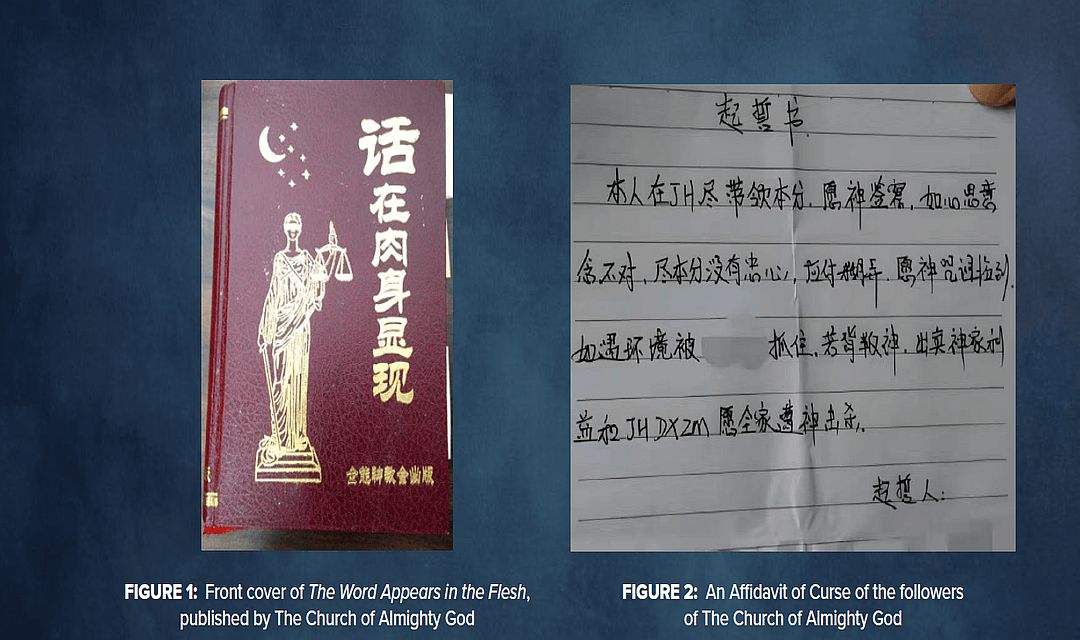
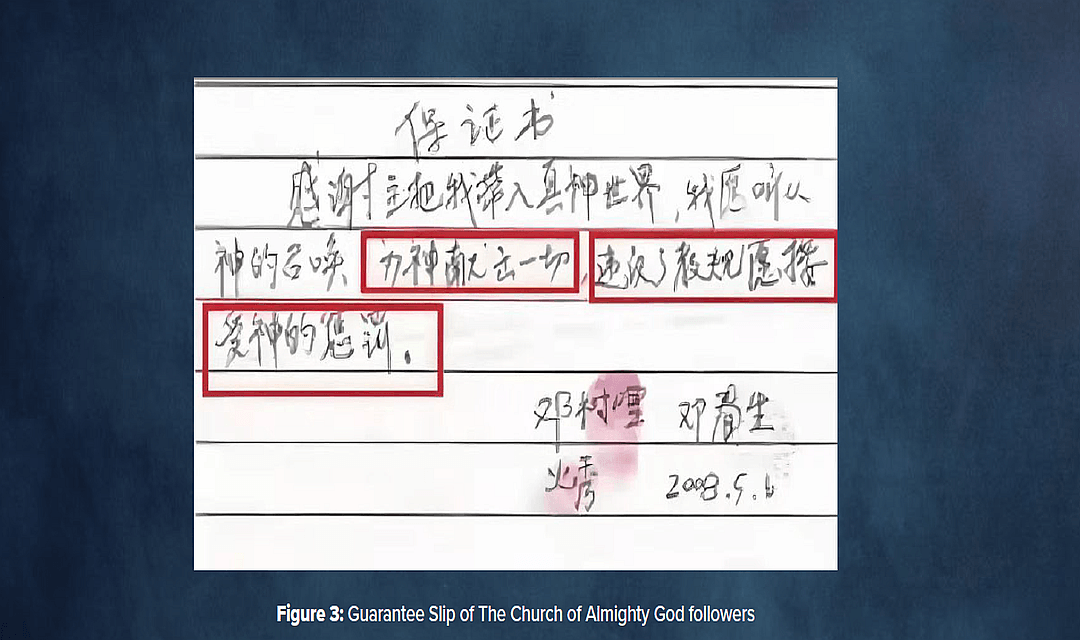
The Church of Almighty God uses intimidation and threats to force ignorant farmers to sign affidavits of curse to express their loyalty to The Church of Almighty God. Its methods are despicable and vicious. Here are two examples:
My Vow39
I am taking the lead in fulfilling my duty in JH.40 May God examine [me]. If my mind goes wrong, and I am not faithful toward my duty, like doing it casually or fooling around, may God’s curse fall upon me. If I am ever caught in a compromising situation, and after that, if I betray God and sell out the interests of God’s family and JH, DX, ZM, may God strike down and kill my entire family. —Guarantor: XX (See Figure 2)
Guarantee Slip41
I thank the Lord for bringing me into the world of the true God. I am willing to listen to God’s calling by offering to God my all. If I violate the rules, I am willing to accept God’s punishment. —Guarantor: Deng Shuli, Deng Chunsheng, Huoxiu. May 1, 2008 (See Figure 3)
4. The Church of Almighty God Harms Society
The teachings of The Church of Almighty God damage Chinese society. The Chinese people are portrayed as “the darkest people” who are to be punished, judged, and burned by the “All-mighty God” in his work of “conquest” and “perfection” in his kingdom:42
The last step of Jehovah’s work is done in the filthiest of nations to judge the world and end the age.…The darkest places have been conquered by men, let alone in other areas. So, only the conquest of China is representative of God’s work. China represents all the dark forces, and the Chinese people represent all the carnal, Satanic, and fleshly people. The Chinese people are the most corrupted by the Great Red Dragon, the most severely resistant to God, and the lowest and most filthy in human nature. So, they are typical representatives of the entire corrupt human race. (The Word Appears in the Flesh, “The Vision of Our Work,” 917–18, emphasis added)
In many places, God has prophesied that a group of victorious ones will be obtained in the land of Qin, that is, in the East of the world. Therefore, the landing point of God’s second incarnation is undoubtedly in the land of Qin, where the Great Red Dragon lies on the rock, and the descendants of the Great Red Dragon will be captured so that they will be ultimately defeated and dishonored. God wants to arouse and thoroughly awaken these suffering people so that they can come out of the mist, reject the Red Dragon, wake up from their dreams, and understand the nature of the Great Red Dragon. (The Word Appears in the Flesh, “Doing the Work and Entering In (6),” 880)
In essence, based on their teachings and social behaviors, it can be said that The Church of Almighty God as a group borrows many Christian terms but departs from central Christian tenets. In addition, their members in China deployed forceful means of violence and psychological intimidation in their behavior. Therefore, The Church of Almighty God poses a challenge to scholars in accurately defining their nature.
III. Cult? Xiejiao? New Religious Movement? A Proposal
In the past decades, scholars in China and the West have published many publications on The Church of Almighty God.43 Emily Dunn chooses “to use the term ‘new religious movement’ in preference to ‘cult’ or ‘sect,’ so as to avoid the negative connotations of the latter terms.”44 Similarly, Introvigne, Richardson, and Rosita Šorytė argue that The Church of Almighty God is a “new religious movement,” not xiejiao.45 For Introvigne et al., the McDonald’s restaurant murder case “was a crime committed in 2014 by a religious group different from the CAG [The Church of Almighty God] and transformed by Chinese propaganda into a CAG crime through a massive operation of fake news spread both at home and internationally.”46 However, these scholars draw their conclusions by ignoring The Church of Almighty God’s sociological deviance, which we demonstrated holistically in §II.3 and §II.4. Unfortunately, Introvigne et al.’s poor scholarship has been uncritically adopted by others.47
In addition, in their article “Church of Almighty God Refugees Asylum Claims. 2. Reasons for Granting or Denying Asylum,” Introvigne et al. challenge European courts’ decisions to deny asylum to certain members of The Church of Almighty God.48 In this article, they confuse concepts such as “religious persecution” in China and the Chinese government’s legal crackdown on The Church of Almighty God. Religious persecution applies to religious followers who are unjustly prosecuted only due to their religious beliefs.49 However, The Church of Almighty God members face legal prosecution in China only because of their illegal, violent means of proselytizing activities.
In another article titled “Church of Almighty God Refugees Asylum Claims. 3. Article 300 of the Chinese Criminal Code,” Introvigne et al. dialogue with Chinese scholar Zhang Xinzhang of the School of Marxism of Zhejiang University and agree with him that “it is a mistake… to translate ‘xie jiao’ as ‘cults’ or ‘evil cults.’” Furthermore, they contend that “[i]f we understand Zhang correctly, he claims that it is not an entire religious movement that is a xie jiao. Rather, a xie jiao is an illegal group that, in the literal terms of Article 300, ‘uses’ a religious movement for its own criminal purposes. A xie jiao is thus, according to Zhang, a group within a group.”50 However, Introvigne et al. misunderstand Zhang. What Zhang refers to is that hidden in the general organizational structure of xiejiao groups such as The Church of Almighty God is a group of leaders who use psychological means of intimidation (§II.3) to control their followers, and it is only this group of leaders who are to be punished by law. However, Introvigne et. al. confuse Zhang’s statement and rather conclude that all members of The Church of Almighty God would be punished based on one-sided testimonies from the asylum-seekers in Europe51
In his article “Xiejiao, Cults, and New Religions,” J. Gordon Melton distances himself from the label of xiejiao and cult when speaking of The Church of Almighty God. Instead, Melton refers to The Church of Almighty God as “a post-Christian” group: “By ‘post-Christian’ we identify groups of a Christian heritage which have moved beyond the commonly held beliefs and practices considered by Christians as essential to [o]rthodox faith and praxis to the point that the group can no longer be considered a part of the Christian community. Such groups are considered not merely heretical but as having adopted a faith no longer identifiable as Christian.”52
Melton’s identification of The Church of Almighty God is noteworthy for the following reasons. First, he correctly notices The Church of Almighty God’s beliefs and practices as “no longer identifiable as Christian,” which corresponds accurately to The Church of Almighty God’s teachings and behaviors (as described in §II). Melton thus refutes Dunn’s identification of The Church of Almighty God as one of many “Protestant-related new religious movements.”53 To say the least, Dunn’s association of The Church of Almighty God with Protestantism is misleading. Second, by doing so, he avoids the historical “baggage” carried in the historically, culturally, sociologically, politically, and religiously laden terms such as xiejiao and cult. However, Melton’s innovative identification of The Church of Almighty God does not do full justice to their illegal, immoral conduct and thus fails to expose their “sociological deviance,” a term fully explained in Hank Hanegraaff ’s well-crafted article .54
Conclusion
Since China’s economic reform in the 1980s, the unprecedented economic transformation has caused severe social unrest, spawning many new xiejiao. These xiejiao damage social order in the name of religion. They not only negatively affect social morality and order but also attempt to infiltrate genuine, law-abiding Christian groups. Moreover, they even endeavor to expand their influence on global Chinese churches in diverse diasporas. As a result, China’s domestic problem of xiejiao has become an international concern. Western scholars have adopted a few approaches in their studies of such an issue by using nomenclature such as “cults,” “new religious movements,” “post-Christian groups,” and so forth. Terms such as cult and xiejiao should be used not interchangeably but rather in collaboration to understand the complex nature of this Chinese phenomenon fully. The Church of Almighty God was presented as a case study. This group uses cunning techniques to substitute the word of the Bible with the word of the “Almighty God” and to replace the saving work of Christ with the deceptive work of “the female christ.” Moreover, in the name of Christianity, The Church of Almighty God has wrought the most severe and reprehensible destruction upon Christians and the Christian churches. By using intimidating and manipulative techniques to control its members, The Church of Almighty God has caused enormous damage to numerous Chinese families, threatening social order and welfare. Therefore, scholarship in China and the West will do well if terms such as cult and xiejiao are used complementarily to understand the Chinese problem now going global.
ABRAHAM HO is the President of the Asia Research Center. His most recent publications include an article in the Ching Feng journal (published by the Christian Study Centre on Chinese Religion and Culture, Hong Kong). His areas of interest are the history of Chinese Christianity, xiejiao studies, Bible translation, among others.
JACOB FENG, PhD, is a lecturer at the School of Humanities of University of California, Irvine. He obtained a PhD in Theological Studies from Fuller Theological Seminary
NOTES:
- Xiejiao can be either singular or plural.
- “It is indeed harmful to set one’s mind upon utterly new and strange doctrines.” “If I have to take a single phrase to sum up The Book of Poetry, all three hundred poems, I should say, ‘Let there be no evil in your thoughts’” (The Analects of Confucius, Book II to Govern). Zhuxi 朱熹 comments on The Analects: “heretical teachings such as the doctrines of Buddhism and Daoism” (A Collection of Conversations of Master Zhu, On Analects).
- In Chinese: “请胡佛邪教,退还天竺,凡是沙门,放归桑梓。” See Hao Dong, Quan Tangwen 全唐文 [Complete Collection of Tang Prose], 1000 vols. (Beijing: Zhonghua shuju 中华书局, 1983), vol. 133.
- Zhongjian Mou and Jian Zhang, Jianming Zhongguo zongjiaoshi duben 简明中国宗教 史读本 [Handbook of the History of Religions in China] (Beijing: Zhongguo shehui kexue chubanshe 中国社会科学出版社, 2015), ch. 5.
- Ping Liu, “Zhongguo ‘Xiejiao’ de youlai yu yanbian 中国‘邪教’的由来与演变,” in Zhongguo shehui lishi pinglun 中国社会历史评论 (Tianjin: Tianjin guji chubanshe 天 津古籍出版社, 2005), 239–54.
- Liu, “Zhongguo ‘Xiejiao’ [Origin and Evolution].”
- Zhongjian Mou and Jian Zhang, Handbook of the History of Religions in China, II: From the Liao Dynasty until the Republican Era, trans. Zhen Chi (Stuttgart, Germany: Ibidem-Verlag, 2020), 219.
- Mou and Zhang, Handbook of the History of Religions in China II, 284–86.
- “They practiced vegetarianism and worshipped demons, and were xiajiao according to our contemporary designation.” See Xinchuan Li, “Jianyan yilai xinian yaolu 建炎以 来系年要录,” (NA), vol. 76.
- David A. Palmer, “Heretical Doctrines, Reactionary Secret Societies, Evil Cults: Labelling Heterodoxy in 20th-Century China,” in Chinese Religiosities: Afflictions of Modernity and State Formation, ed. Mayfair Mei-hui Yang (University of California Press, 2008), 116–17.
- Palmer, “Heretical Doctrines,” 131.
- Mou and Zhang, Handbook of the History of Religions in China II, 350.
- Hank Hanegraaff emphasizes that the word cult is a quintessential example of words/phrases being not univocal but equivocal. See his article, “What Are the Characteristics of C-U-L-T-S Such as Eastern Lightning?,”.
- David A. Palmer, ed., Merriam Webster’s Collegiate Dictionary, Deluxe ed. (The Reader’s Digest, 1998), 441.
- Eileen Barker, “New Religious Movements: Their Incidence and Significance,” in New Religious Movements: Challenges and Response, ed. Bryan Wilson and Jamie Cresswell (London: Routledge, 1999), 15.
- Natan Lerner, Religion, Beliefs, and International Human Rights (Orbis Books, 2000), 7.
- J. Gordon Melton, Encyclopedic Handbook of Cults in America, revised ed. (New York/ London: Garland, 2014 [1986]), 3–7.
- James T. Richardson and Massimo Introvigne, “‘Brainwashing’ Theories in European Parliamentary and Administrative Reports on ‘Cults’ and ‘Sects,’” Journal for the Scientific Study of Religion 40, no. 2 (2001): 143–68.
- Thomas Robbins and Dick Anthony, “Deprogramming, Brainwashing and the Medicalization of Deviant Religious Groups,” Social Problems 29, no. 3 (1982): 283.
- Jane Dillon and James T. Richardson, “The ‘Cult’ Concept: A Politics of Representation Analysis,” Syzygy: Journal of Alternative Religion and Culture 3, no. 4 (1994): 186–87.
- James T. Richardson, “Definition of Cult: From Sociological-Technical to Popular- Negative,” Review of Religious Research 34, no. 4 (1993): 352. Also see Dillon and Richardson, “‘Cult’ Concept,” 186–97.
- Richardson and Introvigne, “Brainwashing.”
- Richardson, “Definition of Cult,” 349–51.
- Richardson, “Definition of Cult,” 349–51.
- Falu chubanshe fagui zhognxin, Xingfa yu Xingshi susongfa: Shuangyu duizhao fagui 刑法与刑事诉讼法:双语对照法规 [Criminal Laws & Criminal Procedure Laws of
China] (Beijing: Falu chubanshe 法律出版社, 2004), 126. - Qigong 气功 refers to a system of coordinated body-posture and movement, breathing, and meditation said to be useful for the purposes of health, spirituality, and martial arts training. See, e.g., “Qigong: What You Need To Know,” NIH (National Institute of Health), 2022, accessed March 6, 2025, https://www.nccih.nih.gov/ health/qigong-what-you-need-to-know.
- For general discussion on Falun Gong, see, e.g., Lindsey Medenwaldt, “Falun Gong: How the West Was Won,” Christian Research Journal 44, no. 2 (2020), https://www.equip.org/articles/falun-gong-how-the-west-was-won/.
- While scholars in the West move away from terminologies such as “brainwashing” and “mind control,” scholars and law enforcement in China still retain the concept. See, e.g., Zhibin Fu, Xinao de lishi 洗腦的歷史 [The History of Brainwashing] (Taipei: Daguan chubanshe 達觀出版社, 2016).
- An Guo, ed., Dangdai shijie xiejiao yu fanxiejiao 当代世界邪教与反邪教 (Beijing: Renmin chubanshe, 2003), 36–42.
- “Interpretation of the Law,” no. 18 (1999). This judicial interpretation was adopted at the 1079th Meeting of the Judicial Committee of the Supreme People’s Court on October 9, 1999. It was passed at the 47th session of the ninth Supreme People’s Procuratorate Procuratorial Committee on October 8 and came into force on October 30, 1999.
- “Interpretation of the Law,” no. 19 (2001). This judicial interpretation was promulgated by the Judicial Committee of the Supreme People’s Court on May 10, 2001, and April 29, 2001, respectively. It was adopted at the 1174th session of the National Committee of the Supreme People’s Procuratorate at the 87th session of the ninth session of the Supreme People’s Procuratorate Procuratorial Committee and came into force on June 11, 2001.
- “Guanyu banli zuzhi, liyong xiejiao zuzhi pohuai falv shishi deng xingshi anjian shiyong falv ruogan wenti de jieshi 关于办理组织、利用邪教组织破坏法律实施等刑事案
件适用法律若干问题的解释,” 2017, trans. Supreme People’s Procuratorate of the People’s Republic of China, accessed October 15, 2024, https://www.spp.gov.cn/zdgz/201701/t20170126_179794.shtml. - Palmer, “Heretical Doctrines.”
- Kangtai Zhao, “Shilun Zhongxi Xiejiao guannian de chayi 试论中西邪教观念的差异,” [On the Sino-Western Differences of the Concepts of Cult.] Hainan daxue xuebao: Renwen shehui kexueban 海南大学学报: 人文社会科学版 20, no. 3 (2002).
- Kejia Yan, “Bentuxing mobai tuanti chutan: Yi Quannengshenjiao weili 本土型膜拜團 體初探:以全能神教為例,” in Jidu shengming zhangcheng: Xiandai Zhongguo bentu Jidujiao shenxue zhi fazhan lunwenji 基督生命長成:現代中國本土基督教神學之發 展論文集, ed. Chengtian Guo, Fuchu Zhou, and Yanren Cai (Taipei: Shengjing ziyuan zhongxin 聖經資源中心, 2013), 191–92. See the article by Zhang Heng, Abraham Ho, and Jacob Feng, “A Firsthand Account of the ‘4/16 Eastern Lightning Kidnapping Case,’”. See also the section, “Visiting the Victims” in the article, “The Sociological Deviance of The Church of Almighty God” by Hank Hanegraaff.
- The Church of Almighty God and scholars such as Massimo Introvigne denied that the 2014 murder was committed by The Church of Almighty God members. See Massimo Introvigne, James T. Richardson, Rosita Šorytė, “Church of Almighty God Refugees Asylum Claims. 1. The Country of Origin Information (COI),” Bitter Winter, updated January 23, 2025, accessed February 14, 2025, https://bitterwinter.org/church-ofalmighty- god-refugees-asylum-claims-1-the-country-of-origin-information-coi/. However, as Hank Hanegraaff argues, the self-designation of a cult leader as Almighty God inevitably leads to sociological deviance. See “The Sociological Deviance of The Church of Almighty God”.
- The references to The Church of Almighty God in this article are drawn from the book The Word Appears in the Flesh, published by The Church of Almighty God. English translations are those of The Church of Almighty God. There is neither the date of publication nor the name of the publisher. Instead, readers see only the words “New Standard Edition /all books of God’s words should use this book as the standard.” A small portion of the book, pp. 250–397, consists of forty-seven speeches spoken between February 20 and June 1, 1992. Other than that, no other publication times are given. There are 1,499 pages. This is volume 1 of an evergrowing series of volumes indicated on The Church of Almighty God’s website (https://www.holyspiritspeaks.org/books/utterances-of-christ/). For an image of the front cover of the first volume, see Figure 1; photo by Jacob Feng.
- The Word Appears in the Flesh, “The Mystery of Incarnation (2),” 985; “Doing the Work and Entering In (6),” 879–80; “The Mystery of Incarnation (4),” 1001.
- See Figure 2 for an image of the original handwritten vow. Translation by Jacob Feng. Photo from China Anti-Cult Network.
- Most likely JH is an abbreviation of the place where this vow was made. So are DX and ZM.
- See Figure 3 for an image of the original handwritten guarantee slip. Translation by Jacob Feng. Photo from China Anti-Cult Network.
- The Word Appears in the Flesh, “Concerning ‘God’ What Is Your Knowledge?,” 1175.
- See, e.g., J. Gordon Melton, “Xiejiao, Cults, and New Religions,” in The Sinicization of Chinese Religions: From Above and Below, ed. Richard Madsen (Brill, 2021); Massimo Introvigne, Inside the Church of Almighty God: The Most Persecuted Religious Movement in China (Oxford University Press, 2020); Xiaoming Shen and Eugene Bach, Kidnapped Cult: A Pastor’s Stand Against a Murderous Sect (Whitaker House, 2017).
- Emily Dunn, Lightning from the East: Heterodoxy and Christianity in Contemporary China, Religion in Chinese Societies 8 (Brill, 2015), 17.
- Introvigne, Richardson, and Šorytė, “Church of Almighty God Refugees Asylum Claims. 1.The Country of Origin Information (COI).”
- Introvigne, Inside, 82.
- For example, J. Gordon Melton approvingly quotes their investigation in his “Xiejiao, Cults, and New Religions,” in The Sinicization of Chinese Religions: From Above and Below, ed. Richard Madsen (Brill, 2021), 169.
- Massimo Introvigne, James T. Richardson, Rosita Šorytė, “Church of Almighty God Refugees Asylum Claims. 2. Reasons for Granting or Denying Asylum,” Bitter Winter, updated January 24, 2025, accessed February 14, 2025, https://bitterwinter.org/ church-of-almighty-god-refugees-asylum-claims-2-reasons-for-granting-or-denyingasylum/.
- Since 1949, many genuine believers have been unjustly persecuted solely due to their Christian convictions. During these persecutions, false charges related to financial misconduct or immoral behavior have often been levied against these individuals to undermine their credibility in society. However, this situation should not be conflated with the government’s actions against The Church of Almighty God, which has committed genuine offenses, including psychological manipulation, financial exploitation of its members, and violent treatment of those outside the group.
- Massimo Introvigne, James T. Richardson, Rosita Šorytė, “Church of Almighty God Refugees Asylum Claims. 3. Article 300 of the Chinese Criminal Code,” Bitter Winter, updated January 27, 2025, accessed February 14, 2025, https://bitterwinter.org/church-of-almighty-god-refugees-asylum-claims-3-article-300-of-the-chinesecriminal-code/.
- According to the testimonies on China’s Anti Evil-Religion website, some ex-members were not punished at all. For instance, “七旬老人的生死劫:‘全能神’ 邪教的陷阱,” March 13, 2025, https://www.chinafxj.cn/n165/c935297/content.html.
- Melton, “Xiejiao, Cults, and New Religions,” 168n31.
- Dunn, Lightning, 17.
- See Hanegraaff’s “The Sociological Deviance of The Church of Almighty God”.