Listen to this article (15:47 min)
Fringe Files Column
This article was published exclusively online in the Christian Research Journal, Volume 49, number 04 (2026).
When you support the Journal, you join the team and help provide the resources at equip.org that minister to people worldwide. These resources include our ever-growing database of more than 2,500 articles and Bible Answers, as well as our free Postmodern Realities podcast.
Another way you can support our online articles is by leaving us a tip. A tip is just a small amount, like $3, $5, or $10, which is the cost of a latte, lunch out, or coffee drink. To leave a tip, click here.
“Our role in all this exchanging and transforming of energy is to facilitate the transformation
of low-frequency energy, such as fear, anger, and greed, into the higher vibration of love.”
—Tim Walter in What Now?1
It’s fall, which means the decorations are creepier and the topics of discussion are often about the supernatural and mysterious. This is the season when we see more interest in ghosts, psychics, tarot cards, paranormal investigations, and all sorts of practices that promise to reveal something hidden. In fact, the other day, I had a conversation with one of my college students about dowsing2 (he noticed a video I had pulled up on my computer screen). He knew what dowsing is because he has seen it featured on social media, particularly TikTok. As this young man shared his concerns with me about the validity of the practice, he confirmed with me that discussing this kind of topic with Christians is important because misinformation and falsehood abound. How can we combat lies when we don’t know the truth?
Unfortunately, sometimes falsehood is enticing. Dowsing is presented as an opportunity to discover deeper love in one’s life and for oneself, which is likely one reason it is so popular in the New Age community. As the opening quote of this article indicates, why should we grapple with fear when we can just tap into love? Author and dowser Tim Walter suggests in his book What Now? that it is possible. We can, according to Walter, “develop greater spiritual wisdom” using “the most basic and grounded practical skill of dowsing.”3
Megan on the YouTube channel Solar Glow Meditations4 seems to agree with Walter’s assessment of dowsing. Her dowsing practice includes having conversations with spirits in what seems to be an effort to increase her own spiritual wisdom. Her content, in which she claims to communicate with Jesus, the angel Gabriel, Lucifer, and others, has attracted nearly 80,000 subscribers on YouTube, more than 415,000 followers on TikTok, and about 600,000 followers on Instagram. In short, she’s a mega-influencer, and it’s easy to see why. Megan has a calm demeanor, her voice is soothing, and after she receives an answer to a question from whomever she’s talking with, she always thanks them for their response. Her videos are peaceful to watch, and yet I’m left with several very serious questions and concerns about dowsing.
For example, is Megan really communicating with spirits? How does dowsing work? Can dowsing truly deliver us from fear and pain as Walter suggests? If dowsing is a spiritual practice, what warnings should Christians heed? Is it grounded in the occult, or is it just a tool people can use to get answers to their questions about life? In this article, I’ll address those questions as well as some historical perspectives and modern-day reflections about the practice.
What Is Dowsing?
Dowsing may sound obscure or inconsequential, but it has made its way into modern-day pop culture through film, which shows that at least some people consider it interesting. In Coraline (Focus Features, 2009), for instance, the protagonist uses a forked stick, which is unfortunately made of poison oak, to find an ancient well. Meanwhile, in The Princess Bride (20th Century Fox, 1987), Inigo Montoya uses his father’s sword as a dowsing rod to find the film’s hero, Westley. Perhaps these examples seem silly, but they do a nice job of illustrating how dowsing works. Historically speaking, it seems to go back centuries, if not millennia.
The History of Dowsing. Imagine holding two rods and using them to help you find groundwater or minerals such as silver. It appears this was the original purpose of dowsing. Some accounts trace dowsing back thousands of years to ancient Egypt and China, based on interpretations of ancient artwork as depicting divining rods, but the archaeological evidence for these claims remains uncertain.5 During the Middle Ages, German miners used two forked rods to help them find metal.6 One German tribe, the Frisians, apparently used divining rods to find murderers, and Marco Polo seems to have used dowsing, as well.7 According to the U.S. Geological Survey, dowsing has historically been popular in the U.S. in rural settings where people wanted to avoid digging wells that turn up no water; instead, they hoped the dowsing rods would steer them in the right direction.8
Over time, a shift has occurred, and the focus is no longer on groundwater. Instead, dowsing has become associated with spiritualism and the occult. Practitioners use dowsing to find invisible energies, diagnose physical illnesses, and manifest or even talk to spirits.9 Wellness influencers on social media claim they can use dowsing to reveal hidden knowledge and raise the world’s vibrations. Some even claim to be able to answer questions about the future.10 “Dowsing is very similar to playing with a Ouija board,” writes Sara Coughlin, “although, within spiritual circles, dowsing is considered to be much more reliable.”11 Before we get into reliability, let’s talk about how dowsing is supposed to work.
The Tools of Dowsing. Although it seems a variety of options are available to dowsers, three types of tools are commonly used: a forked stick, L-shaped metal rods, or a pendulum. One isn’t necessarily better than another, but practitioners have their preferences. With regard to the forked stick, a person holds one end of each fork in their hands, with the main stem pointing forward, and they walk slowly, carefully concentrating on what it is they hope to find. According to proponents, the stick moves downward when they’ve arrived at the correct location, a movement supposedly connected with the energy found below ground. Proponents believe that “the movements generated in dowsing tools — such as spins, oscillations, or vibrations — are not caused by the object itself, but by an interaction between the energetic field of what is being consulted and the sensitivity of the dowser.”12 As I will explain later, this doesn’t mean that the dowser necessarily believes anything supernatural is happening or that occult forces are involved — though, as noted, many today do. According to an allegedly naturalistic view, the dowsing mechanism is supposed to relate to the energies or vibrations proponents believe are found in all of creation, from electrons and atoms to stars and planets.13
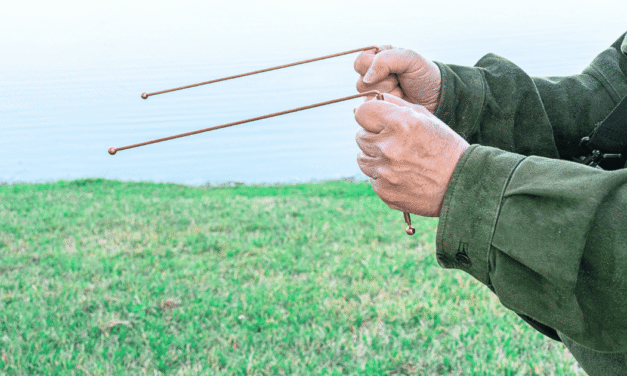
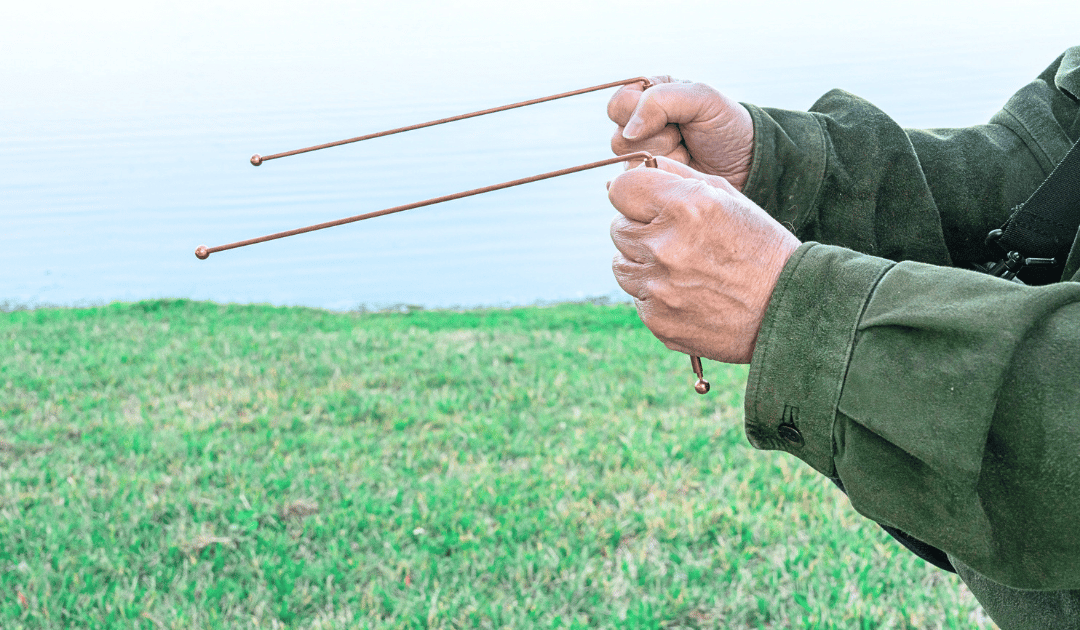
The L-shaped rods are used in a similar way to the stick, but the person holds one rod in each hand, with the long ends pointing forward. When they arrive at the appropriate location, the rods move. Some practitioners, like Megan from Solar Glow Meditations, believe the rods can be used to facilitate conversations with spiritual beings. The rods give them the ability to detect something beyond their consciousness.
Finally, some dowsers use a pendulum, which is a small crystal or weight suspended on a chain or string. The pendulum moves back and forth or in circles to help the practitioner find something or to interact with spirits. Pendulums seem to be popular in the spiritual side of dowsing, especially when practitioners have questions about their relationships, health, or future events.
Beyond Water: Dowsing as a Spiritual Practice. As spiritualism and the New Age blossomed, so, too, did dowsing and other so-called spiritual practices. Today, practitioners believe that dowsing rods and pendulums can not only find water but also locate lost objects, provide answers to life’s questions, and open up a gateway to the spirit world.14 Dowser Gabriel Soca says, “It serves as a gateway to a more subtle dimension of reality, where mind, energy, and consciousness intertwine in a deep dialogue.”15 Dowsing has to do with vibrations, which New Agers believe exist in everything. As one raises their vibrations, the more access they have to their higher self, which leads them to their own godlike status. Walter explains, “Our viewpoint, once based in our wholeness, becomes one of compassion and love.…Arriving at this viewpoint is how you discover that you are not what you thought you were. In fact, you are like a god in your own tiny universe; and that universe is you.”16 To be clear, though, not all dowsers intend to use it as a supernatural practice; rather, some use it more like a metal detector would be used at the beach. So, we can’t assume that all dowsers are willful occultists or are intending to practice the New Age spiritual side of dowsing. Indeed, some dowsers like Walter say it is not supernatural at all; rather, “it is using the natural link we each have with the field of infinite possibility…interacting with the quantum field when you address the universe.”17 Although metaphysically dubious, it seems Walter views dowsing as a natural rather than supernatural phenomenon, even as he claims that it provides access to information beyond our human experience.18
What Does the Evidence Say About Dowsing?
As with other New Age and occult practices, there is no reliable empirical evidence to support dowsing. In the early 1900s, the U.S. Geological Survey (USGS) wondered if there was something to all of the questions it was receiving about dowsing as a practice to find groundwater. So, it researched the issue, and under controlled tests, discovered there was nothing to show that dowsers consistently outperformed chance. The USGS concluded that “any claim” that dowsing works to find groundwater “is purely speculative.”19 Nothing has changed since 1917. Anomalistic psychologist Chris French performed a double-blind study in the early 2000s on dowsing and got results similar to those achieved by the USGS. The dowsers were no more able to find the water than someone who was merely guessing.20
What, then, is happening when the rods, stick, and pendulum move? Psychologists say that it’s a result of the ideomotor effect.21 The ideomotor effect is when our thoughts and expectations can trigger tiny, unconscious muscle movements. These movements are so minuscule that we may not even realize we’re making them. The practitioner may genuinely feel as though they didn’t make the tool move. However, there is no credible evidence to support the assertion that anything other than their own small involuntary muscle twitches or movements are causing the tools to “work.” In fact, it may often be a case of confirmation bias, which is a tendency to interpret behavior in a way that supports one’s pre-existing beliefs. In other words, the dowser’s expectations that the tools will move actually cause the involuntary muscle movement, but for them, the movement confirms that dowsing is real, whether it’s helping them find water or receive answers from a spiritual entity. Ultimately, as I’ve stated, science does not support the validity of dowsing.
Dowsers like Walter do not seem to care what the science says, though. He claims, “The human heart is the barometer of our truth. It should be to our hearts that we turn to assess the moments of our lives. Our hearts can guide our choices on how to interpret the moments and find meaning in them.”22 Walter also explains away the ideomotor effect by saying it actually works in favor of dowsing. He writes,
I support the idea that dowsing works mostly for the majority of people because it is using the ideomotor effect. If the ideomotor effect is a result of the body’s physiology reacting to an unconscious stimulus, then that information must have originated in the quantum realm as that is where all information is stored and created. The ideomotor effect is, for me, the only logical way that dowsing might work for most of us, most of the time.23(emphasis in original)
Unfortunately for Walter, as noted, that’s not how the ideomotor effect works, and he offers no evidence to support his claim that the effect is caused by hidden information originating in the quantum realm. The ideomotor effect is not proof that dowsing is working — it is evidence that it is not. Despite Walter’s claims that dowsing “is the safest way to access the spiritual side of reality,” he has provided no evidence that it works.24 And for some, that’s okay so long as dowsing isn’t causing anyone harm. “As is often the case with divinatory and intuitive practices, there isn’t really science behind dowsing,” admits Coughlin. “But, if you give it a try and find comfort in the responses you receive, there’s no reason it shouldn’t be part of your personal spiritual routine — maybe just don’t delete your Maps app in exchange for a divining rod.”25 Humorous, but still an admission that perhaps dowsing isn’t all it’s cracked up to be.
How Should Christians Respond to Dowsing?
When contemplating a practice like dowsing, the spiritual implications seem clear. Although at first glance these rods and pendulums may seem to just be material tools, for many dowsers they are much more than that because of their purpose. These days, the intent for many dowsers isn’t finding water or metal; rather, the intent is to find access to hidden answers to life’s difficult questions and reaching the higher version of oneself. Some practitioners believe dowsing can detect invisible energies, connect them to their higher self, or even provide spiritual guidance. Unfortunately, it seems that some have determined dowsing is a gift from God, too.26The truth is, though, that just because something exists in God’s creation does not mean that He endorses it.
Deuteronomy 18 is an important passage for Christians to consider. It says, “Let no one be found among you who sacrifices their son or daughter in the fire, who practices divination or sorcery, interprets omens, engages in witchcraft, or casts spells, or who is a medium or spiritist or who consults the dead. Anyone who does these things is detestable to the Lord; because of these same detestable practices the Lord your God will drive out those nations before you” (Deuteronomy 18:10–12).27 Here, God clearly tells His people not to practice divination or seek out certain sources of supernatural knowledge. To employ dowsing instruments in an attempt to communicate with spiritual beings, predict future events, or receive supernatural knowledge or spiritual guidance is to be actively involved in occult practices that are explicitly prohibited by Scripture. The issue isn’t only that something seems strange or mysterious. It’s about where we are turning for guidance and whether we are seeking knowledge in ways God has told us to avoid.
The New Testament warns us about this kind of practice, too. In Acts 16, Paul encounters a woman who practices divination. What’s interesting is that she actually says something true about Paul and his companions by declaring them “servants of the Most High God” (Acts 16:17). That didn’t make her divination acceptable, and according to Scripture, Paul reached his limit with her: “Finally Paul became so annoyed that he turned around and said to the spirit, ‘In the name of Jesus Christ I command you to come out of her!’ At that moment the spirit left her” (Acts 16:18).
In other words, just because something seems to work, or someone claims to have gotten an accurate answer, that doesn’t automatically mean it’s acceptable or appropriate for Christians. We have to be on guard against falsehood. Scripture exhorts us to “test the spirits to see whether they are from God, because many false prophets have gone out into the world” (1 John 4:1). Further, as Christians we must test all prophecies then “hold on to what is good, [and] reject every kind of evil” (1 Thessalonians 5:21–22).
Put simply, we are not supposed to believe every spiritual claim we hear, even if someone says they are hearing from God or Jesus. We are supposed to use discernment. That means looking at the evidence, considering ordinary explanations, and comparing spiritual claims with what the Bible actually teaches. Proverbs 3:5 tells us to trust in the Lord rather than relying solely on our own understanding. James 1:5 encourages us to ask God for wisdom. Our feelings shouldn’t dictate reality in our lives. In fact, contrary to Walter’s advice to trust our hearts, the Bible explicitly warns us that “the heart is deceitful above all things and beyond cure” (Jeremiah 17:9).
As Christians, we can examine practices like dowsing honestly, understand what people believe about them, and recognize when something conflicts with our faith. We all want certainty. We want to know what will happen, whether we’re making the right decisions, and what we might be missing. That desire is understandable. But sometimes, in our search for answers, we can be drawn toward practices that promise more knowledge or control than they can actually deliver. As Christians, we’re called to seek wisdom, test what we hear, and trust God in what He has revealed and in what He has chosen not to reveal. Thus, when we encounter dowsing or another practice that claims to provide hidden spiritual knowledge, we don’t need to panic. Instead, we need to ask good questions, think carefully, and evaluate those claims in light of Scripture. Ultimately, our confidence and hope do not come from a rod, a pendulum, or access to some supposedly hidden source of wisdom. It comes from knowing Christ, knowing His truth, and trusting Him even when we don’t have all the answers. He is our “blessed hope” (Titus 2:13).
—Lindsey Medenwaldt
Lindsey Medenwaldt is an assistant professor of business and economics at Northwestern College and the author of Bridge-Building Apologetics (Harvest Apologetics, 2024) and co-author with Douglas Groothuis of What If Jesus Is Right? (Tyndale Elevate, 2026). She holds a master’s in apologetics and ethics from Denver Seminary, a JD from St. Mary’s University School of Law, and a master’s in public administration from Midwestern State University.
NOTES
- Tim Walter, What Now? Exploring a Simple Spiritual Path Through Dowsing and Self-Discovery (Knights Rose, 2025), 216.
- This topic was covered by the Christian Research Journal more than thirty years ago, but it continues to be a relevant issue and merited an update. See John Weldon, “Dowsing: Divine Gift, Human Ability or Occult Power?” Christian Research Journal 14, no. 4 (Spring 1992), https://www.equip.org/articles/dowsing/.
- Walter, What Now?, 216.
- Solar Glow Meditations (@SolarGlowMeditations), YouTube channel, accessed October 18, 2026, https://www.youtube.com/@SolarGlowMeditations. These videos are cited solely for documentation. I strongly discourage readers from viewing them because they are dangerously steeped in occult practices. The host in these videos is channeling, which should be avoided by Christians. See Douglas Groothuis, “Channeling: Revelations of Deception,” Christian Research Journal 43, no. 01 (2020), https://www.equip.org/articles/channeling-revelations-of-deception/.
- Carlotta Gulvas Swarden, “Dowsing: A New, Ancient Way of Finding Almost Anything,” The New York Times, June 21, 1992, https://www.nytimes.com/1992/06/21/nyregion/dowsing-a-new-ancient-way-of-finding-almost-anything.html; Cassandra Eason, The Art of the Pendulum (Weiser Books, 2005), 12; cf. H. C. Halliday, “Divining for Water and Minerals, Etc.,” Proceedings of the Suffolk Institute of Archaeology and Natural History 23, no. 1 (1937): 31, https://suffolkinstitute.pdfsrv.co.uk/customers/Suffolk%20Institute/2014/01/10/Volume%20XXIII%20Part%201%20%281937%29_Divining%20for%20water%20and%20minerals%20etc%20H%20C%20Halliday_31%20to%2034.pdf.
- S. Baring-Gould, Curious Myths of the Middle Ages (Rivingtons, 1877), 58; Arthur J. Ellis, The Divining Rod: A History of Water Witching, with a Bibliography, Water-Supply Paper 416 (Government Printing Office, 1917), 12, https://pubs.usgs.gov/wsp/0416/report.pdf.
- Ellis, The Divining Rod, 9.
- Water Science School, “Water Dowsing,” U.S. Geological Survey, September 17, 2026, https://www.usgs.gov/water-science-school/science/water-dowsing#overview. See also “Water Dowsing,” U.S. Department of the Interior/Geological Survey, 1988, https://pubs.usgs.gov/gip/water_dowsing/pdf/water_dowsing.pdf.
- Gabriel Soca, “Dowsing: What It Is, How It Works, and What It’s Used For,” Gaia, February 1, 2026, https://www.gaia.com/article/dowsing-what-it-is.
- Sara Coughlin, “The Psychic Practice That Can Answer Your Questions About the Future,” Refinery29, January 9, 2018, https://www.refinery29.com/en-us/predict-future-dowsing-divination.
- Coughlin, “The Psychic Practice That Can Answer Your Questions About The Future.”
- Soca, “Dowsing: What It Is, How It Works, and What It’s Used For,” https://www.gaia.com/article/dowsing-what-it-is.
- As I explain below, no reliable scientific evidence supports the dowser’s view of energy or its detection through dowsing instruments. For a scientific explanation of how matter and energy interact in the Earth system, see “Energy and Matter Cycles,” myNASAdata, n.d., https://mynasadata.larc.nasa.gov/basic-page/energy-and-matter-cycles.
- See, for example, American Society of Dowsers, “About the American Society of Dowsers,” accessed October 20, 2026, https://dowsers.org/About.
- Soca, “Dowsing.”
- Walter, What Now?, 5.
- Walter, What Now?, 86.
- The fact that a practitioner interprets dowsing as a purely mechanical naturalistic process does not entail that the practice is spiritually harmless.
- Ellis, The Divining Rod, 25.
- A video of this experiment was narrated by Richard Dawkins. See “Dawkins Debunks Dowsing,” @CoolGuy23423, January 31, 2009, YouTube, video 4:56, https://youtu.be/_VAasVXtCOI?si=gQgRe5re2PFP9nhQ.
- Yun Kyoung Shin, et al., “Strong Evidence for Ideomotor Theory: Unwilled Manifestation of the Conceptual Attribute in Movement Control,” Frontiers in Psychology 14 (2023), doi:10.3389/fpsyg.2023.1066839.
- Walter, What Now?, 203.
- Walter, What Now?, 105.
- Walter, What Now?, 105.
- Coughlin, “The Psychic Practice That Can Answer Your Questions About the Future.”
- Amy Grisak, “The Ancient Art of Dowsing Still Practiced Today,” Great Falls Tribune, November 23, 2015, https://www.greatfallstribune.com/story/money/2015/11/24/ancient-art-dowsing-stilled-practiced-today/76265210/.
- Scripture quotations are from the NIV, unless noted otherwise.