Listen to this article (18:12 min)
Cultural Apologetics Column
This article was published exclusively online in the Christian Research Journal, Volume 49, number 04 (2026).
When you support the Journal, you join the team and help provide the resources at equip.org that minister to people worldwide. These resources include our ever-growing database of more than 2,500 articles and Bible Answers, as well as our free Postmodern Realities podcast.
Another way you can support our online articles is by leaving us a tip. A tip is just a small amount, like $3, $5, or $10, which is the cost of a latte, lunch out, or coffee drink. To leave a tip, click here.
[Editor’s Note: This review contains spoilers for Backrooms.]
Backrooms
Directed by Kane Parsons
Written by Will Soodik
Produced by James Wan, Michael Clear, Roberto Patino, Shawn Levy, Dan Cohen, Dan Levine, Osgood Perkins, Chris Ferguson, Peter Chernin, Jenno Topping, and Kori Adelson
Starring Chiwetel Ejiofor, Renate Reinsve, Mark Duplass, Finn Bennett, and Lukita Maxwell
Feature Film (R)
(A24, 2026)
In the era of sequels, reboots, and franchises, few films have arrived as unexpectedly (or as successfully) as Backrooms (2026). Directed by Kane Parsons, the film adapts an internet phenomenon that, on its surface, seems almost impossible to translate into a feature-length narrative: an endless maze of sallow, fluorescent-lit office rooms where something unseen lurks just out of sight. Yet what began as a fairly obscure online image has become one of the more remarkable cinematic success stories of the decade. Backrooms received positive reviews from critics, grossed over $380 million worldwide against a budget of less than $10 million, and became A24’s highest-grossing film to date.1 In the process, Parsons became the youngest filmmaker ever to direct a number one film at the United States box office, being twenty years old when the film released in May 2026.
The success of Backrooms is all the more impressive considering its origins. In 2019, while still a teenager, Parsons encountered a now-famous image circulating online of an empty yellow-carpeted room accompanied by a short description imagining an infinite labyrinth of monotonous office spaces, buzzing fluorescent lights, and the unsettling realization that one is not alone.2 Parsons then expanded the premise into an ambitious analog horror series on YouTube. Using the free 3D modeling software Blender, he produced convincing found-footage videos that blurred the line between amateur filmmaker and Hollywood visual effects. Millions of viewers were captivated, and the series quickly evolved into one of the defining works of internet horror.
Yet Parsons was never the sole architect of the phenomenon. Because the original image belonged to no single creator, the concept evolved into a form of internet-born folklore. Fans contributed their own stories, artwork, games, theories, and videos, steadily transforming a simple “creepypasta” into a sprawling and collaborative digital age mythology.3 Entire online communities emerged to catalog its imagined locations and “lore.” By the time Hollywood came calling, Backrooms was a shared cultural project that thousands of people had helped expand over the course of several years. That communal history helps explain why the film has clearly found an audience in younger viewers. For many, Backrooms is the culmination of an internet mythology they watched develop in real time and, in many cases, helped create themselves.
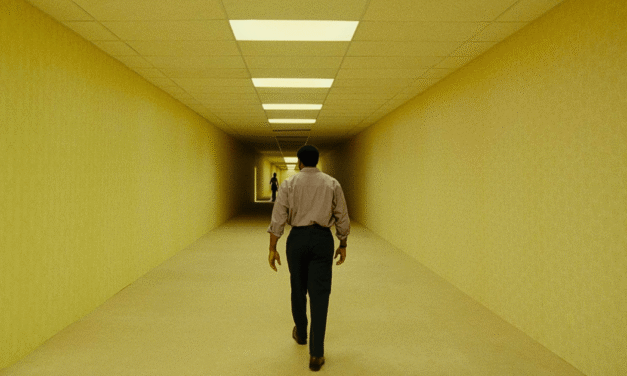
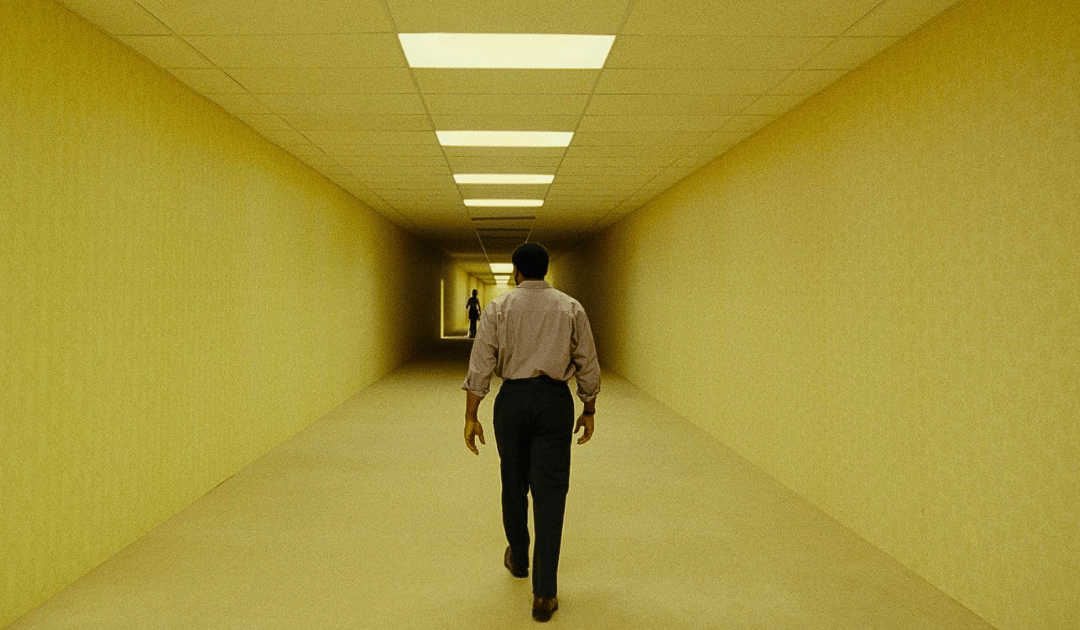
Liminal Spaces. The horror of Backrooms begins with a simple violation of expectations. Unlike the exaggerated architecture of German Expressionist classics, where twisted streets and distorted shadows captured through canted (“Dutch”) angles externalized psychological terror, the spaces of Backrooms appear almost aggressively ordinary.4 Its rooms are not grotesque or obviously threatening; rather, they are clean enough to feel functional and familiar enough to seem mundane — they are also empty enough to feel wrong. The lights work and the carpet is intact; the walls stand where they ought to stand. None of these things appear, however, to serve any specific purpose. There are corridors without destinations, doorways without thresholds, and rooms designed for occupation despite the complete absence of life. The result is not so much the terror of entering an overtly hostile or unknown world, but the subtler and more distorting experience of entering a world that one almost recognizes.
The failure of the ordinary to remain intelligible gives the Backrooms their liminal quality. A liminal space is, in the strictest sense, a space of transition: a hallway, an airport terminal, a waiting room, a hotel corridor. Such places are ordinarily passed through on the way to somewhere else. They become uncanny when emptied of movement and detached from any specific destination.5 A school at night, an abandoned shopping mall, or an office building after hours can feel unsettling because the activity that makes the space intelligible has disappeared, not because anything visible has changed. The architecture remains, while the social world that explains it has vanished.
The Backrooms radicalize this effect by eliminating the possibility of arrival altogether. Their horror lies less in what might be hiding there than in the suggestion that the structure itself has neither outside nor center, in the realization that there is no “final room.” It is an environment made entirely of transition, but one in which transition never leads anywhere.
That image is especially powerful within contemporary digital culture. The internet has accustomed its users to moving endlessly through spaces that are both intimate and somehow impersonal. A screen can display someone’s bedroom, confession, childhood photograph, private argument, or apparent death, all within the same stream that carries advertisements, jokes, fiction, and misinformation. Each item appears in roughly the same visual frame and is encountered through the same gestures of scrolling, clicking, and swiping. Context is not entirely absent, to be sure; it is, however, unstable. The viewer is constantly being asked to decide what is sincere, staged, ironic, manipulated, generated, fictional, or algorithmically amplified.
The popularity of horror that erodes the distinction between fiction and reality should therefore come as no surprise. Found footage, analog horror, alternate-reality games, creepypasta, and faux-documentary storytelling reproduce the ordinary epistemological conditions of life lived “online.” Digital users already inhabit an environment in which authenticity is only partial, identities are “performed,” images are detached from their sources, and narratives are collaboratively revised as they circulate. The “pleasure” of such horror comes from turning this uncertainty into a deliberate aesthetic experience. Viewers know that they are being invited to investigate and speculate, to suspend disbelief, but they also recognize the anxiety the form uniquely expresses, which is the fear that reality itself has become difficult to authenticate.
In other words, the whole phenomenon resembles the internet’s underlying structure — repetitive, decentralized, infinitely expandable, and assembled from fragments, the original meanings of which have been lost. Anyone can add another level, entity, recording, or explanation, yet no contribution can definitively complete the whole. The mythology itself is constructed from a network rather than a finished story, one through which participants wander, searching for patterns and origins and exits that may not exist.
Hauntology. If liminality explains where the horror of Backrooms takes place, then hauntology goes a long way toward explaining why those places feel so emotionally charged. The term, coined by Jacques Derrida in Specters of Marx (1993) and later developed by cultural critic Mark Fisher, describes a peculiar condition in which the present is haunted by futures that never arrived.6 It is the sensation of living amid the remnants of unrealized possibilities, surrounded by cultural artifacts that seem to belong to promises history failed to keep.7
The endless corridors, stained carpets, dead lighting, and anonymous office partitions that characterize Backrooms evoke a world that feels immediately recognizable yet strangely displaced in time. These are not the Gothic castles of classic horror; rather, they are the interiors of twentieth-century modernity: office parks, convention centers, shopping malls, schools, hospitals, and corporate buildings. They are the spaces built by a civilization that imagined itself progressing toward efficiency and prosperity. Yet in the Backrooms themselves, that confidence has evaporated. The systems remain while their purpose does not.
The film itself resists offering a definitive explanation and concludes by suggesting that the Backrooms themselves are a faulty, misremembered copy of reality, a space that continues reproducing fragments of the familiar long after their original function has been forgotten. The final image, a distorted imitation of an ordinary interrogation room occupied by an empty simulacrum of Mary (Renate Reinsve), reinforces the film’s central insight that the horror has become the architecture itself.
The Backrooms are not nostalgic in the conventional sense, as nostalgia longs for a past that once existed. Instead, they invoke what Fisher described as “lost futures,” visions of tomorrow that once seemed inevitable but now feel abandoned. The office corridor lit by a buzzing fluorescent light is frightening because it looks like a future that has already become obsolete and belongs to an era that believed institutional life, corporate order, suburban expansion, and technological progress would continue indefinitely. Now, though, those environments come across as suspended between relevance and decay, still standing and functioning, but altogether empty of conviction or meaning.
For a generation raised almost entirely within digital networks, this experience has become strangely intuitive. Young adults move constantly between physical and virtual environments, yet both often share the same quality of incompleteness.8 Social media timelines never end while recommendation algorithms promise discovery only to produce repetition — endless scrolling subsists on movement without arrival. One clicks from page to page, platform to platform, profile to profile, perpetually in transit but never quite reaching a satisfying destination.
The internet has become populated by digital ghosts, abandoned traces of lives, conversations, aesthetics, and expectations that linger long after their original moment has passed. Backrooms embodies this sensation spatially so that the titular spaces read as memory itself, incomplete, repetitive, impossible to date with any kind of certainty, and curiously resistant to explanation. Even the human figures encountered within the labyrinth reinforce this logic, as they are not ghosts in the traditional sense or fully realized persons; rather, they are warped simulacra, misshapen expressions of human beings reproduced without genuine interiority. Like the spaces they inhabit, they resemble reality without quite achieving it, as though the Backrooms remember the outward shape of humanity while forgetting what made those people alive. They are echoes or outlines of individuals rather than individuals themselves, silhouettes of moments preserved after meaning has drained away, their unsettling “blankness” suggesting to viewers — who, like the characters, are desperate to understand what is actually happening — that the Backrooms do not create life so much as replicate fragments of memory, preserving surfaces while losing the substance that once animated them.
Horror fiction has always trafficked in isolation. Backrooms specializes in amplifying the suspicion that the structures one inhabits (architectural, technological, even cultural) continue operating long after their purposes have become obscure. The hallway continues to lead somewhere, yet nowhere that resolves the journey. In that sense, the Backrooms are themselves an image of contemporary existence itself — nobody seems entirely certain just where things are headed.
The Backrooms of Faith. There is a temptation, particularly among older Christians, to interpret the anxieties expressed by films such as Backrooms as uniquely generational, as though today’s young adults have somehow invented uncertainty. History offers little support for such a conclusion. Augustine watched the Western Roman Empire collapse around him. The Great Schism of the eleventh century marked the formal rupture between Eastern and Western Christianity. The Black Death transformed medieval Europe. The Reformation further fractured the religious unity of Western Christendom. The twentieth century endured two world wars, totalitarianism, genocide, and the persistent anxiety of nuclear annihilation. Every generation inherits its own bewilderments, its own reasons to wonder whether the world still possesses coherence.
The Christian faith has never depended upon the absence of cultural anxiety — quite the opposite, actually. It was born into political oppression, matured under intense periods of persecution, and developed much of its theological imagination amid civilizational instability. Augustine’s City of God, written as Rome’s political order was visibly unraveling, did not attempt to convince Christians that the empire would recover. Instead, it challenged the assumption that history’s meaning had ever rested upon Rome in the first place. Earthly cities rise and fall; the City of God endures because its foundation does not depend upon the fortunes of any one civilization.
That insight speaks with — or ought to — outright nuclear force to the world excavated by Backrooms. The terror of the labyrinth is ultimately theological. It is not so much that one is lost, but that one inhabits a universe in which there appears to be no author, no destination, no intelligible purpose. Every hallway suggests meaning without ever delivering it, and every room appears designed for life while remaining utterly indifferent to flourishing. The architecture continues to function without anyone who knows or remembers what it was built to accomplish. The Backrooms imagine a cosmos in which teleology has fallen apart while structure remains.
The Chrisitan confession begins by rejecting that possibility. Scripture presents creation as a world spoken into existence by a personal God and directed toward a promised consummation, not as an accident suspended between meaningless beginnings and uncertain endings. Christian hope is therefore not optimism about cultural progress, technological innovation, or even political renewal; rather, it is confidence that history is neither cyclical nor absurd because Christ is “before all things, and in him all things hold together” (Colossians 1:17 ESV). The world may become difficult to interpret — that does not mean that it is without its Author.
This is where the church has something distinctive to offer a generation shaped by digital life, but it is most certainly not a nostalgic invitation to recover an imagined “golden age.” The Christian faith in America has no such golden age to recover. How far back, exactly, should we return? To the anti-intellectual excesses of the Satanic Panic, when some Christians publicly burned books, records, and games in fear — objects of a rapidly dwindling physical media market that today could be better sold to fund a missionary? To the moral failures of Jim Crow? To the complacency that tolerated slavery? Or should we return further still to an era when women possessed few legal rights, children routinely died young, and violence, poverty, and disease were accepted as ordinary features of life? Young Christian women enamored with the online aesthetics of the “tradwife” movement might ask themselves whether they would truly wish to surrender their right to vote for the policies they seem to feel so strongly about. The longing itself betrays a misunderstanding of Christian hope. The gospel does not point backward to an imagined Christian America. It points forward to the Kingdom of God.
Make no mistake, fidelity to Christ has often required Christians to critique the very cultures that formed them and betray the idols of their own age. Standing in solidarity with Jesus Christ is not identical to standing in solidarity with any particular subculture, one’s upbringing, one’s denomination, one’s nation, one’s political coalition, or one’s preferred version of “evangelicalism.” Too many Christians have gotten lost in the Backrooms and have learned to play the same game as identity politics while convincing themselves they wear the righteous jersey. The progressive makes an idol of race, gender, and sexuality while the conservative keeps trying to baptize (often to the point of drowning) nation, party, family, and “tradition.” Both mistake tribal loyalty for some kind of moral courage, and both imagine history as a contest between competing teams, each certain that if only one side wins, the world will finally be put right.
The New Testament has less than no patience for that illusion. Jesus Christ is not portrayed as returning to coach one team to victory, nor does He come wearing anyone’s colors. He shows up as the King, and He carries something a lot sharper than a big stick. When Christ appears, every tribe will discover that it mistook the arena for the Kingdom — the banners will be struck and the mascots retired, and there will not be a single jersey worth more than another. Neither the revolutionaries nor the traditionalists, the activists nor the culture warriors, the secularists nor the self-congratulatory Pharisees will stand before Him waving their colors in triumph. We will all, every last solitary one of us, bend the knee. And He will not negotiate with those who refuse. They will not outvote Him, or organize against Him, or tweet Him into submission. He will not ask their permission to reign — and there will be more than a few ejections from the arena on that day.
What the church — the Christian — has to offer is Christ as the judge of every earthly loyalty, including those that one inherited without reflection. And that task is especially urgent when the dominant temptation on a cultural scale is fragmentation. Digital culture trains its participants to curate identities and “noclip” into parallel realities, to assemble meaning from an endless stream of disconnected fragments. But the church of Scripture gathers people into a single story that did not originate with them and will not end with them. Week after week, Christians confess the same creed, proclaim the same gospel, celebrate the same Lord’s Supper, and await the same resurrection. These habits of reorientation remind believers that reality is not, in fact, something one constructs for themselves. In a culture exhausted by performance, anxious over identity, and pressured to reinvent itself each day before an invisible audience, that should come as a profound relief.9 Stop performing and simply belong to Christ, and your identity no longer depends upon your ability to successfully navigate it. Christ has already spoken the decisive word about who we — about who you — are in Him. Everything else is commentary.
Backrooms captures the atmosphere of the digital age with precision. It is a world of endless corridors and seemingly infinite choices, of forgotten purposes and identities assembled from fragments that never coalesce into a whole. It is a maze populated by copies of reality that cannot remember what they were copying. The film’s best scare is that it recognizes its audience.
The gospel offers no map through that labyrinth because it refuses the first lie. History is not an endless corridor, and reality is not a broken simulation. Meaning is not something we manufacture from whatever tribe or ideology or “identity” happens to comfort us. The Christian confession begins with the audacious claim that history has an Author, that the maze has an exit because it has an Architect, and that at the center of that reality is not the self but the crucified and risen God-man. Every other kingdom, every other movement, and every other banner will pass away until Christ alone remains.
If the modern world really is haunted by lost futures, then the gospel is better than good news. It is the only future worth hoping for. —Cole Burgett and Ethan Thomas
Cole Burgett is a graduate of Dallas Theological Seminary and the Moody Bible Institute. He currently serves as the Assistant Director of Online and Nontraditional Learning at Corban University, as well as an Assistant Professor of Theology. He writes extensively about theology and popular culture.
Ethan Thomas graduated from Gilbert Christian High School and currently attends Grand Canyon University, where he studies entrepreneurship and finance. During his time at Gilbert Christian, he was a member of two 3A state championship soccer teams. His academic interests include entrepreneurship, finance, and the intersection of faith and business.
NOTES
- With a return of approximately 38 times its production budget, Backrooms surpassed A24’s Oscar-winning Everything Everywhere All at Once (2022) to become the studio’s highest-grossing film, making it one of the most commercially successful independent films of the last ten years. See the numbers at Box Office Mojo supplied by IMDB Pro, accessed September 29, 2026, https://www.boxofficemojo.com/title/tt26657236/.
- The original “Backrooms” image was posted anonymously on the imageboard 4chan in 2019 as part of a thread inviting users to share unsettling photographs. Accompanied by a short caption describing an endless maze of empty yellow rooms accessible by “noclipping” out of reality, the post quickly spread across the internet and became one of the defining examples of “digital folklore” in contemporary culture. For context, “noclip” is a term borrowed from video games to refer to a glitch or cheat that allows players to pass through walls or other solid objects. See Michael Dobuski, “The Backrooms: Horror Storytelling Goes Online,” ABC News, November 5, 2022, https://abcnews.com/US/backrooms-horror-storytelling-online/story?id=92623707.
- The term “creepypasta” refers to a genre of internet-based horror fiction that is created, copied, and widely shared online. The term combines “creepy” with “copypasta,” which itself is internet slang for blocks of text that are repeatedly copied and pasted across forums and social media. Like urban legends, creepypastas are often anonymously authored, collaboratively expanded and circulated, and presented in ways that soften the distance between fiction and reality.
- German Expressionism was an artistic movement that emerged in Germany after the First World War, emphasizing stylized forms, exaggerated architecture, stark chiaroscuro lighting, and unconventional camera compositions and angles to externalize both psychological and emotional states. Landmark films such as The Cabinet of Dr. Caligari (1920), Nosferatu (1922), and The Golem (1920) established many of the visual conventions that would later define cinematic horror. As German filmmakers emigrated to Hollywood in the 1920s and 1930s, these techniques profoundly influenced Universal Pictures’ classic horror cycle — including Dracula (1931), Frankenstein (1931), The Mummy (1932), and Bride of Frankenstein (1935) — where distorted lighting accompanied by dramatic shadows and expressive set design became visual shorthand for the monstrous and the uncanny. See Andrew Dickos, Street with No Name: A History of the Classic American Film Noir (University Press of Kentucky, 2002), esp. “German Expressionism and the Roots of Film Noir,” 9–19.
- The popular use of the term “liminal space” differs somewhat from its academic origins. Arnold van Gennep first employed the concept of liminality (from the Latin limen, “threshold”) to describe the transitional stage of rites of passage, while Victor Turner later expanded it to denote the ambiguous condition of being “betwixt and between,” when established structures of identity and meaning have been suspended but not yet replaced. The architectural spaces commonly described today as liminal are perhaps more closely related to what anthropologist Marc Augé termed non-places; that is, anonymous environments such as airports, hotel corridors, shopping malls, and waiting rooms that are designed for transit rather than dwelling and therefore possess little perennial relation to memory, identity, or community. Their meaning derives from the destinations they connect rather than the spaces themselves. When emptied of movement and severed from their function — as in the endless corridors of Backrooms — they begin to resemble what Sigmund Freud described as das Unheimliche, or “the uncanny,” the not wholly alien, yet strangely familiar, made unsettling through subtle displacement. The terror of the whole Backrooms concept, then, is that one is trapped forever within spaces whose only purpose was ever to be left behind. See Marc Augé, Non-Places: Introduction to an Anthropology of Supermodernity, trans. by John Howe (Versio, 1995; orig. pub. in French, 1992); Sigmund Freud, “The ‘Uncanny’ (Das Unheimliche),” reprinted in The Standard Edition of the Complete Psychological Works of Sigmund Freud, Vol. XVII, trans. by James Strachey (Hogarth Press, 1955; orig. pub. 1919); Victor Turner, The Ritual Process: Structure and Anti-Structure (Aldine Publishing, 1969); and Arnold van Gennep, The Rites of Passage, trans. by Monika B. Vizedom and Gabrielle L. Caffee (University of Chicago Press, 1960; orig. pub. in French, 1909).
- Derrida introduced the term hauntology (hantologie) in Specters of Marx (1993) as a philosophical play on ontology, arguing that the present is continually haunted by absences — ideas, possibilities, and historical trajectories that never fully disappeared despite their apparent disappearance. Fisher later adapted the concept to describe late twentieth and early twenty-first century culture, arguing that contemporary society increasingly recycles the aesthetics of the past because it has lost confidence in imagining genuinely new futures. See Jacques Derrida, Specters of Marx: The State of the Debt, the Work of Mourning, and the New International, trans. Peggy Kamuf (Routledge, 1994); and Mark Fisher, Ghosts of My Life: Writings on Depression, Hauntology, and Lost Futures (Zero Books, 2014).
- The twentieth century was marked by remarkably optimistic visions of the future. Popular science fiction imagined atomic-powered automobiles, permanent lunar colonies, household robots, undersea cities, personal helicopters, flying cars, videophones, and routine interplanetary travel. Works ranging from the illustrations of Frank R. Paul and Chelsey Bonestell to television series such as The Jetsons (1962–1963) and Star Trek (1966–1969) assumed that technological progress would continually transform everyday life into something recognizably different from the present. Even World’s Fairs — particularly New York’s 1939–1940 and 1964–1965 expositions —presented visitors with immersive visions of tomorrow in which prosperity, automation, suburban abundance, and scientific advancement seemed historically inevitable. By the late twentieth century, however, these confident futures had begun to fade. Rather than imagining radically new worlds, popular culture increasingly revisited, rebooted, or nostalgically reconstructed earlier visions of tomorrow. Frederic Jameson famously described postmodernism as a culture in which historical depth gives way to “perpetual recycling,” while Fisher, drawing on Franco “Bifo” Berardi, argued that “the slow cancellation of the future” had become one of late capitalism’s defining cultural experiences. In addition to Fisher, Ghosts of My Life, see Frederic Jameson, “Future City,” New Left Review 21 (May/June 2003), https://newleftreview.org/issues/ii21/articles/fredric-jameson-future-city.
- To the surprise of absolutely no one, it has become increasingly difficult to sustain distinctions between “online” and “offline” for those who have grown up with ubiquitous digital technologies. Rather than functioning as separate “realms,” physical and digital environments overlap to form a continuous social experience in which identity, memory, communication, and community are negotiated across multiple platforms simultaneously. Philosopher Luciano Floridi describes this condition as the “onlife” world, arguing that digital technologies have fundamentally altered how human beings inhabit reality rather than just adding a virtual layer to it. See Luciano Floridi, The Fourth Revolution: How the Infosphere Is Reshaping Human Reality (Oxford University Press, 2014), esp. chaps. 3–5. See also Luciano Floridi, ed., The Onlife Manifesto: Being Human in a Hyperconnected Era (Springer, 2015).
- Sherry Turkle argues that digital technologies have fundamentally reshaped how people experience identity, presence, and relationships, encouraging the continuous management and presentation of the self before an unseen audience. Although Alone Together predates the rise of TikTok and algorithmically driven social media, its central insight that constant connectivity encourages perpetual self-performance while often deepening anxiety and isolation, has proven uncannily prescient. See Sherry Turkle, Alone Together: Why We Expect More from Technology and Less from Each Other (Basic Books, 2011).